
Close Menu
    Facebook X (Twitter) Instagram
    SciTechDaily
    • Biology
    • Chemistry
    • Earth
    • Health
    • Physics
    • Science
    • Space
    • Technology
    Facebook X (Twitter) Pinterest YouTube RSS
    SciTechDaily
    Home»Space»Chandra Views Glowing Gas in the Milky Way, NGC 3576
    Space

    Chandra Views Glowing Gas in the Milky Way, NGC 3576

    By NASANovember 4, 2013No Comments2 Mins Read
    Facebook Twitter Pinterest Telegram LinkedIn WhatsApp Email Reddit
    Share
    Facebook Twitter LinkedIn Pinterest Telegram Email Reddit


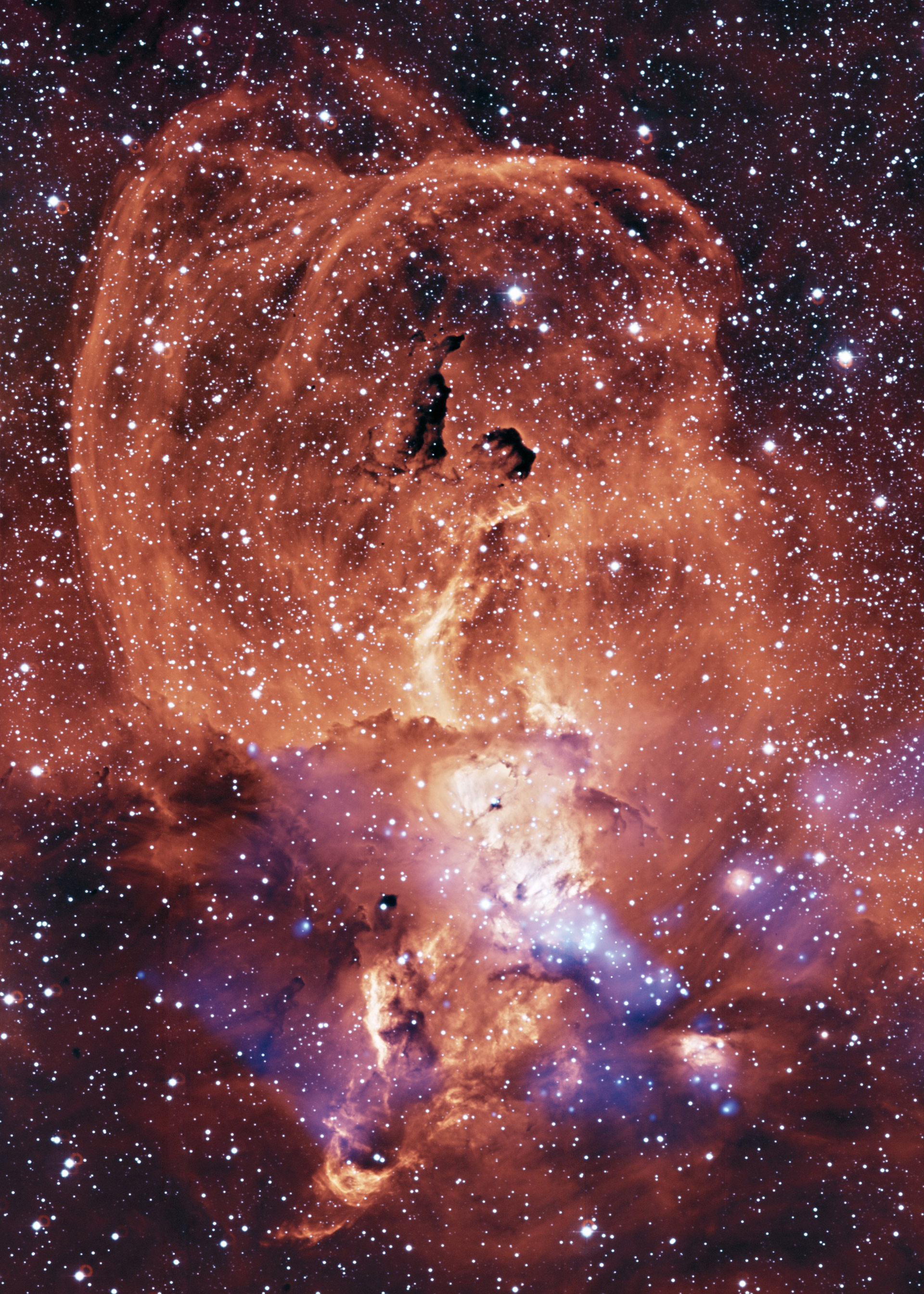
    Chandra Image of NGC 3576
    NGC 3576, a luminous gas region in the Sagittarius arm of the Milky Way, lies approximately 9,000 light-years away from Earth. Credit: X-ray: NASA/CXC/Penn State/L.Townsley et al, Optical: ESO/2.2m telescope

    Released to the public for the first time, this Chandra/ESO image shows NGC 3576.

    A region of glowing gas in the Sagittarius arm of the Milky Way galaxy, NGC 3576 is located about 9,000 light-years from Earth. Such nebulas present a tableau of the drama of the evolution of massive stars, from the formation in vast dark clouds, their relatively brief (a few million years) lives, and the eventual destruction in supernova explosions. The diffuse X-ray data detected by Chandra (blue) are likely due to the winds from young, massive stars that are blowing throughout the nebula. Optical data from ESO are shown in orange and yellow.

    More Info:
    Every year, October is designated as American Archive Month. While many people may think “archive” means only dusty books and letters, there are, in fact, many other types of important archives. This includes the use of archives for major telescopes and observatories like NASA’s Chandra X-ray Observatory.

    The Chandra Data Archive (CDA) plays a central role in the mission by enabling the astronomical community – as well as the general public – access to data collected by the observatory. The primary role of the CDA is to store and distribute data, which the CDA does with the help of powerful search engines. The CDA is one of the legacies of the Chandra mission that will serve both the scientific community and the public for decades to come.

    To celebrate and support American Archive Month, we have selected images from a group of eight objects in the CDA to be released to the public for the first time. These images represent the observations of thousands of objects that are permanently available to the world thanks to Chandra’s archive.


    Never miss a breakthrough: Join the SciTechDaily newsletter.
    Follow us on Google and Google News.

    Astronomy Chandra X-ray Observatory European Southern Observatory NASA
    Share. Facebook Twitter Pinterest LinkedIn Email Reddit

    Related Articles

    Red Dwarf Fury: How Wolf 359’s Radiation May Fry Alien Atmospheres

    X-Ray Echoes Unveil the Milky Way’s Hidden 3D Blueprint

    X-Ray Flares Turn Alien Worlds Into Cosmic Battlefields

    X-Ray Echoes Unveil the Hidden 3D Landscape of Our Galaxy’s Heart

    Black Holes Cook Their Own Fuel in a Cosmic Feast

    NASA Reveals Cosmic Christmas Tree and Celestial Wreath Illuminating Star Birth

    NASA Captures Black Hole’s Double-Star Destruction in Epic Collision

    Black Hole Tears Star to Shreds, Unleashing Cosmic Shockwaves

    Centaurus A’s Massive 13,000 Light-Year Jet Captured in Stunning Detail

    Leave A Reply Cancel Reply

    • Facebook
    • Twitter
    • Pinterest
    • YouTube

    Don't Miss a Discovery

    Subscribe for the Latest in Science & Tech!

    Trending News

    This Copper Drug Clears Alzheimer’s Brain Toxins and Boosts Memory

    Adults Over 65 Lost Massive Amounts of Weight With Ozempic

    How Flocking Birds “Defy” One of Physics’ Most Fundamental Laws

    Physicists Create a New Kind of Schrödinger’s Cat State From Exotic Quantum Building Blocks

    Your Diet Could Be Missing the Key Ingredient for Heart Protection

    Researchers Warn Widely Prescribed Blood Pressure Drugs Could Be Harming Diabetic Kidneys

    James Webb Spots Something Strange Between Day and Night on an Alien Planet

    How Ancient People Moved a 6-Ton Stone 700 Kilometers to Stonehenge

    Follow SciTechDaily
    • Facebook
    • Twitter
    • YouTube
    • Pinterest
    • Newsletter
    • RSS
    SciTech News
    • Biology News
    • Chemistry News
    • Earth News
    • Health News
    • Physics News
    • Science News
    • Space News
    • Technology News
    Recent Posts
    • Scientists Uncover Cause of Inflammatory Bowel Disease Solving Decades-Old Mystery
    • The Surprising Reason Swimming Could Be Better for Your Heart Than Running
    • Could Vitamin C Be the Secret to Keeping Your Brain Younger?
    • The Surprising Fix for Robot Traffic Jams
    • Near Absolute Zero, This Transistor Starts Acting Like a Brain Cell
    Copyright © 1998 - 2026 SciTechDaily. All Rights Reserved.
    • Science News
    • About
    • Contact
    • Editorial Board
    • Privacy Policy
    • Terms of Use

    Type above and press Enter to search. Press Esc to cancel.