

Close Menu
    Facebook X (Twitter) Instagram
    SciTechDaily
    • Biology
    • Chemistry
    • Earth
    • Health
    • Physics
    • Science
    • Space
    • Technology
    Facebook X (Twitter) Pinterest YouTube RSS
    SciTechDaily
    Home»Health»Unlocking the Secrets of “Good Fat” – Protein Discovery Advances Potential Treatments for Obesity and Diabetes
    Health

    Unlocking the Secrets of “Good Fat” – Protein Discovery Advances Potential Treatments for Obesity and Diabetes

    By University of PennsylvaniaJuly 3, 20232 Comments3 Mins Read
    Facebook Twitter Pinterest Telegram LinkedIn WhatsApp Email Reddit
    Share
    Facebook Twitter LinkedIn Pinterest Telegram Email Reddit
    Weight Loss Success Before and After
    Scientists have unveiled the atomic structure of UCP1, a protein key to calorie burning in ‘good’ brown fat. This discovery, enabled by a cryogenic electron microscope, offers insights into potential weight loss treatments and methods for regulating body temperature via thermogenesis.

    Findings represent the first structural details of uncoupling protein 1 (UCP1), which allows fat tissue to burn off calories as heat.

    New research has unlocked insights into how “good fat” tissue could potentially be harnessed to combat obesity and remove glucose from the blood, helping to control diabetes. Published today in Science Advances, the work is a collaboration between researchers with the Perelman School of Medicine at the University of Pennsylvania and University of Cambridge, Free University of Brussels, and University of East Anglia.

    Human bodies consist of two types of fat: brown and white. Brown fat breaks down blood sugar (glucose) and fat molecules, generating heat in response to cold temperatures helping to maintain normal body temperature. The majority of fat in humans is white fat, and building up too much white fat contributes to obesity and other health issues.

    Using the Krios G3i, a cryogenic electron microscope at the Penn Singh Center for Nanotechnology researchers were able to view mitochondrial uncoupling protein 1 (UCP1)—a protein which allows fat tissue to burn off calories as heat—in atomic detail for the first time. This work uncovered new insights into how this protein’s activity in brown fat cells could potentially be harnessed for weight loss.
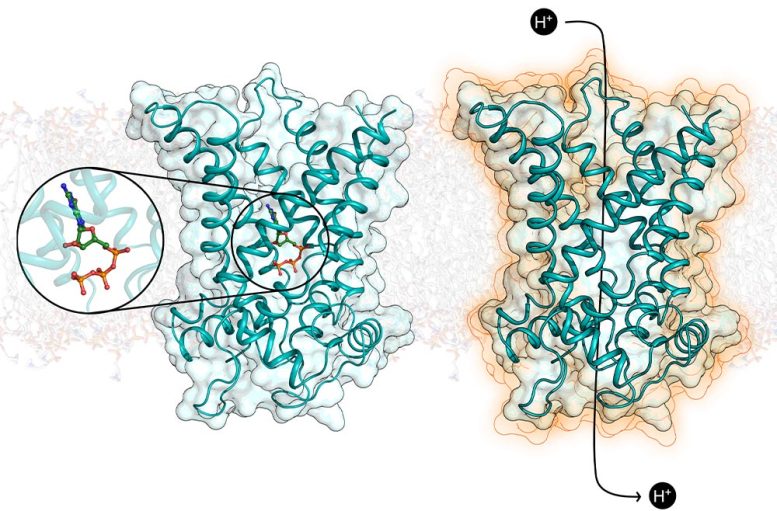
    Human Uncoupling Protein in Brown Adipose Tissue
    The human uncoupling protein in brown adipose tissue in its inactive form (left), inhibited by a nucleotide, and in its activated form (right), which short-circuits the mitochondrion to produce heat. Credit: Penn Medicine

    “This is an exciting development that follows more than four decades of research into what UCP1 looks like and how it works,” said Vera Moiseenkova-Bell, PhD, a professor of Systems Pharmacology and Translational Therapeutics and faculty director of the Beckman Center for Cryo-Electron Microscopy. “These new indings would not have been possible without the collaboration between everyone involved.”

    In mammals, UCP1 gives brown fat a specialized ability to burn calories as heat for maintaining a stable body temperature. When activated by fatty acids, UCP1 short-circuits the mitochondria—known as the powerhouse of the cell for its work releasing energy from food—by allowing protons to seep across mitochondrial inner membrane. The short-circuiting generates heat and allowing the body to regulate its temperature through a process called thermogenesis.

    For more on this research, see The Breakthrough That Could Lead to New Obesity Treatments.

    Reference: “Structural basis of purine nucleotide inhibition of human uncoupling protein 1” by Scott A. Jones, Prerana Gogoi, Jonathan J. Ruprecht, Martin S. King, Yang Lee, Thomas Zögg, Els Pardon, Deepak Chand, Stefan Steimle, Danielle M. Copeman, Camila A. Cotrim, Jan Steyaert, Paul G. Crichton, Vera Moiseenkova-Bell, Edmund R. S. Kunji, 31 May 2023, Science Advances.
    DOI: 10.1126/sciadv.adh4251

    This work was supported by the Medical Research Council (MC_UU_00028/2, MC_UU_00015/1), by the U.K. Biological and Biotechnological Sciences Research Council (BB/S00940X/1) and by National Institutes of Health/National Institute of General Medical Sciences (R01 GM073791, F31 HL156431). Nanobody discovery was funded by the Instruct-ERIC part of the European Strategy Forum on Research infrastructures, and the Research Foundation – Flanders, and the Strategic Research Program of the Vrije Universiteit Brussel.

    Never miss a breakthrough: Join the SciTechDaily newsletter.
    Follow us on Google and Google News.

    Diabetes Obesity Popular Protein University of Pennsylvania Weight Loss
    Share. Facebook Twitter Pinterest LinkedIn Email Reddit

    Related Articles

    Weight Loss Wonders: New Study Uncovers Surprising Benefits of the Protein Kallistatin

    Flipping the Fat Burn Switch: The Breakthrough That Could Lead to New Obesity Treatments

    New Obesity Treatment Delivers Dramatic Weight Loss – Benefits of Gastric Bypass Without Surgery

    Does Intermittent Fasting Actually Work? Study Finds Meal Frequency Matters More Than Timing

    Low-Carb vs. Low-Fat: Science Reveals Which Diet Is Better for Weight Loss and Diabetes Control

    A Potential Cure for Obesity – New Particles Stop the Absorption of Fat and Carbs

    A New Way To Lose Weight Could Change Your Metabolism

    New Game-Changing Obesity Drug Dramatically Reduces Risk of Type 2 Diabetes

    Weight Loss Medication Shows Promise for People With Diabetes and Obesity

    2 Comments

    1. Vois Akawshin on July 3, 2023 7:36 pm

      This is the same study scitechdaily published the press release for in “New Obesity Breakthrough: Protein Molecular Structure Discovery Could Unlock Fat Burning” last week. Only this is from the UoP, and it was the UofCambridge’s press release last time. It was a joint study, so now we get the Pennsylvanian perspective on it. So, it’s the same thing, only with extra cheese.

      Reply
    2. Nick Arrizza on July 4, 2023 4:50 am

      What a total waste of money, effort and time. It’s been known for over 100 years that the key to sustainable weight loss and type 2 diabetes ( prevention and ) reversal ( as well as that of many other chronic illnesses ) is readily and economically achievable with a 100% whole food plant based no oil diet. All that is needed is an acknowledgment of this and public health education of same. Clearly no one is interested in this research as there is no money to be made from it.

      Reply
    Leave A Reply Cancel Reply

    • Facebook
    • Twitter
    • Pinterest
    • YouTube

    Don't Miss a Discovery

    Subscribe for the Latest in Science & Tech!

    Trending News

    Breakthrough Bowel Cancer Trial Leaves Patients Cancer-Free for Nearly 3 Years

    Natural Compound Shows Powerful Potential Against Rheumatoid Arthritis

    100,000-Year-Old Neanderthal Fossils in Poland Reveal Unexpected Genetic Connections

    Simple “Gut Reset” May Prevent Weight Gain After Ozempic or Wegovy

    2.8 Days to Disaster: Scientists Warn Low Earth Orbit Could Suddenly Collapse

    Common Food Compound Shows Surprising Power Against Superbugs

    5 Simple Ways To Remember More and Forget Less

    The Atomic Gap That Could Cost the Semiconductor Industry Billions

    Follow SciTechDaily
    • Facebook
    • Twitter
    • YouTube
    • Pinterest
    • Newsletter
    • RSS
    SciTech News
    • Biology News
    • Chemistry News
    • Earth News
    • Health News
    • Physics News
    • Science News
    • Space News
    • Technology News
    Recent Posts
    • Powerful Antioxidant Found To Play a Key Role in Proper Protein Folding
    • MIT Laser Breakthrough Lets Scientists Watch Drugs Enter the Brain in Real Time
    • Study Reveals Malaria’s Hidden Role in Human Evolution
    • Scientists Print Artificial Neurons That Can Talk to the Brain
    • Bowel and Ovarian Cancers Are Dramatically Rising in Young Adults and Scientists Aren’t Sure Why
    Copyright © 1998 - 2026 SciTechDaily. All Rights Reserved.
    • Science News
    • About
    • Contact
    • Editorial Board
    • Privacy Policy
    • Terms of Use

    Type above and press Enter to search. Press Esc to cancel.