
Close Menu
    Facebook X (Twitter) Instagram
    SciTechDaily
    • Biology
    • Chemistry
    • Earth
    • Health
    • Physics
    • Science
    • Space
    • Technology
    Facebook X (Twitter) Pinterest YouTube RSS
    SciTechDaily
    Home»Space»Newly Released Hubble Image of Spiral Galaxy NGC 1433
    Space

    Newly Released Hubble Image of Spiral Galaxy NGC 1433

    By Hubble Space TelescopeJuly 7, 2014No Comments2 Mins Read
    Facebook Twitter Pinterest Telegram LinkedIn WhatsApp Email Reddit
    Share
    Facebook Twitter LinkedIn Pinterest Telegram Email Reddit
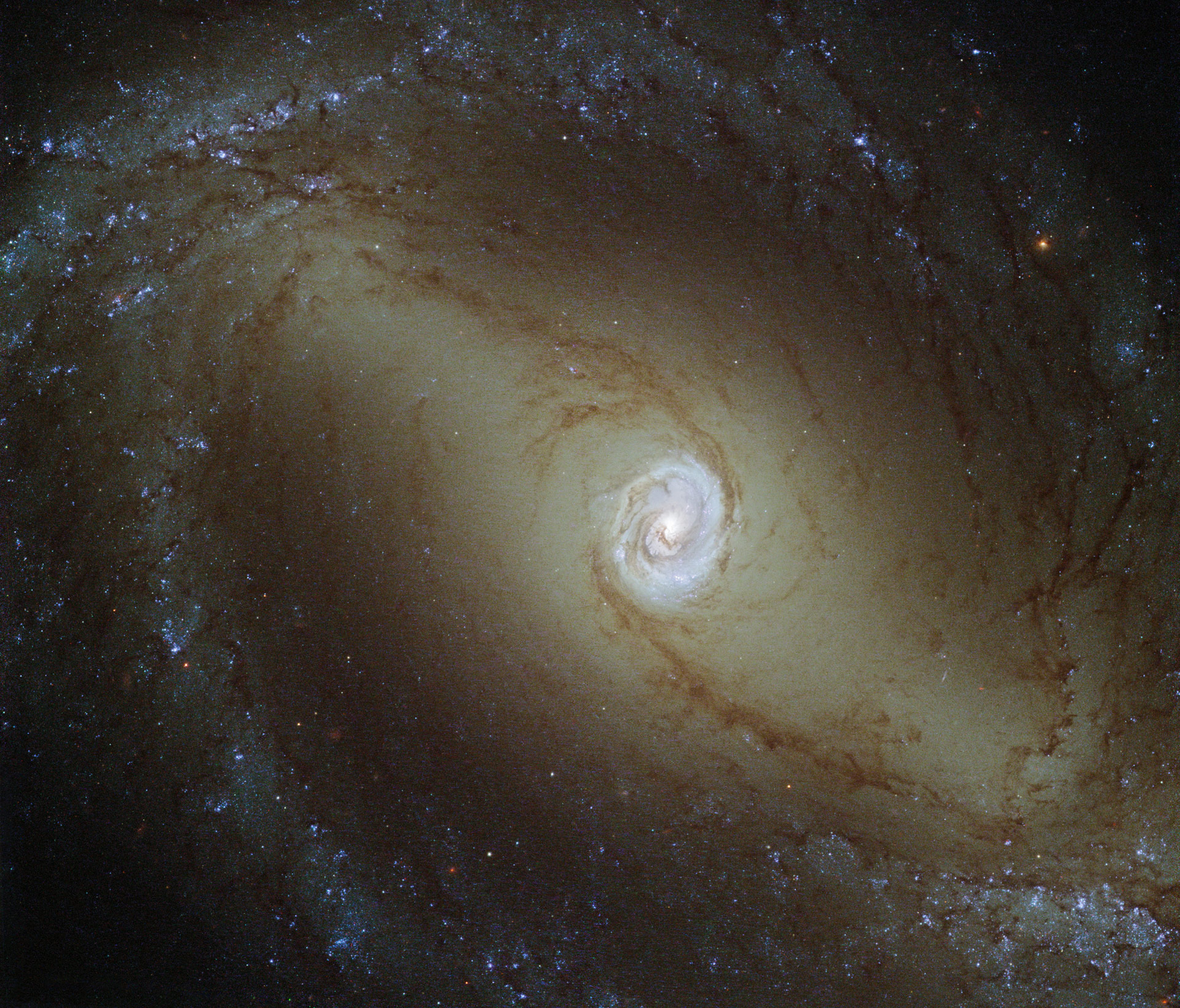
    New Hubble Image of Spiral Galaxy NGC 1433
    NGC 1433 is situated approximately 32 million light-years away from Earth. It belongs to a category of highly active galaxies called Seyfert galaxies, which make up about 10% of all galaxies. These galaxies are characterized by exceptionally bright and radiant central regions, similar to our own Milky Way galaxy. Credit: ESA/Hubble & NASA; Acknowledgements: D. Calzetti (UMass) and the LEGUS Team

    This newly released Hubble image shows spiral galaxy NGC 1433, which is located roughly 32 million light-years from Earth.

    This view, captured by the NASA/ESA Hubble Space Telescope, shows a nearby spiral galaxy known as NGC 1433. At about 32 million light-years from Earth, it is a type of very active galaxy known as a Seyfert galaxy — a classification that accounts for 10% of all galaxies. They have very bright, luminous centers comparable to that of our galaxy, the Milky Way.

    Galaxy cores are of great interest to astronomers. The centers of most, if not all, galaxies are thought to contain a supermassive black hole, surrounded by a disc of infalling material.

    NGC 1433 is being studied as part of a survey of 50 nearby galaxies known as the Legacy ExtraGalactic UV Survey (LEGUS). Ultraviolet radiation is observed from galaxies, mainly tracing the most recently formed stars. In Seyfert galaxies, ultraviolet light is also thought to emanate from the accretion discs around their central black holes. Studying these galaxies in the ultraviolet part of the spectrum is incredibly useful to study how the gas is behaving near the black hole. This image was obtained using a mix of ultraviolet, visible, and infrared light.

    LEGUS will study a full range of properties from a sample of galaxies, including their internal structure. This Hubble survey will provide a unique foundation for future observations with the James Webb Space Telescope (JWST) and the Atacama Large Millimeter/submillimeter Array (ALMA). ALMA has already caught unexpected results relating to the center of NGC 1433, finding a surprising spiral structure in the molecular gas close to the center of NGC 1433. The astronomers also found a jet of material flowing away from the black hole, extending for only 150 light-years — the smallest such molecular outflow ever observed in a galaxy beyond our own.

    Never miss a breakthrough: Join the SciTechDaily newsletter.
    Follow us on Google and Google News.

    Astronomy Hubble Space Telescope Popular
    Share. Facebook Twitter Pinterest LinkedIn Email Reddit

    Related Articles

    Astronomers Puzzled by Dark Storm’s U-Turn on Neptune, Appearance of New Dark Spot

    Rings of Relativity: A Truly Strange and Very Rare Phenomenon

    Hubble Discovers a Strange Exoplanet That Resembles the Long-Sought “Planet Nine”

    Ethereal Orange Glow Radiates From Heart of Stellar Forge

    Hubble Captures Unprecedented Fading of Stingray Nebula – “This Is Very, Very Dramatic, and Very Weird”

    Hubble Space Telescope Explains Oddball Galaxy’s Missing Dark Matter

    ULLYSES: Hubble Embarks on Largest Observing Program of Its Career

    Hubble Spots a Gorgeous Waterfall of Stars

    Hubble Spots Giant Space “Pumpkin” [Video]

    Leave A Reply Cancel Reply

    • Facebook
    • Twitter
    • Pinterest
    • YouTube

    Don't Miss a Discovery

    Subscribe for the Latest in Science & Tech!

    Trending News

    After 50 Years, Astronomers Finally Found What the Milky Way’s Black Hole Was Hiding

    The Most Powerful Drug of All Isn’t Found in a Pill Bottle

    Scientists Capture Immune Cells Eating Live Cancer Cells for the First Time

    Why Older Adults Need To Pay Closer Attention to Vitamin B12

    Scientists Say a Daily Probiotic May Help Fight Depression in Older Adults

    This Deadly Disease Was Wiping Out Humans 5,500 Years Ago

    Beyond DNA: Scientists Discover Inheritance That Breaks the Rules of Genetics

    Scientists Just Discovered the Eye Defies a Long-Held Rule of Vision

    Follow SciTechDaily
    • Facebook
    • Twitter
    • YouTube
    • Pinterest
    • Newsletter
    • RSS
    SciTech News
    • Biology News
    • Chemistry News
    • Earth News
    • Health News
    • Physics News
    • Science News
    • Space News
    • Technology News
    Recent Posts
    • A Plastic Motor Just Defied a Century of Engineering Assumptions
    • Interstellar Visitor 3I/ATLAS Is Bursting With an Unexpected Chemical
    • Scientists Just Found All 5 Genetic “Letters” of DNA and RNA on an Asteroid
    • After Decades of Mystery, Researchers Locate a Missing Page of the Archimedes Palimpsest
    • The 4,000-Year-Old City That Defied History’s Rules on Wealth and Power
    Copyright © 1998 - 2026 SciTechDaily. All Rights Reserved.
    • Science News
    • About
    • Contact
    • Editorial Board
    • Privacy Policy
    • Terms of Use

    Type above and press Enter to search. Press Esc to cancel.