
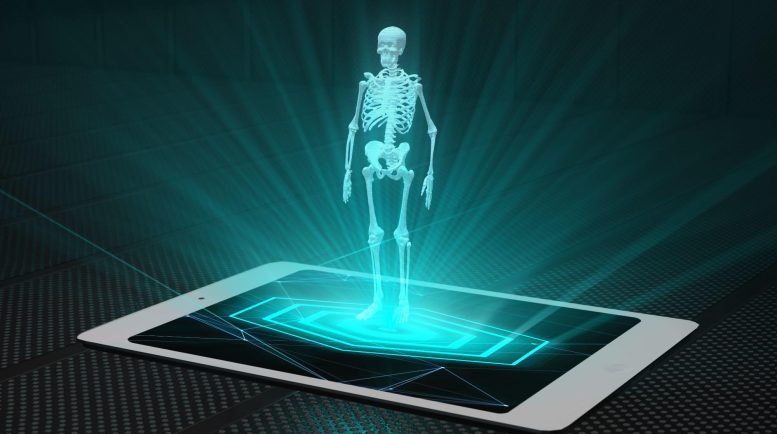
Researchers suggest a new method that employs deep learning to create three-dimensional holograms from two-dimensional colored images.
Holograms provide a three-dimensional (3D) view of objects, offering a level of detail that two-dimensional (2D) images cannot match. Their realistic and immersive display of 3D objects makes holograms incredibly valuable across various sectors, including medical imaging, manufacturing, and virtual reality.
Traditional holography involves recording an object’s three-dimensional data and its interactions with light, a process that demands high computational power and the use of specialized cameras for capturing 3D images. This complexity has restricted the widespread adoption of holograms.
Deep Learning in Hologram Generation
In recent times, many deep-learning methods have also been proposed for generating holograms. They can create holograms directly from the 3D data captured using RGB-D cameras that capture both color and depth information of an object. This approach circumvents many computational challenges associated with the conventional method and represents an easier approach for generating holograms.
Revolutionizing Holography With a Novel Approach
Now, a team of researchers led by Professor Tomoyoshi Shimobaba of the Graduate School of Engineering, Chiba University, propose a novel approach based on deep learning that further streamlines hologram generation by producing 3D images directly from regular 2D color images captured using ordinary cameras. Yoshiyuki Ishii and Tomoyoshi Ito of the Graduate School of Engineering, Chiba University were also a part of this study, which was recently published in the journal Optics and Lasers in Engineering.
Explaining the rationale behind this study, Prof. Shimobaba says, “There are several problems in realizing holographic displays, including the acquisition of 3D data, the computational cost of holograms, and the transformation of hologram images to match the characteristics of a holographic display device. We undertook this study because we believe that deep learning has developed rapidly in recent years and has the potential to solve these problems.”
The Three-Stage Deep Learning Process
The proposed approach employs three deep neural networks (DNNs) to transform a regular 2D color image into data that can be used to display a 3D scene or object as a hologram. The first DNN makes use of a color image captured using a regular camera as the input and then predicts the associated depth map, providing information about the 3D structure of the image.
Both the original RGB image and the depth map created by the first DNN are then utilized by the second DNN to generate a hologram. Finally, the third DNN refines the hologram generated by the second DNN, making it suitable for display on different devices.
The researchers found that the time taken by the proposed approach to process data and generate a hologram was superior to that of a state-of-the-art graphics processing unit.
“Another noteworthy benefit of our approach is that the reproduced image of the final hologram can represent a natural 3D reproduced image. Moreover, since depth information is not used during hologram generation, this approach is inexpensive and does not require 3D imaging devices such as RGB-D cameras after training,” adds Prof. Shimobaba, while discussing the results further.
Future Applications and Conclusion
In the near future, this approach can find potential applications in heads-up and head-mounted displays for generating high-fidelity 3D displays. Likewise, it can revolutionize the generation of an in-vehicle holographic head-up display, which may be able to present the necessary information on people, roads, and signs to passengers in 3D. The proposed approach is thus expected to pave the way for augmenting the development of ubiquitous holographic technology.
Kudos to the research team for this remarkable achievement!
Reference: “Multi-depth hologram generation from two-dimensional images by deep learning” by Yoshiyuki Ishii, Fan Wang, Harutaka Shiomi, Takashi Kakue, Tomoyoshi Ito and Tomoyoshi Shimobaba, 2 August 2023, Optics and Lasers in Engineering.
DOI: 10.1016/j.optlaseng.2023.107758
Never miss a breakthrough: Join the SciTechDaily newsletter.
Follow us on Google and Google News.
2 Comments
The possibilities are exciting, such as the 3D conversion of classical paintings; the gap between past and present, old and new, real and simulation continues to close.
Where can I learn more about hologram