
Close Menu
    Facebook X (Twitter) Instagram
    SciTechDaily
    • Biology
    • Chemistry
    • Earth
    • Health
    • Physics
    • Science
    • Space
    • Technology
    Facebook X (Twitter) Pinterest YouTube RSS
    SciTechDaily
    Home»Space»Hubble’s Galactic Reveal: A Dynamic Duo … or Trio?
    Space

    Hubble’s Galactic Reveal: A Dynamic Duo … or Trio?

    By European Space Agency (ESA)October 22, 2023No Comments2 Mins Read
    Facebook Twitter Pinterest Telegram LinkedIn WhatsApp Email Reddit
    Share
    Facebook Twitter LinkedIn Pinterest Telegram Email Reddit
    Arp-Madore 2339-661
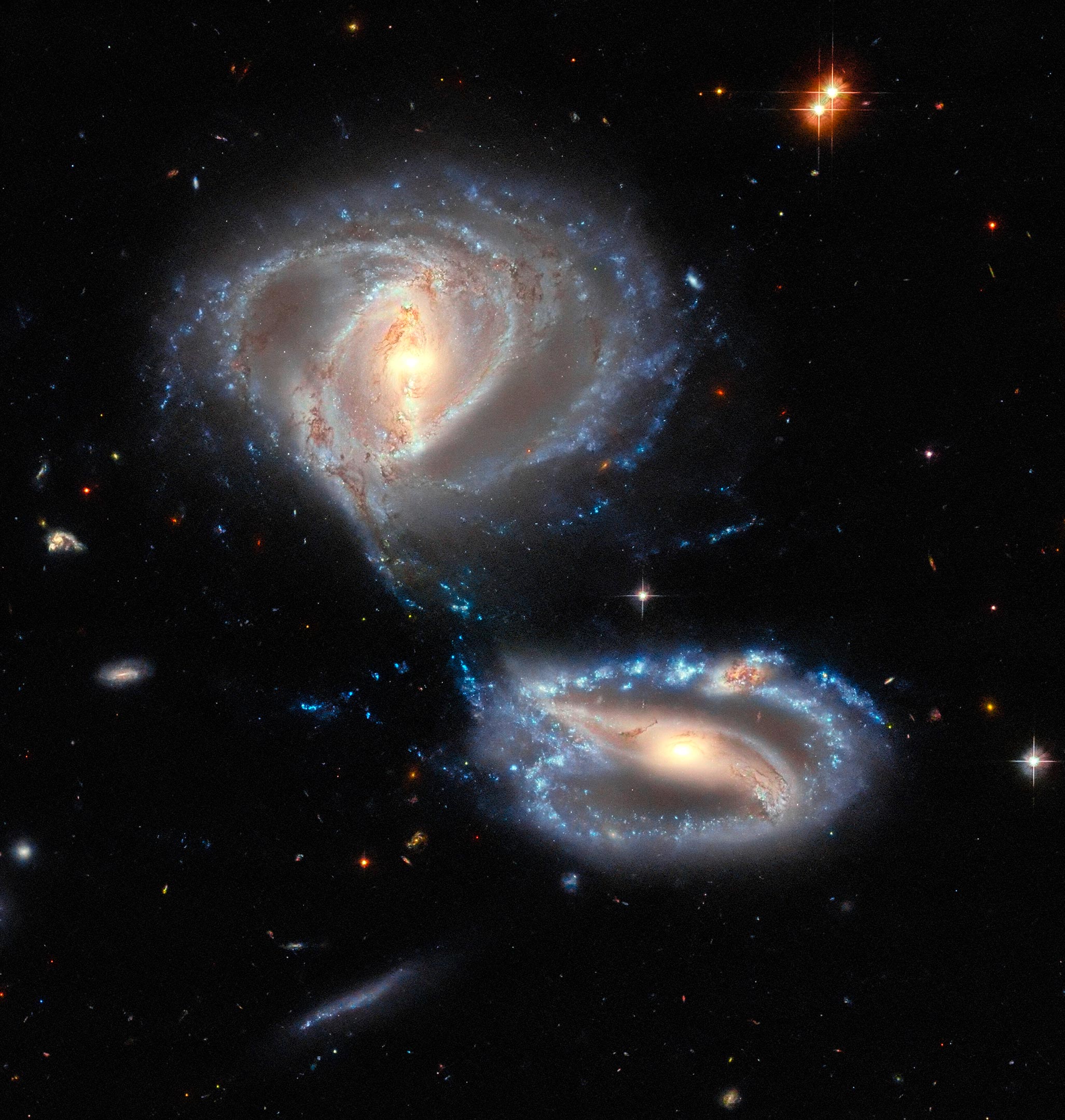
    This Hubble Space Telescope image of Arp-Madore 2339-661 reveals an interacting galaxy pair from the Arp-Madore catalog of peculiar galaxies. However, a closer look uncovers a third galaxy, making it a trio of interacting galaxies. The main two are NGC 7733 and NGC 7734, while the third, NGC 7733N, is subtly visible as a unique knot-like structure on NGC 7733’s arm.  Credit: ESA/Hubble & NASA, J. Dalcanton, Dark Energy Survey/DOE/FNAL/NOIRLab/NSF/AURA, Acknowledgment: L. Shatz

    Arp-Madore 2339-661, initially thought to be a pair of interacting galaxies, is in fact a trio comprising NGC 7733, NGC 7734, and NGC 7733N. Located in the Tucana constellation, they are on course to merge into a single entity.

    This striking image from the Hubble Space Telescope captures the interacting galaxy pair known as Arp-Madore 2339-661, so named because they belong to the Arp-Madore catalog of peculiar galaxies. However, this particular peculiarity might be even odder than first meets the eye, as there are in fact three galaxies interacting here, not just two. 

    The two clearly defined galaxies are NGC 7733 (smaller, lower right) and NGC 7734 (larger, upper left). The third galaxy is currently referred to as NGC 7733N, and can actually be spotted in this picture if you look carefully at the upper arm of NGC 7733, where there is a visually notable knot-like structure, glowing with a different color to the arm and obscured by dark dust.

    This could easily pass as part of NGC 7733, but analysis of the velocities (speed, but also considering direction) involved in the galaxy shows that this knot has a considerable additional redshift, meaning that it is very likely its own entity and not part of NGC 7733. This is actually one of the many challenges that observational astronomers face: working out whether an astronomical object really is just one, or one lying in front of another as seen from Earth’s perspective!

    All three galaxies lie quite close to each other, roughly 500 million light-years from Earth in the constellation Tucana, and, as this image shows, they are interacting gravitationally with one another. In fact, some science literature refers to them as a ‘merging group’, meaning that they are on a course to ultimately become a single entity.

    Never miss a breakthrough: Join the SciTechDaily newsletter.
    Follow us on Google and Google News.

    Astronomy European Space Agency Hubble Space Telescope
    Share. Facebook Twitter Pinterest LinkedIn Email Reddit

    Related Articles

    A Diamond Necklace of Cosmic Proportions

    Hubble Snaps a Stunning Close-Up of a Magnificent Spiral Galaxy

    Extraordinary Hubble Image: Light Bends From the Beyond

    Hubble Space Telescope Sees Volcanic Activity Reforming the Atmosphere on a Rocky Exoplanet

    Hubble Spies a Luminous Heart With Dark Tendrils

    Spectacular Return to the Veil Nebula

    Hubble Spots a Peculiar Sight: Unusual Spiral Galaxy With a Heavy Arm

    A Flash of Life: Hubble Spies an Unusual Planetary Nebula

    Through the Cosmic Clouds: Hubble Spots a Beautiful Stellar Nursery

    Leave A Reply Cancel Reply

    • Facebook
    • Twitter
    • Pinterest
    • YouTube

    Don't Miss a Discovery

    Subscribe for the Latest in Science & Tech!

    Trending News

    Scientists Discover New Compound That Burns Fat Without Killing Your Appetite

    Mount Vesuvius Buried These Scrolls for 2,000 Years – Now Scientists May Read Them

    The Asteroid That Killed the Dinosaurs Was Stranger Than We Thought

    Scientists Rewrite the Atomic Structure of Glass While It Melts

    DNA Has a Four-Letter Alphabet. Scientists Just Expanded It to Eight

    A Little-Known Protein Could Point to a New Way To Treat Alzheimer’s

    Scientists Turn Plastic Waste Into Protein-Rich Cookies

    New Findings Could Help Build Computers That Think More Like Your Brain

    Follow SciTechDaily
    • Facebook
    • Twitter
    • YouTube
    • Pinterest
    • Newsletter
    • RSS
    SciTech News
    • Biology News
    • Chemistry News
    • Earth News
    • Health News
    • Physics News
    • Science News
    • Space News
    • Technology News
    Recent Posts
    • Could This Cellular “Cleanup Crew” Hold New Clues to Chronic Inflammation?
    • Four Million Ancient Coins Reveal What Really Held the Roman Empire Together
    • 240-Million-Year-Old Fossil Discovery Challenges the Story of the First Dinosaurs
    • Researchers Test a New Way To Find Pancreatic Cancer Before It’s Too Late
    • Stress Hormone Cortisol Rewires the Brain to Strengthen Emotional Memories
    Copyright © 1998 - 2026 SciTechDaily. All Rights Reserved.
    • Science News
    • About
    • Contact
    • Editorial Board
    • Privacy Policy
    • Terms of Use

    Type above and press Enter to search. Press Esc to cancel.