
Close Menu
    Facebook X (Twitter) Instagram
    SciTechDaily
    • Biology
    • Chemistry
    • Earth
    • Health
    • Physics
    • Science
    • Space
    • Technology
    Facebook X (Twitter) Pinterest YouTube RSS
    SciTechDaily
    Home»Biology»Key Process in Brain Development Identified
    Biology

    Key Process in Brain Development Identified

    By Ziba Kashef, Yale UniversityFebruary 6, 2015No Comments2 Mins Read
    Facebook Twitter Pinterest Telegram LinkedIn WhatsApp Email Reddit
    Share
    Facebook Twitter LinkedIn Pinterest Telegram Email Reddit
    Yale Identifies Key Process in Brain Development
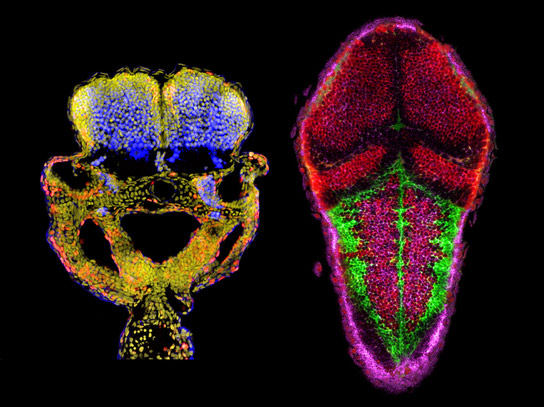
    Left, hindbrain of zebrafish embryo at 48 hours post fertilization shows an increase of neurogenesis. Right, dorsal view of a Zebrafish embryo treated for miR-107. Credit: Emma Ristori

    By studying miR-107 in zebrafish, Yale researchers have discovered that miR-107 plays a key role in early brain development, and perhaps in the development of brain-related disease.

    MicroRNA are the tiny non-coding RNA molecules that help determine whether genes are expressed or silenced. One particular microRNA — miR-107 — plays a key role in early brain development, and perhaps in the development of brain-related disease, a Yale School of Medicine team has found.

    Experts have long known that miRNAs are involved in brain development but not precisely how. Assistant professor of medicine Stefania Nicoli and her team set out to describe the process by studying miR-107 in zebrafish. They discovered that miR-107 regulates the levels of an enzyme known as dicer, which in turn regulates another RNA molecule, miR-9, that is essential to normal brain development. This regulatory loop was previously unknown.

    Though miR-107 has been studied previously in cancer progression and diabetes, the Yale team observed how it impacts brain development in an animal for the first time. The loss of miR-107 in the zebrafish led to an excessive amount of neurons (nerve cells) and neural progenitors.

    “This is the first paper showing that if you lose miR-107, you have abnormal embryonic hindbrain development,” said Nicoli. Understanding this miRNA’s functions may be essential to understanding the genetic and cellular basis of neural disorders that can occur during brain development, she notes.

    The study findings may also point to future research into treatment for adult neurological disorders involving miR-107, the expression of which is dramatically lost in the brain of early Alzheimer’s patients, the paper noted.

    The study was published early online in the journal Developmental Cell.

    Other authors included Emma Ristori, Miguel Alejandro Lopez-Ramirez, Anand Narayanan, Guillermina Hill-Teran, Albertomaria Moro, Charles-Felix Calvo, and Jean Leon Thomas.

    It was supported by grants from the National Institute of Health (5R00HL105791) and from the Alzheimer’s Association (NIRP 12-259162).

    Reference: “A Dicer-miR-107 Interaction Regulates Biogenesis of Specific miRNAs Crucial for Neurogenesis” by Emma Ristori, Miguel Alejandro Lopez-Ramirez, Anand Narayanan, Guillermina Hill-Teran, Albertomaria Moro, Charles-Félix Calvo, Jean-Léon Thomas and Stefania Nicoli, 5 February 2015, Developmental Cell.
    DOI: 10.1016/j.devcel.2014.12.013

    Never miss a breakthrough: Join the SciTechDaily newsletter.
    Follow us on Google and Google News.

    Cell Biology MicroRNA Neurology Neuroscience Yale University Zebrafish
    Share. Facebook Twitter Pinterest LinkedIn Email Reddit

    Related Articles

    Laminin Alpha 5 is Crucial to Adolescent Brain Maturation

    Researchers Identify Molecular Factors that Push the Domino of Life into Motion

    New Technique Allows Researchers to Measure Electrical Activity in a Living Neuron

    Mechanism for Controlling Calcium Influx in Cells Identified

    Researchers Control Seizures in Epileptic Mice Using Brain Cells

    Human Cells Enhance Synaptic Plasticity and Learning in Adult Mice

    Suppressing NgR1 Returns Brain to Adolescent Levels of Plasticity

    Neurologists Repair Neurons Associated With Traumatic Nerve Injury Pain

    GATA1 Plays a Role in the Loss of Connections Between Neurons and in Symptoms of Depression

    Leave A Reply Cancel Reply

    • Facebook
    • Twitter
    • Pinterest
    • YouTube

    Don't Miss a Discovery

    Subscribe for the Latest in Science & Tech!

    Trending News

    Scientists Recreate a Nuclear Fireball and Uncover Fallout’s Hidden Chemistry

    These Tiny Gut Particles Could Be Accelerating Aging Throughout the Body

    Doctors Changed One Thing and Weight Gain Stopped

    Magnetic Fields May Solve a Longstanding Binary Star Mystery

    The Probiotic Breakthrough for Natural Anxiety Relief and Better Mental Health

    Animal vs. Plant Protein: Scientists Found a Surprising Nutritional Difference

    According to Scientists, This Simple Dietary Change Is Linked to Lower Depression Scores

    Researchers Discover a Hidden Vitamin D Problem That Persists Year-Round

    Follow SciTechDaily
    • Facebook
    • Twitter
    • YouTube
    • Pinterest
    • Newsletter
    • RSS
    SciTech News
    • Biology News
    • Chemistry News
    • Earth News
    • Health News
    • Physics News
    • Science News
    • Space News
    • Technology News
    Recent Posts
    • A Hidden Gut Signal May Be Driving Sleep Apnea’s Deadly Heart Risks
    • This AI-Designed “Universal Vaccine” Could Stop Future Pandemics Before They Start
    • Scientists Unveil Powerful New Diabetes Pill That Cuts Weight and Lowers Blood Sugar
    • Rising Seas Could Turn Mangroves From Climate Heroes Into Carbon Sources
    • The Surprising Way Asteroids May Have Helped Life Begin on Earth
    Copyright © 1998 - 2026 SciTechDaily. All Rights Reserved.
    • Science News
    • About
    • Contact
    • Editorial Board
    • Privacy Policy
    • Terms of Use

    Type above and press Enter to search. Press Esc to cancel.