

Researchers at the European XFEL suspect effects on complex magnetic field.
An international team of researchers led by Mungo Frost from the SLAC research center in California has gained new insights into the formation of diamond rain on icy planets such as Neptune and Uranus, using the X-ray laser European XFEL in Schenefeld. The results, which have now been published in the scientific journal Nature Astronomy, also provide clues to the formation of the complex magnetic fields of these planets.
In earlier work on X-ray lasers, scientists had already discovered that diamonds should form from carbon compounds in the interior of the large gas planets because of the high pressure prevailing there. These would then sink further into the interior of the planets as a rain of precious stones from the higher layers.
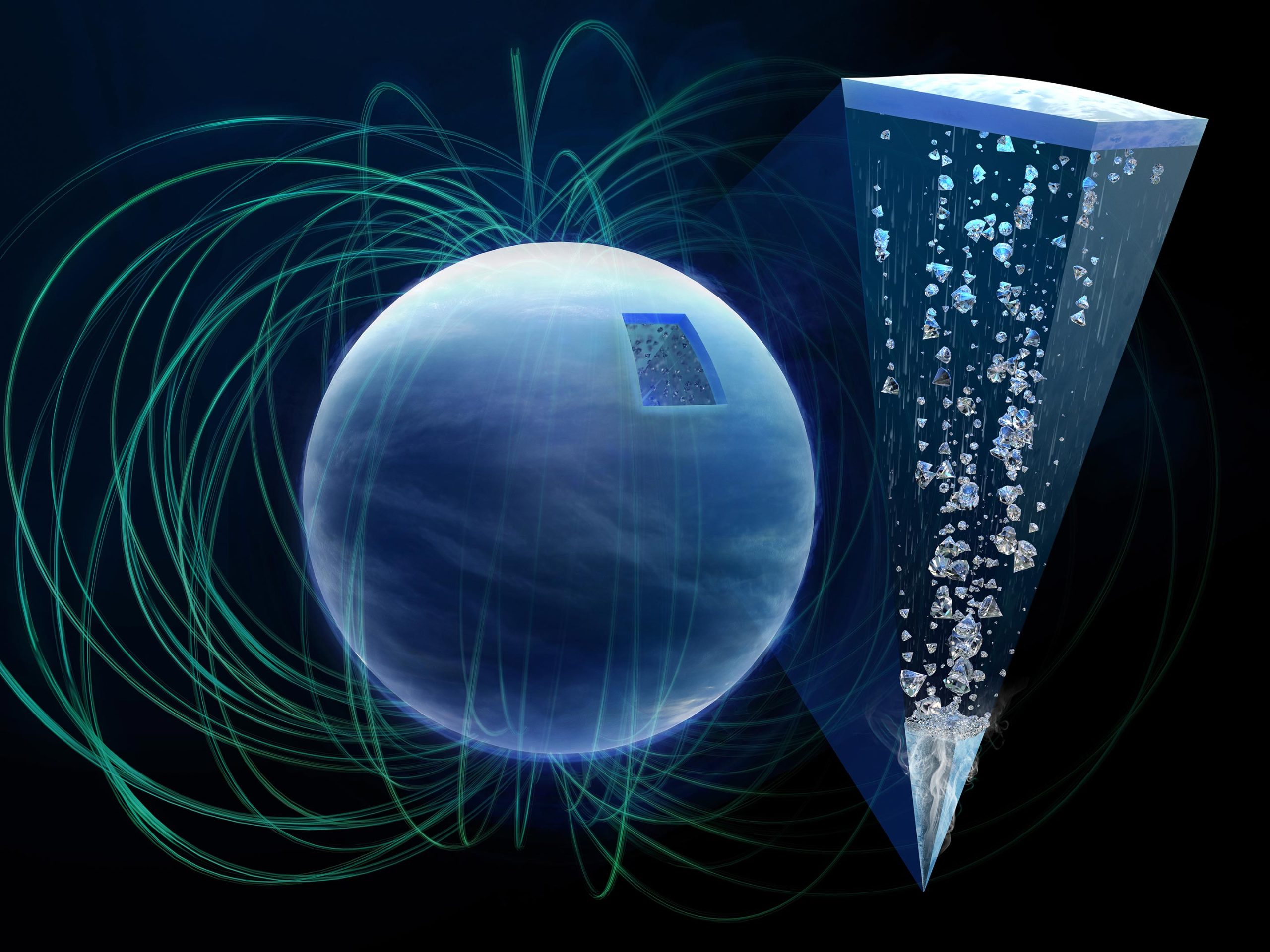
A new experiment at the European XFEL has now shown that the formation of diamonds from carbon compounds already starts at lower pressures and temperatures than assumed. For the gas planets, this means that diamond rain already forms at a lower depth than thought, and could thus have a stronger influence on the formation of the magnetic fields. In addition, diamond rain would also be possible on gas planets that are smaller than Neptune and Uranus and are called “mini-Neptunes.” Such planets do not exist in our solar system, but they do occur as exoplanets outside of it.
On their way from the outer to the inner layers of the planets, the diamond rain can entrain gas and ice, causing currents of conductive ice. Currents of conductive fluids act as a kind of dynamo through which the magnetic fields of planets are formed. “The diamond rain probably has an influence on the formation of the complex magnetic fields of Uranus and Neptune,” Frost said.
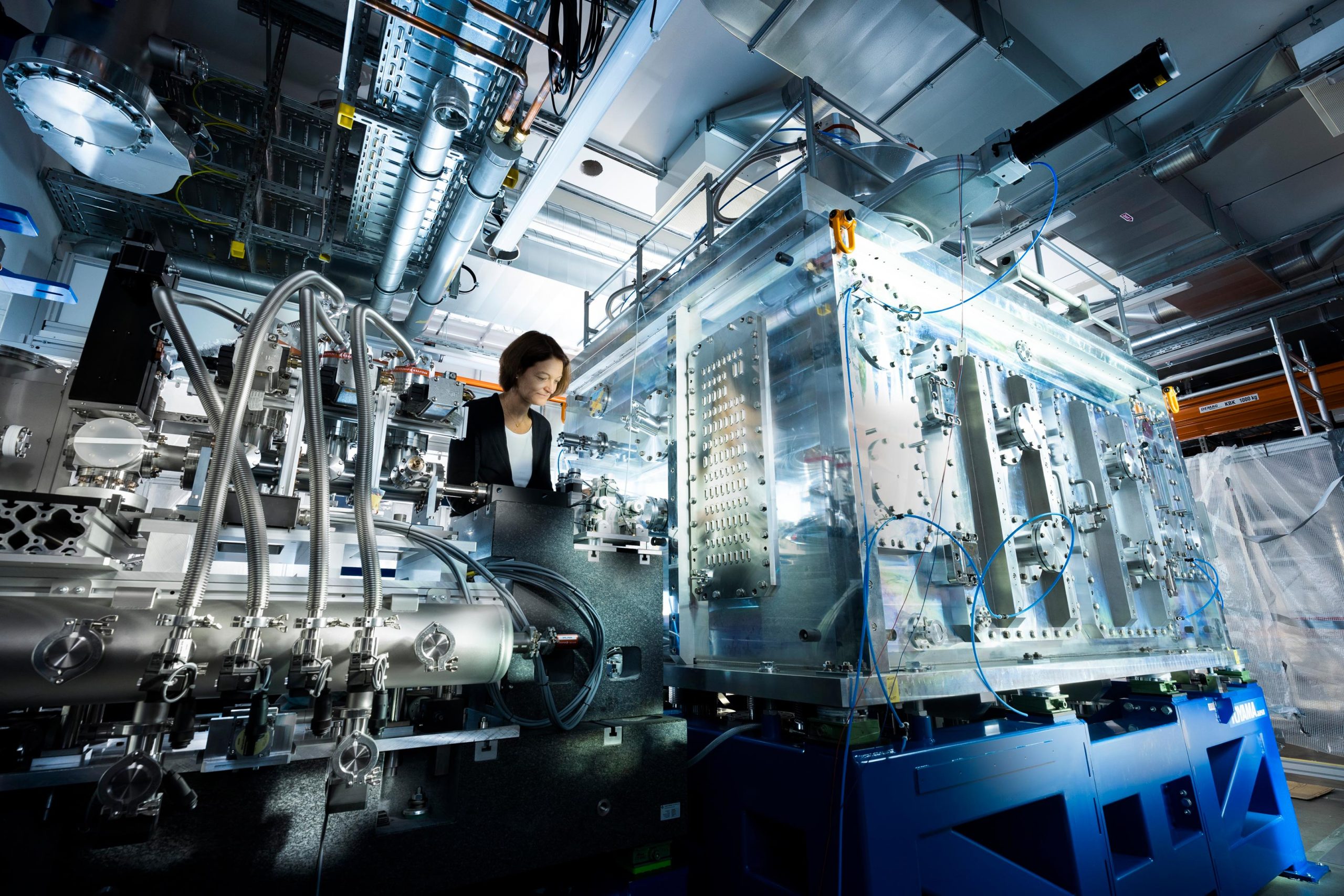
The group used a plastic film made from the hydrocarbon compound polystyrene as a carbon source. Under very high pressure, diamonds are formed from the foil – a process that takes place in the same way as in the interior of planets and which can be imitated at the European XFEL. The researchers generated the high pressure and the temperature of more than 2200 degrees Celsius that prevail inside the icy gas giants with the help of diamond stamp cells and lasers. The stamp cells function like a mini vice in which the sample is squeezed between two diamonds. With the help of the European XFEL X-ray pulses, the time, conditions and sequence of the formation of the diamonds in the stamp cell can be precisely observed.
The international research team also includes scientists from European XFEL, the German research centers DESY in Hamburg and the Helmholtz Centre Dresden-Rossendorf, as well as other research institutions and universities from different countries. The European XFEL user consortium HIBEF, involving the research centers HZDR and DESY, contributed significantly to this work.
“Through this international collaboration, we have made great progress at the European XFEL and gained remarkable new insights into icy planets,” says Frost.
For more on this study, see “Diamond Rain” on Icy Planets: Unlocking Magnetic Field Mysteries.
Reference: “Diamond precipitation dynamics from hydrocarbons at icy planet interior conditions” by Mungo Frost, R. Stewart McWilliams, Elena Bykova, Maxim Bykov, Rachel J. Husband, Leon M. Andriambariarijaona, Saiana Khandarkhaeva, Bernhard Massani, Karen Appel, Carsten Baehtz, Orianna B. Ball, Valerio Cerantola, Stella Chariton, Jinhyuk Choi, Hyunchae Cynn, Matthew J. Duff, Anand Dwivedi, Eric Edmund, Guillaume Fiquet, Heinz Graafsma, Huijeong Hwang, Nicolas Jaisle, Jaeyong Kim, Zuzana Konôpková, Torsten Laurus, Yongjae Lee, Hanns-Peter Liermann, James D. McHardy, Malcolm I. McMahon, Guillaume Morard, Motoaki Nakatsutsumi, Lan Anh Nguyen, Sandra Ninet, Vitali B. Prakapenka, Clemens Prescher, Ronald Redmer, Stephan Stern, Cornelius Strohm, Jolanta Sztuk-Dambietz, Monica Turcato, Zhongyan Wu, Siegfried H. Glenzer and Alexander F. Goncharov, 8 January 2024, Nature Astronomy.
DOI: 10.1038/s41550-023-02147-x
Never miss a breakthrough: Join the SciTechDaily newsletter.
Follow us on Google and Google News.