

Close Menu
    Facebook X (Twitter) Instagram
    SciTechDaily
    • Biology
    • Chemistry
    • Earth
    • Health
    • Physics
    • Science
    • Space
    • Technology
    Facebook X (Twitter) Pinterest YouTube RSS
    SciTechDaily
    Home»Physics»Spintronics Breakthrough: Unlocking the Power of Radial Vortices
    Physics

    Spintronics Breakthrough: Unlocking the Power of Radial Vortices

    By Helmholtz-Zentrum Berlin für Materialien und EnergieApril 21, 2024No Comments4 Mins Read
    Facebook Twitter Pinterest Telegram LinkedIn WhatsApp Email Reddit
    Share
    Facebook Twitter LinkedIn Pinterest Telegram Email Reddit
    Spintronics Technology Concept Art
    Researchers have developed a method to create and stabilize complex spin textures, like radial vortices, using superconducting structures and surface defects. This advancement could significantly impact spintronics by allowing the use of various ferromagnetic materials and enhancing data storage and logic operations with lower power consumption. Credit: SciTechDaily.com

    A team at HZB has investigated a new, simple method at BESSY II that can be used to create stable radial magnetic vortices in magnetic thin films.

    In some materials, spins form complex magnetic structures within the nanometre and micrometer scale in which the magnetization direction twists and curls along specific directions. Examples of such structures are magnetic bubbles, skyrmions, and magnetic vortices.

    Spintronics aims to make use of such tiny magnetic structures to store data or perform logic operations with very low power consumption, compared to today’s dominant microelectronic components. However, the generation and stabilization of most of these magnetic textures is restricted to a few materials and achievable under very specific conditions (temperature, magnetic field…).

    A New Approach

    An international collaboration led by HZB physicist Dr Sergio Valencia has now investigated a new approach that can be used to create and stabilize complex spin textures, such as radial vortices, in a variety of compounds. In a radial vortex, the magnetization points towards or away from the center of the structure. This type of magnetic configuration is usually highly unstable. Within this novel approach, radial vortices are created with the help of superconducting structures while their stabilization is achieved by the presence of surface defects.
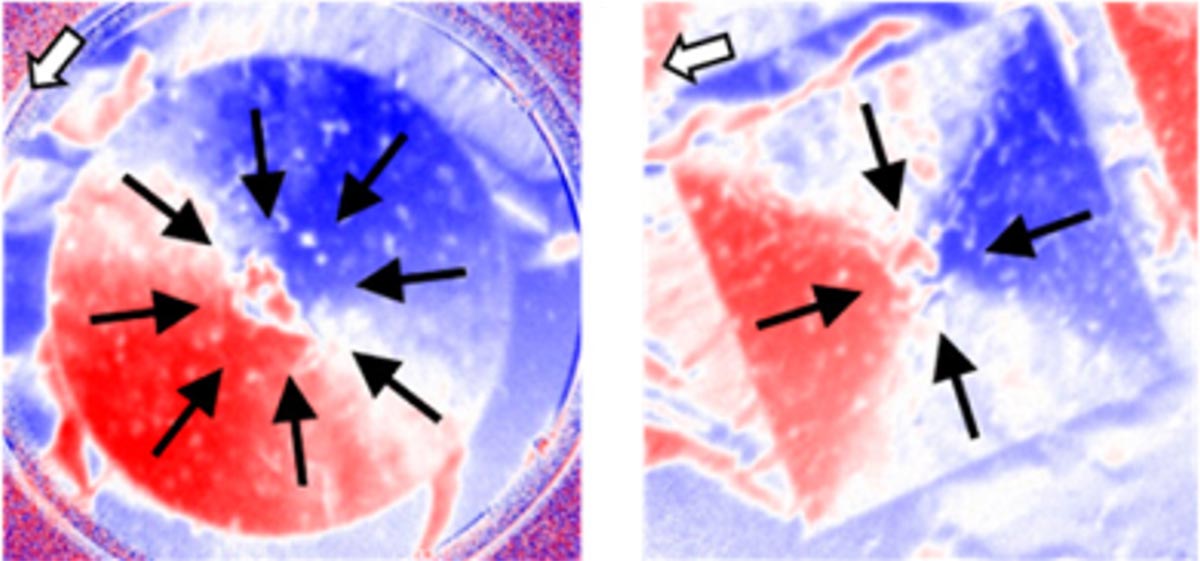
    Radially Aligned Spin Textures Superconducting YBCO Island
    The team led by Sergio Valencia analyzed the samples with photoemission electron microscopy using XMCD at BESSY II. The images show the radially aligned spin textures in a round and a square sample consisting of a ferromagnetic material on a superconducting YBCO island. The white arrow shows the incident X-ray beam. Credit: © HZB

    Superconducting YBCO-Islands

    Samples consist of micrometer-sized islands made of the high-temperature superconductor YBCO on which a ferromagnetic compound is deposited. On cooling the sample below 92 Kelvin (-181 °C), YBCO enters the superconducting state. In this state, an external magnetic field is applied and immediately removed. This process allows the penetration and pinning of magnetic flux quanta, which in turn creates a magnetic stray field. It is this stray field that produces new magnetic microstructures in the overlying ferromagnetic layer: spins emanate radially from the structure center, as in a radial vortex.

    The Role of Defects

    As the temperature is increased, YBCO transits from the superconducting to a normal state. So the stray field created by YBCO islands disappears, and so should the magnetic radial vortex. However HZB researchers and collaborators have observed that the presence of surface defects prevents this to happen: the radial vortices partially retain the imprinted state, even when approaching room temperature.

    “We use the magnetic field generated by the superconducting structures to imprint certain magnetic domains on the ferromagnets placed on them, and the surface defects to stabilize them. The magnetic structures are akin to that of a skyrmion and are interesting for spintronic applications,” explains Valencia.

    Geometry Matters

    Smaller imprinted vortices were about 2 micrometers in diameter, about ten times the size of typical skyrmions. The team studied samples with circular and square geometries and found that circular geometries increased the stability of imprinted magnetic radial vortices.

    “This is a novel way to create and stabilize such structures and it can be applied in a variety of ferromagnetic materials. These are good new prospects for the further development of superconducting spintronics,” says Valencia.

    Reference: “Size-Dependence and High Temperature Stability of Radial Vortex Magnetic Textures Imprinted by Superconductor Stray Fields” by David Sanchez-Manzano, Gloria Orfila, Anke Sander, Lourdes Marcano, Fernando Gallego, Mohamad-Assaad Mawass, Francesco Grilli, Ashima Arora, Andrea Peralta, Fabian A. Cuellar, Jose A. Fernandez-Roldan, Nicolas Reyren, Florian Kronast, Carlos Leon, Alberto Rivera-Calzada, Javier E. Villegas, Jacobo Santamaria and Sergio Valencia, 2 April 2024, ACS Applied Materials & Interfaces.
    DOI: 10.1021/acsami.3c17671

    Never miss a breakthrough: Join the SciTechDaily newsletter.
    Follow us on Google and Google News.

    Helmholtz-Zentrum Berlin Skyrmions Spintronics Superconduction
    Share. Facebook Twitter Pinterest LinkedIn Email Reddit

    Related Articles

    Twisting the Rules of Physics: Giant Magnetic Textures Emerge From Atomic Misalignment

    Scientists Discover Surprising Quantum Properties in Seemingly Ordinary Element

    Hopfions Unveiled: The 3D Spin Structures Set to Spin Up Future Tech

    Skyrmions – Tiny Magnetic Swirls – Used To Generate True Random Numbers

    New Exotic Magnetic Quasiparticle: “Skyrmion Bundle” Joins Topological Zoo

    Next-Gen Information Technology: The Spintronics Revolution Could Be Just a Hopfion Away

    Orbitronics Breakthrough: Scientists Break the Link Between a Quantum Material’s Spin and Orbital States

    Physicists Produce New Evidence for an Exotic Superconducting State

    NIST Researches the Use of Switching Mechanisms in Advanced Computer Memory Device

    Leave A Reply Cancel Reply

    • Facebook
    • Twitter
    • Pinterest
    • YouTube

    Don't Miss a Discovery

    Subscribe for the Latest in Science & Tech!

    Trending News

    Scientists Discover Stem Cells That Could Regrow Teeth and Bone

    Early Cannabis Use May Stall Key Brain Skills in Teens

    Popular Vitamin D Supplement Has “Previously Unknown” Negative Effect, Study Finds

    Study Reveals Malaria’s Hidden Role in Human Evolution

    The Hidden Risk of Taking Breaks From Weight-Loss Drugs Like Ozempic

    Scientists Warn That This Common Pet Fish Can Wreck Entire Ecosystems

    Scientists Make Breakthrough in Turning Plastic Trash Into Clean Fuel Using Sunlight

    This Popular Supplement May Interfere With Cancer Treatment, Scientists Warn

    Follow SciTechDaily
    • Facebook
    • Twitter
    • YouTube
    • Pinterest
    • Newsletter
    • RSS
    SciTech News
    • Biology News
    • Chemistry News
    • Earth News
    • Health News
    • Physics News
    • Science News
    • Space News
    • Technology News
    Recent Posts
    • This Tiny Creature Survived a World of Dinosaurs and Changed What Came Next
    • Millions of People Have Osteopenia Without Realizing It – Here’s What You Need To Know
    • Researchers Discover Boosting a Single Protein Helps the Brain Fight Alzheimer’s
    • AI Detects “Invisible” Signs of Pancreatic Cancer Years Before Diagnosis
    • Kratom Use Explodes in the US, With Life-Changing Consequences
    Copyright © 1998 - 2026 SciTechDaily. All Rights Reserved.
    • Science News
    • About
    • Contact
    • Editorial Board
    • Privacy Policy
    • Terms of Use

    Type above and press Enter to search. Press Esc to cancel.