
Close Menu
    Facebook X (Twitter) Instagram
    SciTechDaily
    • Biology
    • Chemistry
    • Earth
    • Health
    • Physics
    • Science
    • Space
    • Technology
    Facebook X (Twitter) Pinterest YouTube RSS
    SciTechDaily
    Home»Space»NASA’s Speed Demon: Parker Probe’s Closest Sun Encounter at 394,736 Miles per Hour
    Space

    NASA’s Speed Demon: Parker Probe’s Closest Sun Encounter at 394,736 Miles per Hour

    By Michael Buckley, Johns Hopkins Applied Physics LaboratoryJuly 6, 20241 Comment2 Mins Read
    Facebook Twitter Pinterest Telegram LinkedIn WhatsApp Email Reddit
    Share
    Facebook Twitter LinkedIn Pinterest Telegram Email Reddit
    Parker Solar Probe Close to Sun
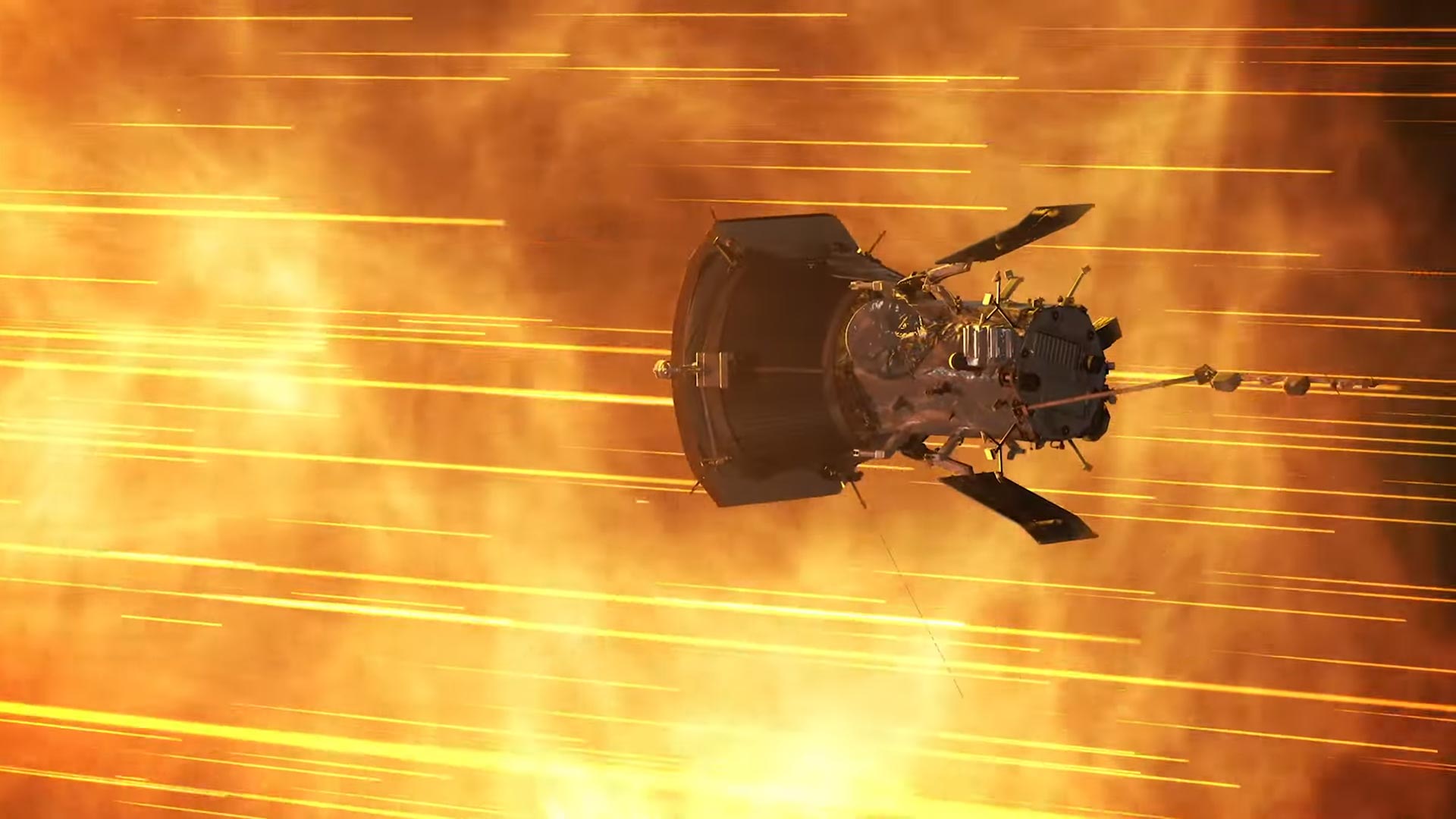
    The Parker Solar Probe completed its 20th close approach to the Sun, matching previous records in both distance and speed. It reported back in good health and is scheduled for three more approaches in 2024, with one featuring a reduced proximity to the Sun after a Venus flyby. Credit: NASA GSFC/CIL/Brian Monroe

    NASA’s Parker Solar Probe successfully completed its 20th close approach to the Sun on June 30, 2024.

    NASA’s Parker Solar Probe completed its 20th close approach to the Sun on June 30, 2024, matching its own distance record by coming about 4.51 million miles (7.26 million kilometers) from the solar surface.

    The close approach (known as perihelion) occurred at 3:47 UTC (11:47 p.m. EDT on June 29), with Parker Solar Probe moving 394,736 miles per hour (635,266 kilometers per hour) around the Sun, again matching its own record. On July 2, the spacecraft checked in with mission operators at the Johns Hopkins Applied Physics Laboratory in Laurel, Maryland (where the spacecraft was also designed and built), with a beacon tone indicating it was in good health and all systems were operating normally.


    Parker Solar Probe’s 20th orbit included a perihelion that brought the spacecraft within 4.51 million miles of the Sun. Credit: NASA/Johns Hopkins APL/Steve Gribben

    The milestone also marked the midpoint in the mission’s 20th solar encounter, which began June 25 and continues through July 5.

    Parker will fly around the Sun at the same distance and speed one more time this year — on September 30 — before making the first of its three final planned closest approaches on December 24. At that point, with Parker’s orbit shaped by the mission’s final Venus gravity assist-flyby on November 6, the spacecraft will zoom just 3.8 million miles from the solar surface, moving about 430,000 miles per hour.

    Never miss a breakthrough: Join the SciTechDaily newsletter.
    Follow us on Google and Google News.

    Johns Hopkins APL NASA Parker Solar Probe Sun
    Share. Facebook Twitter Pinterest LinkedIn Email Reddit

    Related Articles

    NASA’s Spacecraft That Touched the Sun Just Won Aerospace’s Biggest Prize

    NASA’s Parker Solar Probe: The Fastest Human-Made Object Just “Touched” the Sun and Shattered Records

    NASA’s Parker Solar Probe Survives Fiery Sun Flyby at 430,000 MPH

    Parker Solar Probe: For the First Time in History, a Spacecraft Has Touched the Sun

    NASA’s Parker Solar Probe Touches the Sun for the First Time – Bringing New Discoveries

    NASA’s Parker Solar Probe Completes a Record-Setting Swing by the Sun

    Celestial Geometry Posed a Special Opportunity During Parker Solar Probe’s 7th Solar Encounter

    NASA’s Parker Solar Probe Teams Up With Observatories Around Solar System

    5 Astonishing New Discoveries From NASA’s Parker Solar Probe [Video]

    1 Comment

    1. Clyde Spencer on July 6, 2024 7:16 pm

      Is there a clock on board that can be used to determine if the craft experienced time dilation?

      Reply
    Leave A Reply Cancel Reply

    • Facebook
    • Twitter
    • Pinterest
    • YouTube

    Don't Miss a Discovery

    Subscribe for the Latest in Science & Tech!

    Trending News

    NASA’s Voyager 1 Is About to Become the First Spacecraft One Light-Day From Earth

    A Woman Who Lived 30,000 Years Ago Is Changing What We Know About Ice Age Europe

    A Rare Radioactive Element Reveals a Hidden Secret About the Heaviest Atoms

    Breakthrough Cancer Treatment Wipes Out Deadly Brain Tumors in Every Mouse Tested

    Something Remarkable Is Happening to Dogs Living Near Chernobyl’s Nuclear Plant

    Hubble Uncovers a Mysterious 93-Billion-Mile Structure Hiding in a Nearby Star System

    Earth’s Oceans Were Slowly Suffocating Millions of Years Before a Devastating Mass Extinction

    Why Are Men Twice As Likely To Develop Parkinson’s? Scientists Discover a Hidden Clue in the Brain

    Follow SciTechDaily
    • Facebook
    • Twitter
    • YouTube
    • Pinterest
    • Newsletter
    • RSS
    SciTech News
    • Biology News
    • Chemistry News
    • Earth News
    • Health News
    • Physics News
    • Science News
    • Space News
    • Technology News
    Recent Posts
    • Scientists Find a Clever Way to Read Quantum Information Without Destroying It
    • Chemical Breakthrough Could Unlock the “Holy Grail” of Solid-State Battery Technology
    • Kids Who Learn To Swim Early May Have an Unexpected Advantage in School
    • Could Type 2 Diabetes Be Reversed? 14-Year Study Reveals Remarkable Results
    • The Secret to Saving Shellfish From Acidifying Oceans Could Be Hiding in Crushed Shells
    Copyright © 1998 - 2026 SciTechDaily. All Rights Reserved.
    • Science News
    • About
    • Contact
    • Editorial Board
    • Privacy Policy
    • Terms of Use

    Type above and press Enter to search. Press Esc to cancel.