
Close Menu
    Facebook X (Twitter) Instagram
    SciTechDaily
    • Biology
    • Chemistry
    • Earth
    • Health
    • Physics
    • Science
    • Space
    • Technology
    Facebook X (Twitter) Pinterest YouTube RSS
    SciTechDaily
    Home»Space»NASA’s Speed Demon: Parker Probe’s Closest Sun Encounter at 394,736 Miles per Hour
    Space

    NASA’s Speed Demon: Parker Probe’s Closest Sun Encounter at 394,736 Miles per Hour

    By Michael Buckley, Johns Hopkins Applied Physics LaboratoryJuly 6, 20241 Comment2 Mins Read
    Facebook Twitter Pinterest Telegram LinkedIn WhatsApp Email Reddit
    Share
    Facebook Twitter LinkedIn Pinterest Telegram Email Reddit
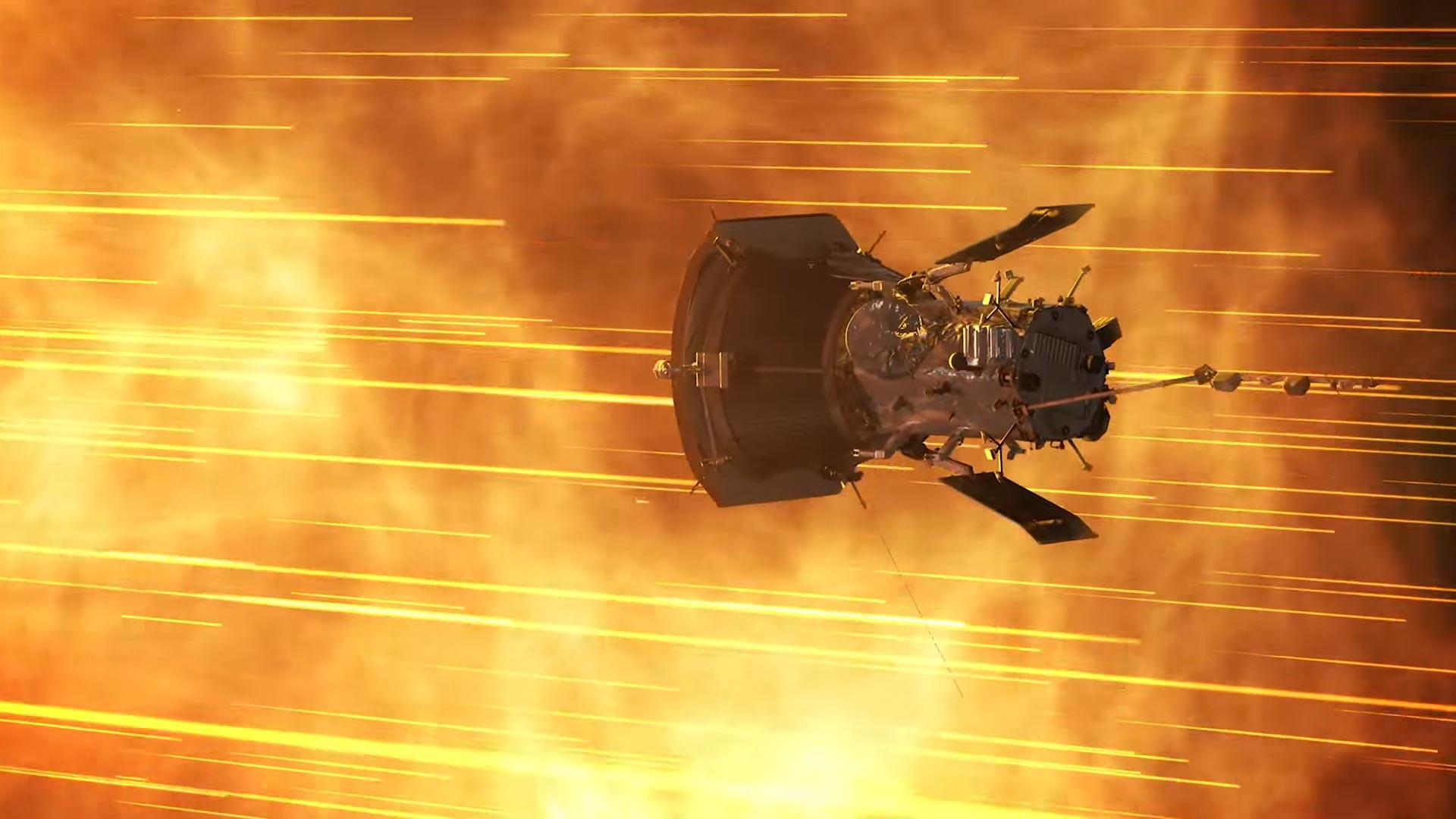
    Parker Solar Probe Close to Sun
    The Parker Solar Probe completed its 20th close approach to the Sun, matching previous records in both distance and speed. It reported back in good health and is scheduled for three more approaches in 2024, with one featuring a reduced proximity to the Sun after a Venus flyby. Credit: NASA GSFC/CIL/Brian Monroe

    NASA’s Parker Solar Probe successfully completed its 20th close approach to the Sun on June 30, 2024.

    NASA’s Parker Solar Probe completed its 20th close approach to the Sun on June 30, 2024, matching its own distance record by coming about 4.51 million miles (7.26 million kilometers) from the solar surface.

    The close approach (known as perihelion) occurred at 3:47 UTC (11:47 p.m. EDT on June 29), with Parker Solar Probe moving 394,736 miles per hour (635,266 kilometers per hour) around the Sun, again matching its own record. On July 2, the spacecraft checked in with mission operators at the Johns Hopkins Applied Physics Laboratory in Laurel, Maryland (where the spacecraft was also designed and built), with a beacon tone indicating it was in good health and all systems were operating normally.


    Parker Solar Probe’s 20th orbit included a perihelion that brought the spacecraft within 4.51 million miles of the Sun. Credit: NASA/Johns Hopkins APL/Steve Gribben

    The milestone also marked the midpoint in the mission’s 20th solar encounter, which began June 25 and continues through July 5.

    Parker will fly around the Sun at the same distance and speed one more time this year — on September 30 — before making the first of its three final planned closest approaches on December 24. At that point, with Parker’s orbit shaped by the mission’s final Venus gravity assist-flyby on November 6, the spacecraft will zoom just 3.8 million miles from the solar surface, moving about 430,000 miles per hour.

    Never miss a breakthrough: Join the SciTechDaily newsletter.
    Follow us on Google and Google News.

    Johns Hopkins APL NASA Parker Solar Probe Sun
    Share. Facebook Twitter Pinterest LinkedIn Email Reddit

    Related Articles

    NASA’s Spacecraft That Touched the Sun Just Won Aerospace’s Biggest Prize

    NASA’s Parker Solar Probe: The Fastest Human-Made Object Just “Touched” the Sun and Shattered Records

    NASA’s Parker Solar Probe Survives Fiery Sun Flyby at 430,000 MPH

    Parker Solar Probe: For the First Time in History, a Spacecraft Has Touched the Sun

    NASA’s Parker Solar Probe Touches the Sun for the First Time – Bringing New Discoveries

    NASA’s Parker Solar Probe Completes a Record-Setting Swing by the Sun

    Celestial Geometry Posed a Special Opportunity During Parker Solar Probe’s 7th Solar Encounter

    NASA’s Parker Solar Probe Teams Up With Observatories Around Solar System

    5 Astonishing New Discoveries From NASA’s Parker Solar Probe [Video]

    1 Comment

    1. Clyde Spencer on July 6, 2024 7:16 pm

      Is there a clock on board that can be used to determine if the craft experienced time dilation?

      Reply
    Leave A Reply Cancel Reply

    • Facebook
    • Twitter
    • Pinterest
    • YouTube

    Don't Miss a Discovery

    Subscribe for the Latest in Science & Tech!

    Trending News

    Millions Take These IBS Drugs, But a New Study Finds Serious Risks

    Scientists Unlock Hidden Secrets of 2,300-Year-Old Mummies Using Cutting-Edge CT Scanner

    Bread Might Be Making You Gain Weight Even Without Eating More Calories

    Scientists Discover Massive Magma Reservoir Beneath Tuscany

    Europe’s Most Active Volcano Just Got Stranger – Here’s Why Scientists Are Rethinking It

    Alzheimer’s Symptoms May Start Outside the Brain, Study Finds

    Millions Take This Popular Supplement – Scientists Discover a Concerning Link to Heart Failure

    The Universe Is Expanding Too Fast and Scientists Can’t Explain Why

    Follow SciTechDaily
    • Facebook
    • Twitter
    • YouTube
    • Pinterest
    • Newsletter
    • RSS
    SciTech News
    • Biology News
    • Chemistry News
    • Earth News
    • Health News
    • Physics News
    • Science News
    • Space News
    • Technology News
    Recent Posts
    • Simple Blood Test May Predict Alzheimer’s Years Before Brain Scans Show Signs
    • Scientists Say Adding This Unusual Seafood to Your Diet Could Reverse Signs of Aging
    • U.S. Waste Holds $5.7 Billion Worth of Crop Nutrients
    • Scientists Say a Hidden Structure May Exist Inside Earth’s Core
    • Doctors Surprised by the Power of a Simple Drug Against Colon Cancer
    Copyright © 1998 - 2026 SciTechDaily. All Rights Reserved.
    • Science News
    • About
    • Contact
    • Editorial Board
    • Privacy Policy
    • Terms of Use

    Type above and press Enter to search. Press Esc to cancel.