
Close Menu
    Facebook X (Twitter) Instagram
    SciTechDaily
    • Biology
    • Chemistry
    • Earth
    • Health
    • Physics
    • Science
    • Space
    • Technology
    Facebook X (Twitter) Pinterest YouTube RSS
    SciTechDaily
    Home»Space»Hubble Space Telescope Probes a Possible Relic of the Early Universe
    Space

    Hubble Space Telescope Probes a Possible Relic of the Early Universe

    By NASA's Goddard Space Flight CenterAugust 24, 20241 Comment2 Mins Read
    Facebook Twitter Pinterest Telegram LinkedIn WhatsApp Email Reddit
    Share
    Facebook Twitter LinkedIn Pinterest Telegram Email Reddit
    VV124 UGC 4879
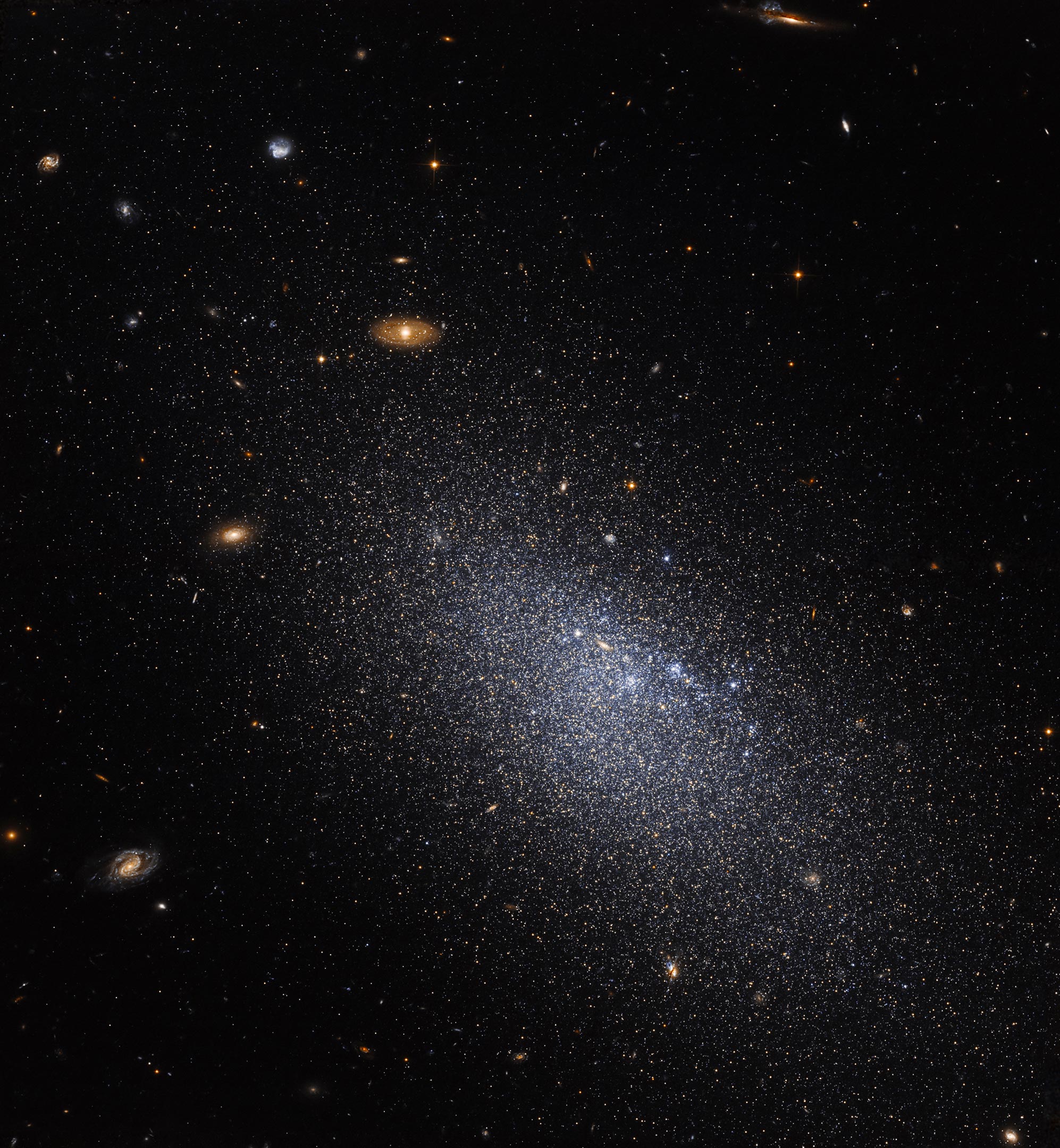
    VV124, or UGC 4879, is an isolated dwarf galaxy that resides just beyond our own Local Group of galaxies some four million light-years away. Credit: NASA, ESA, K. Chiboucas (NOIRLab – Gemini North (HI), and M. Monelli (Instituto de Astrofisica de Canarias); Image Processing: Gladys Kober (NASA/Catholic University of America)

    Captured by the Hubble Space Telescope, this image of the dwarf galaxy UGC 4879 offers a close look at its composition and structure, providing astronomers with valuable data on its age, distance, and formation, which could illuminate aspects of the universe’s early development.

    This NASA Hubble Space Telescope image captures the dwarf irregular galaxy UGC 4879 or VV124. As this image illustrates, Hubble’s high resolution can detect individual stars, even in the densest parts of the galaxy. This allows astronomers to better determine the galaxy’s distance, and the composition and age of its stars.

    Investigating Isolated Dwarf Galaxies

    UGC 4879 is an isolated dwarf galaxy, lying just beyond our own Local Group of galaxies some four million light-years away. Because of its isolation, astronomers are studying UGC 4879 to determine if it is a relatively undisturbed, old galaxy. Theories suggest that the lowest mass dwarf galaxies may have been the first galaxies to form. If UGC 4879 is a relic of the early universe, it could provide clues to the hierarchical structure and evolution of galaxies, galaxy clusters, and even the universe itself.

    The image combines data from two Hubble observing programs, both focused on learning more about dwarf galaxies: how they form and evolve.

    Never miss a breakthrough: Join the SciTechDaily newsletter.
    Follow us on Google and Google News.

    Astronomy NASA NASA Goddard Space Flight Center
    Share. Facebook Twitter Pinterest LinkedIn Email Reddit

    Related Articles

    Webb Space Telescope Uncovers Star Birth Secrets at Galaxy’s Edge

    Historic Discovery: Twin Titans Clash As NASA Unveils Closest Supermassive Black Hole Duo

    The Great Escape: NASA’s Hubble and MAVEN Help Solve Mystery of Mars’ Vanishing Water

    Into the Rosy Depths: Hubble’s Journey Through Andromeda

    Into the Stellar Forge: Hubble Peers Deep Into the Star-Forming Heart of the Triangulum Galaxy

    Hubble Observes a Lonely Beacon in the Cosmic Dark

    What Lies Within? Hubble’s Deep Dive Into the Structured Chaos of Leo A

    Revealing Secrets of Distant Planets With NASA’s Soaring EXCITE Telescope

    Hubble Spots Billowing Bubbles of Stellar Floss Across 1,000 Light-Year Expanse

    1 Comment

    1. Ed Stauffer on August 25, 2024 8:00 pm

      Light red shifts as it climbs out of a gravity well. Thus the further you go back in time the more light is redshifted. This would leave everything the same with the exception of our perception that the universe is expanding. Also if a big portion of the redshift is from climbing out of a deeper gravity well then we are not looking as far into the past as we think.

      Reply
    Leave A Reply Cancel Reply

    • Facebook
    • Twitter
    • Pinterest
    • YouTube

    Don't Miss a Discovery

    Subscribe for the Latest in Science & Tech!

    Trending News

    First-of-Its-Kind Discovery: Homer’s Iliad Found Embedded in a 1,600-Year-Old Egyptian Mummy

    Beyond Inflammation: Scientists Uncover New Cause of Persistent Rheumatoid Arthritis

    A Simple Molecule Could Unlock Safer, Easier Weight Loss

    Scientists Just Built a Quantum Battery That Charges Almost Instantly

    Researchers Unveil Groundbreaking Sustainable Solution to Vitamin B12 Deficiency

    Millions of People Have Osteopenia Without Realizing It – Here’s What You Need To Know

    Researchers Discover Boosting a Single Protein Helps the Brain Fight Alzheimer’s

    World-First Study Reveals Human Hearts Can Regenerate After a Heart Attack

    Follow SciTechDaily
    • Facebook
    • Twitter
    • YouTube
    • Pinterest
    • Newsletter
    • RSS
    SciTech News
    • Biology News
    • Chemistry News
    • Earth News
    • Health News
    • Physics News
    • Science News
    • Space News
    • Technology News
    Recent Posts
    • Scientists Just Solved the Mystery of the Twelve Apostles
    • Stone Age Mystery: DNA Reveals Ancient Population Wipeout in France
    • Why Did the Neanderthals Disappear? Scientists Reveal Humans Had a Hidden Advantage
    • Unusually Warm Water Detected Creeping Toward Antarctica – and Scientists Are Alarmed
    • Scientists Uncover Hidden Property of Light That Twists Matter Sideways
    Copyright © 1998 - 2026 SciTechDaily. All Rights Reserved.
    • Science News
    • About
    • Contact
    • Editorial Board
    • Privacy Policy
    • Terms of Use

    Type above and press Enter to search. Press Esc to cancel.