
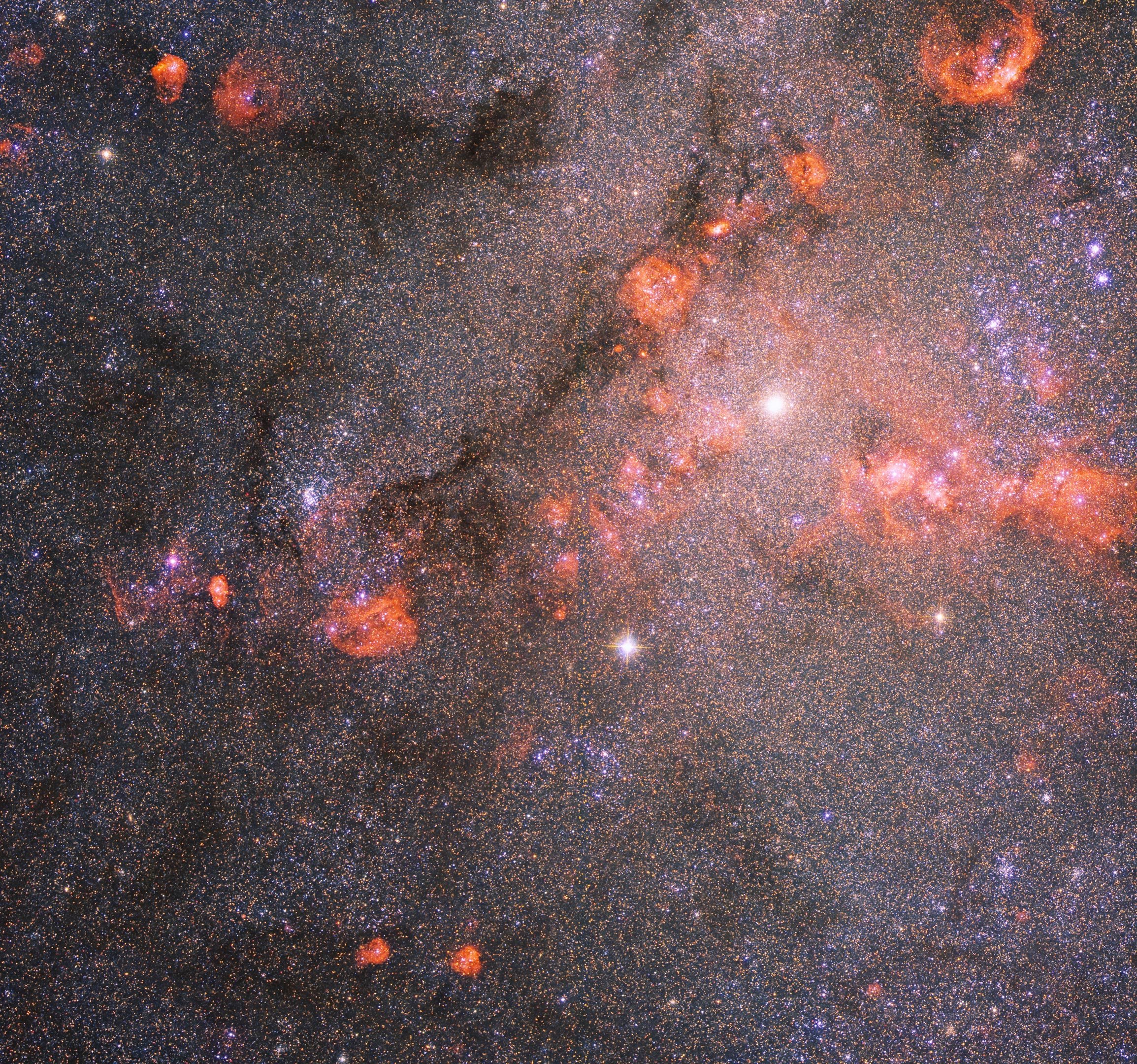
The Hubble Space Telescope provides a stunning view into the heart of the Triangulum Galaxy (M33), revealing its vibrant star formation process and unique structural features.
Despite being smaller than the Milky Way and lacking a central bulge or supermassive black hole, M33 is a prolific star factory, producing stars at ten times the rate of the neighboring Andromeda galaxy. The image showcases reddish ionized hydrogen and dark dust lanes, highlighting the galaxy’s status as one of the few where individual stars can be resolved. M33’s future holds potential drama as it might collide with the Milky Way and Andromeda.
Messier 33 – The Triangulum Galaxy
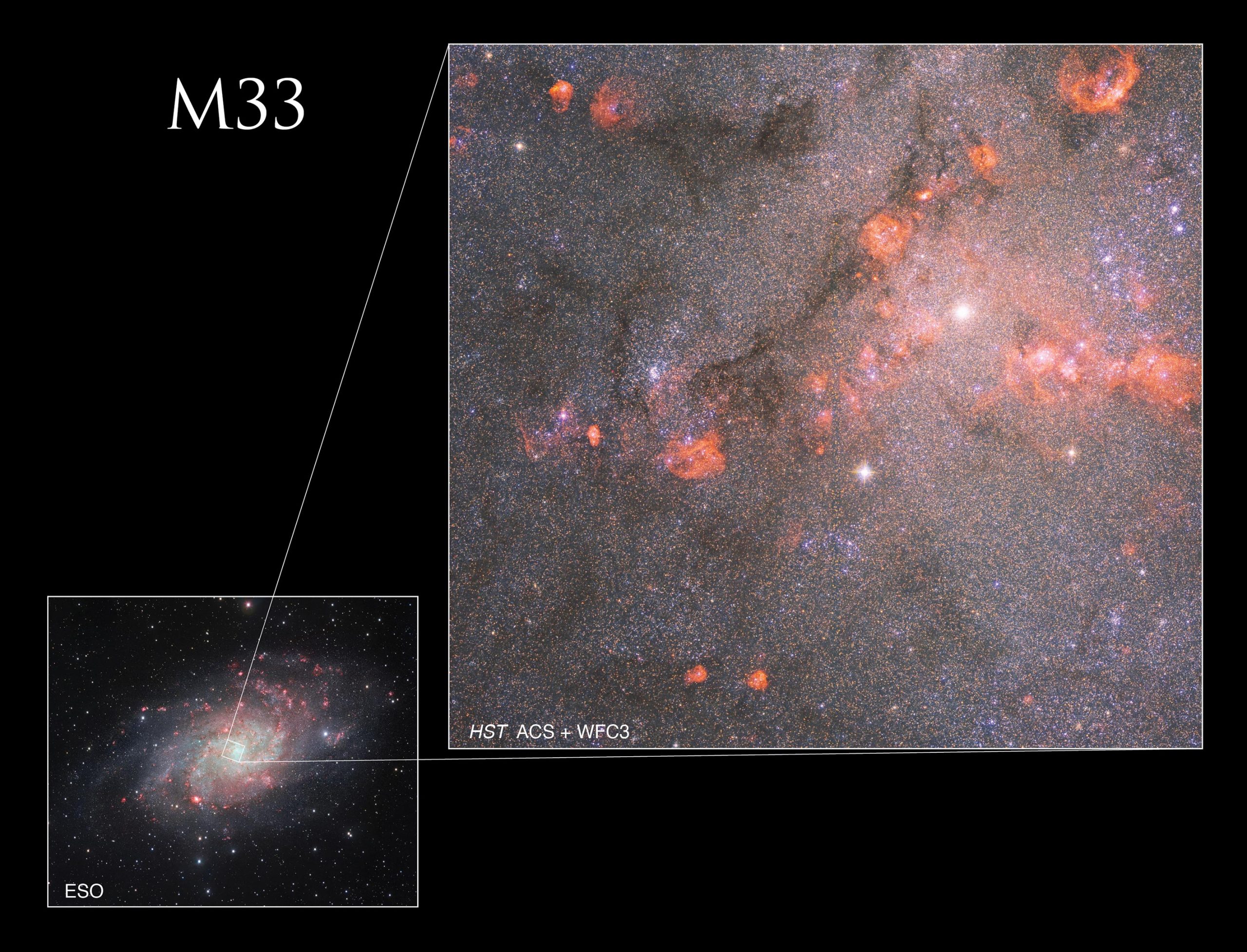
This view from NASA’s Hubble Space Telescope plunges into the center of spiral galaxy Messier 33 (M33), also known as the Triangulum Galaxy.
Located within the triangle-shaped constellation Triangulum and about half the size of our Milky Way galaxy, M33 is the third-largest member of our Local Group of galaxies after the Andromeda galaxy (M31) and the Milky Way.
Star Formation in M33
M33 is known to be a hotbed of starbirth, forming stars at a rate 10 times higher than the average of its neighbor, the Andromeda galaxy. Interestingly, M33’s neat, organized spiral arms indicate little interaction with other galaxies, so its rapid starbirth is not fueled by galactic collision, as in many other galaxies. The galaxy contains plenty of dust and gas for churning out stars, and numerous ionized hydrogen clouds, also called H-II regions, that give rise to tremendous star formation. Researchers have offered evidence that high-mass stars are forming in collisions between massive molecular clouds within M33.
This image captures reddish clouds of ionized hydrogen interspersed with dark lanes of dust. The apparent graininess of the image is actually swarms of countless stars. M33 is one of less than 100 galaxies close enough for telescopes like Hubble to resolve individual stars, as evident here.
Unique Structural Features of M33
M33 is known to lack a central bulge, and there is no evidence of a supermassive black hole at its core ― strange since most spirals have a central bulge made up of densely concentrated stars and most large galaxies have supermassive black holes at their centers. Galaxies with this type of structure are called “pure disk galaxies,” and studies suggest they make up around 15-18 percent of galaxies in the universe.
M33 may lose its streamlined appearance and undisturbed status in a dramatic fashion ― it’s on a possible collision course with both the Andromeda galaxy and the Milky Way. This image was taken as part of a survey of M33 in an effort to help refine theories about such topics as the physics of the interstellar medium, star-formation processes, and stellar evolution.
Never miss a breakthrough: Join the SciTechDaily newsletter.
Follow us on Google and Google News.
2 Comments
M33 is known to lack a central bulge, and there is no evidence of a supermassive black hole at its core ― strange since most spirals have a central bulge made up of densely concentrated stars and most large galaxies have supermassive black holes at their centers. Galaxies with this type of structure are called “pure disk galaxies,” and studies suggest they make up around 15-18 percent of galaxies in the universe.
VERY GOOG!
Many strange things are actually not strange.
Scientific research guided by correct theories can help humanity avoid detours, failures, and pomposity. Please witness the exemplary collaboration between theoretical physicists and experimentalists (https://scitechdaily.com/microscope-spacecrafts-most-precise-test-of-key-component-of-the-theory-of-general-relativity/#comment-854286). Some people in contemporary physics has always lived in a self righteous children’s story world. Whose values have been overturned by such a comical and ridiculous reality?
Space has physical properties of zero viscosity and absolute incompressibility. Zero viscosity and absolute incompressibility are physical characteristics of ideal fluids. The space with ideal fluid physical characteristics forms vortices via topological phase transitions, which is not difficult to understand mathematically. Once the topological vortex is formed, it occupies space and maintains its presence in time. This is the transition from chaos to order via two bidirectional coupled continuous chaotic systems.
From cosmic accretion disks to particle spins, topological vortex fractal structures are ubiquitous. Symmetry of topological vortex can be used to explore particle behavior under spatial, temporal, and quantum reversals, involving gravitation, discrete and continuous changes. It underpins the consistency of natural laws and experiment reproducibility.
The physical phenomena observed in scientific experiments are always just appearances, not the natural essence of things. The natural essence of things needs to be extracted and sublimated based on natural phenomena via mathematical theories. Mathematics is the main environment for modeling problems in other areas. Observations and experiments, theory, and modeling reinforce each other and together lead to our understanding of physical phenomena. After understanding and mastering the natural essence of things, humans can predict more possible natural phenomena, and even manipulate and implement them.
Low dimensional spacetime matter is the substructure of high-dimensional spacetime matter. Topological vortices and their antivortices have identical spatiotemporal structures. The synchronous effect of countless topological vortex fractal structures makes spatiotemporal motion more complex. Symmetry is mainly manifested between topological vortices and their anticyclones, rather than between the high-dimensional spacetime matter formed by their interactions. In theory, it is difficult for two disk galaxies, two planets or stars, even two molecules or atoms, and any observable high-dimensional spacetime objects to be absolutely identical or symmetrical.