
Close Menu
    Facebook X (Twitter) Instagram
    SciTechDaily
    • Biology
    • Chemistry
    • Earth
    • Health
    • Physics
    • Science
    • Space
    • Technology
    Facebook X (Twitter) Pinterest YouTube RSS
    SciTechDaily
    Home»Space»Look Up! Catch a Glimpse of NASA’s Giant Solar Sail Gliding Above
    Space

    Look Up! Catch a Glimpse of NASA’s Giant Solar Sail Gliding Above

    By NASA Ames Research CenterAugust 31, 20242 Comments2 Mins Read
    Facebook Twitter Pinterest Telegram LinkedIn WhatsApp Email Reddit
    Share
    Facebook Twitter LinkedIn Pinterest Telegram Email Reddit
    Advanced Composite Solar Sail System Spacecraft
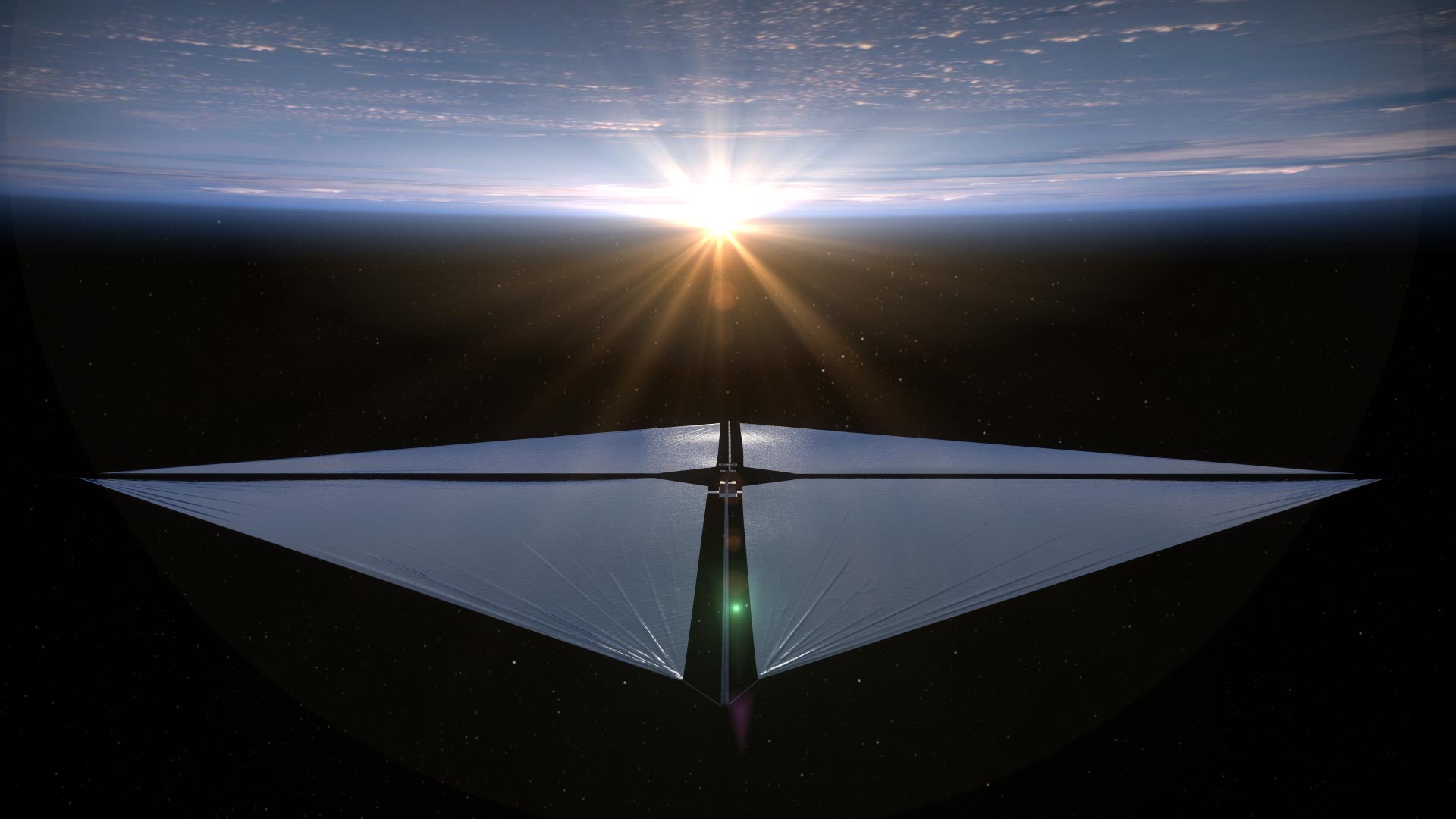
    An artist’s concept of NASA’s Advanced Composite Solar Sail System spacecraft in orbit as the Sun crests Earth’s horizon. Credit: NASA/Aero Animation/Ben Schweighart

    NASA’s Advanced Composite Solar Sail System has achieved full deployment in space, marking a significant milestone with its sail-hoisting boom system now operational.

    High-resolution images of the reflective sail and supporting composite booms, captured by onboard cameras, will soon be released, enhancing our understanding of solar sail mechanics. In the coming weeks, NASA will explore the sail’s maneuverability, potentially revolutionizing solar sail-equipped missions for science and exploration by adjusting the spacecraft’s orbit.

    Successful Deployment of NASA’s Solar Sail

    NASA’s Advanced Composite Solar Sail System is now fully deployed in space after a successful test of its sail-hoisting boom system. Mission operators confirmed success at 1:33 p.m. EDT (10:33 a.m. PDT) on Thursday, August 29, after receiving data from the spacecraft. Centrally located aboard the spacecraft are four cameras that captured a panoramic view of the reflective sail and supporting composite booms. High-resolution imagery from these cameras will be available on Wednesday, September 4.

    Testing and Future Applications

    During the next few weeks, the team will test the maneuvering capabilities of the sail in space. Raising and lowering the orbit of the Advanced Composite Solar Sail System spacecraft will provide valuable information that may help guide future concepts of operations and designs for solar sail-equipped science and exploration missions.

    Observational Opportunities

    The Advanced Composite Solar Sail System spacecraft orbits Earth at approximately twice the altitude of the International Space Station. From above, the sail will appear as a square, with an area of approximately 860 square feet (80 square meters) – about half the size of a tennis court. Now, with the sail fully extended, the Solar Sail System may be visible to some keen skywatchers on Earth who look up at the right time.

    Never miss a breakthrough: Join the SciTechDaily newsletter.
    Follow us on Google and Google News.

    Ames Research Center NASA Popular Solar Sail
    Share. Facebook Twitter Pinterest LinkedIn Email Reddit

    Related Articles

    Tumbling in Orbit: NASA’s Test of Advanced Solar Sail Technology Encounters Early Challenges

    Liftoff! NASA’s Next-Generation Solar Sail Boom Technology Launched

    Origin of Saturn’s Rings: Massive Collision Between Icy Moons During the Time of the Dinosaurs?

    Autonomous Invasion: NASA’s Starling Mission Sending Swarm of Satellites Into Orbit

    Swarm Intelligence in Space: NASA’s Starling CubeSats Ready To Test Critical Technology

    Moon’s Hidden Treasure: Lunar Water Map Unveiled by Pioneering Study

    Moon Mountain Named in Honor of NASA Mathematician and Computer Programmer

    After 15 Years and 1,000 Tests – Is Orion’s Heat Shield Ready To Take the Heat?

    Innovative Diffractive Solar Sail Funded by NASA Could Take Science to Exciting New Destinations

    2 Comments

    1. Priscilla Wood on August 31, 2024 12:43 pm

      Great photos. I’ve enjoyed learning about outer space since my childhood–80 years ago. We’ve come a long way.

      Reply
      • Darren on September 2, 2024 8:23 pm

        agreed, the advancement of space technology has kept me wanting to know more…🫂

        Reply
    Leave A Reply Cancel Reply

    • Facebook
    • Twitter
    • Pinterest
    • YouTube

    Don't Miss a Discovery

    Subscribe for the Latest in Science & Tech!

    Trending News

    The Universe Is Expanding Too Fast and Scientists Can’t Explain Why

    “Like Liquid Metal”: Scientists Create Strange Shape-Shifting Material

    Early Warning Signals of Esophageal Cancer May Be Hiding in Plain Sight

    Common Blood Pressure Drug Shows Surprising Power Against Deadly Antibiotic-Resistant Superbug

    Scientists Uncover Dangerous Connection Between Serotonin and Heart Valve Disease

    Scientists Discover a “Protector” Protein That Could Help Reverse Hair Loss

    Bone-Strengthening Discovery Could Reverse Osteoporosis

    Scientists Uncover Hidden Trigger Behind Stem Cell Aging

    Follow SciTechDaily
    • Facebook
    • Twitter
    • YouTube
    • Pinterest
    • Newsletter
    • RSS
    SciTech News
    • Biology News
    • Chemistry News
    • Earth News
    • Health News
    • Physics News
    • Science News
    • Space News
    • Technology News
    Recent Posts
    • Scientists Crack Alfalfa’s Chromosome Mystery After Decades of Debate
    • Ancient Ant-Plant Alliance Collapses As Predatory Wasps Move In
    • Scientists Discover Tiny New Spider That Hunts Prey 6x Its Size
    • Natural Component From Licorice Shows Promise for Treating Inflammatory Bowel Disease
    • New Research Finds Shocking Link Between Chili Peppers and Cancer
    Copyright © 1998 - 2026 SciTechDaily. All Rights Reserved.
    • Science News
    • About
    • Contact
    • Editorial Board
    • Privacy Policy
    • Terms of Use

    Type above and press Enter to search. Press Esc to cancel.