
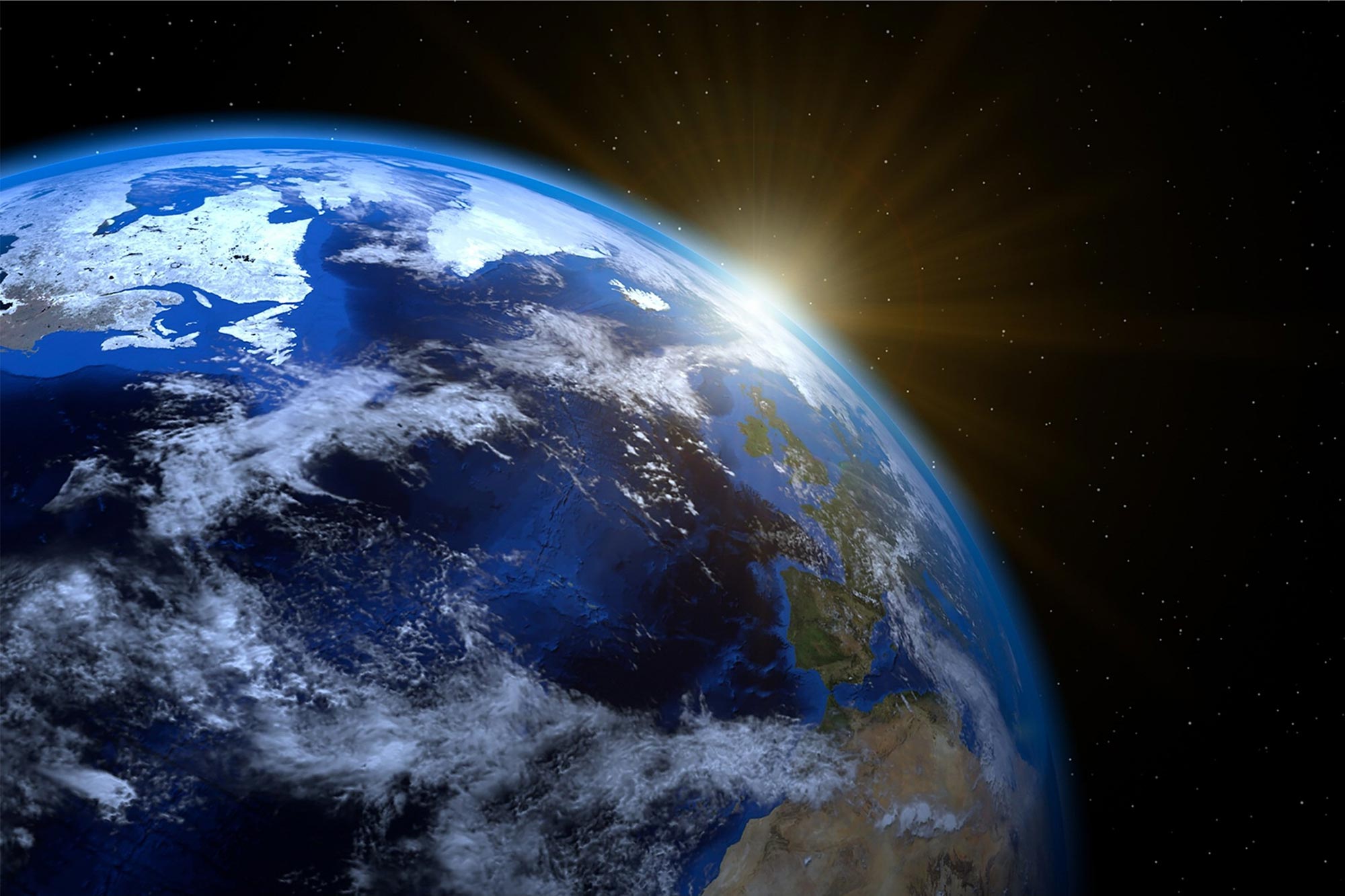
University of Groningen scientist Klaus Hubacek investigates planetary boundaries.
With a global population of eight billion, humanity places immense demands on the Earth’s resources, often in unsustainable ways. Klaus Hubacek, a Professor of Science, Technology, and Society at the University of Groningen in the Netherlands, evaluates this critical challenge. How much land, water, and other resources are consumed to support our lifestyles? And what adjustments are necessary to ensure we live within the Earth’s ecological limits? Hubacek demonstrates that achieving sustainability is possible, but it hinges on implementing policies grounded in scientific evidence.
Our consumption patterns affect the environment, that much we know. A clear example is the concentration of carbon dioxide in the atmosphere. It has been rising at an increasingly faster rate since the 1960s, resulting in global warming, along with all its dire consequences.
There is a limit to the amount of consumption the Earth can support, and in 2009, scientists defined nine ‘planetary boundaries’ as indicators of when we have reached that limit. Crossing them may lead to irreversible damage to the Earth’s stability and resilience. These planetary boundaries include indicators such as ocean acidification and the global use of fresh water. In 2023, six of these planetary boundaries had already been crossed.

Hubacek has devoted his academic career to studying how humanity is performing in terms of these planetary boundaries, and what needs to change to prevent us from crossing them even further. According to him, “The basic calculation is: given a certain number of people on the planet and the planetary boundaries, how much can we consume to stay inside these limits?”
The divide between rich and poor
At the moment, the richest one percent of the world’s population produces 50 times more greenhouse gasses than the four billion people in the bottom 50 percent. The divide between the rich and the poor on this planet is a common thread in Hubacek’s work. He is one of the authors of a paper, published in the journal Nature on November 13, that describes this issue. Using an extensive dataset covering up to 201 consumption groups across 168 countries, the paper analyses the impact of spending patterns on six key environmental indicators.

The analysis reveals how different consumer behaviors contribute to planetary transgressions, and concludes that if the world’s top 20 percent of consumers shifted their consumption habits toward more sustainable patterns found within their group, they could reduce their environmental impact by 25 to 53 percent. The study also shows that changing consumption patterns in just the food and services sectors could help bring critical planetary boundaries back within safe limits.
Changing our lifestyle to stay within the boundaries
In previous papers, Hubacek researched specific solutions that could help us balance our lives to better deal with the planetary boundaries. In a study published last August, he showed that if a diet with less red meat and more legumes and nuts was adopted by the richest part of the world, food-driven emissions would fall by 17 percent, even when the inhabitants of poorer nations increase their meat consumption.
And just last month, Hubacek co-authored a paper describing how the livestock sector is dangerously transgressing several of the planetary boundaries. The paper argues that any measures to counter this negative effect should be ’region-specific’: “Obviously, there will be differences. A plant-based diet is not suitable for traditional Mongolian nomads, who depend on yaks and their milk.”
Hubacek keeps pointing to solutions when he identifies transgressions of planetary boundaries. “However, we shouldn’t focus so much on creating new technical solutions, as there are already so many solutions which we don’t implement,” he argues. “And most governments subsidize bad behavior.” For example, subsidies for fossil fuels globally are overcompensating for the mitigation effect that we achieve through carbon pricing such as carbon taxes and carbon trading schemes. “And there are also many inconsistent policies, such as stimulating the use of heat pumps and, at the same time, raising the price of the electricity they use.”
It is possible
What Hubacek shows is that not all hope is lost: humanity can stay within the planetary boundaries. But it seems that there is little political will to tackle issues such as climate change. Hubacek: “This worries me. And it causes real fear in the younger generation.” Hubacek underlines that his science is not activism-driven. “I’m doing this work first and foremost because of my academic interest. But I also don’t want to waste my time on something that is meaningless. What we need are evidence-based policies.”
Reference: “Keeping the global consumption within the planetary boundaries” by Peipei Tian, Honglin Zhong, Xiangjie Chen, Kuishuang Feng, Laixiang Sun, Ning Zhang, Xuan Shao, Yu Liu and Klaus Hubacek, 13 November 2024, Nature.
DOI: 10.1038/s41586-024-08154-w
Never miss a breakthrough: Join the SciTechDaily newsletter.
Follow us on Google and Google News.
8 Comments
The global population is starting the decline, so I’m not all that worried.
“A clear example is the concentration of carbon dioxide in the atmosphere. It has been rising at an increasingly faster rate since the 1960s, …”
Actually, it has been very close to linear since about 2005! What caused the plateaus about 1974 (actual decline), 1993, and 2000?
https://climate.nasa.gov/internal_resources/1914/
“Hubacek demonstrates that achieving sustainability is possible, but it hinges on implementing policies grounded in scientific evidence.”
How? Through a ‘scientifically’ planned and enforced economy such as has been tried by Russia and China? Once the politician are given that much power, it will be very difficult to take it back, even after they have failed, yet again.
“…, if the world’s top 20 percent of consumers shifted their consumption habits toward more sustainable patterns …, they could reduce their environmental impact by 25 to 53 percent.”
And what is next if the population grows by 10% (20% x 50%). Will the demand be to shift consumption habits to the top 30 or 40%, or reduce the impact by more than 50%? Or will the next demand be to have everyone live on the same fixed income (except those in power, of course.)?
“…, Hubacek co-authored a paper describing how the livestock sector is dangerously transgressing several of the planetary boundaries.”
The number of beef cattle have ranged between about 29 and 34 million head in July, between 2003 and 2023, according to the USDA. US Wheat production has been essentially flat since 2017, with an uptrend the last 3 years. Where is the evidence of impending disaster from ‘planetary boundary transgression?’
How ’bout possibly criminal public scare mongering “Are We on the Brink of Environmental Collapse?”- All life on earth grew into robust stability with CO2 concentrations of 0.2%.
If we were reduce atmospheric carbon by half the present 0.04% – all plant life would die away.
You people enjoy incomes for passing ‘climate crisis’ – but we’re teetering on catastrophically low carbon levels. Plants breathe carbon exactly as you breathe Oxygen.
But no sense in opening your eyes. Not when you’re all swept right along; and the money’s good – right?
Sorry for the blunt message.
reducing CO2 by 50% is an incredibly huge reduction. No one considers the need to reduce CO2 by THAT much, maybe 4-7%. Watch your math!
“It causes real fear in the younger generation.” Only because climate alarmists, in combination with public schools, feel compelled to indoctrinate children with problems that they are neither to blame for, nor can they do much of anything to fix. How about teaching only age appropriate problems that children are equipped to address: Shut off unused lights, recycle, don’t waste things? I know that goes directly against the current dogma of getting to them early and indoctrinating them with the latest social fads.