
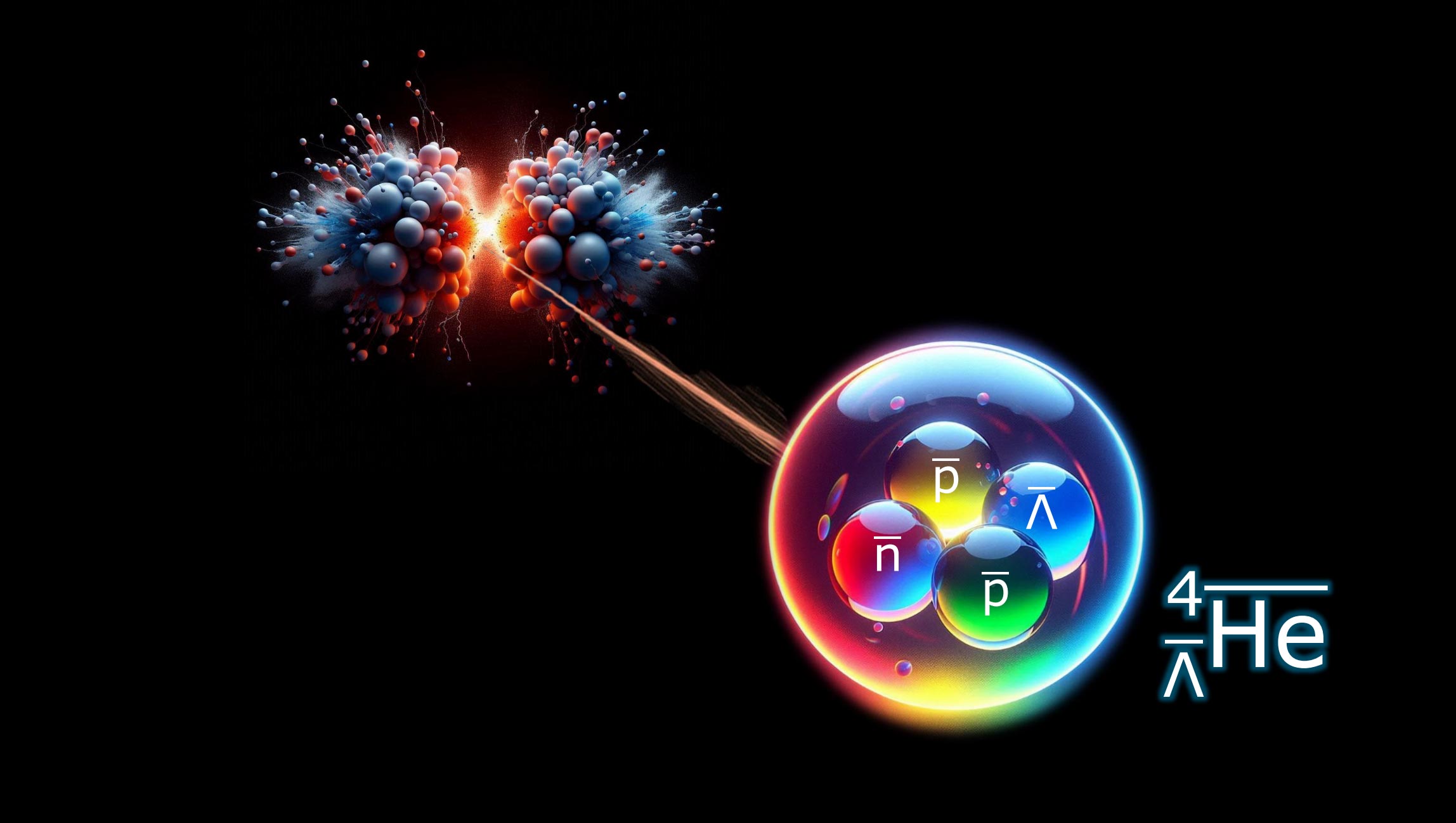
Heavy ion collisions at the Large Hadron Collider generate conditions conducive to the formation of hypernuclei and their antimatter versions, providing insight into the early universe.
Recent detections of antihyperhelium-4 have validated statistical hadronization models, enhancing knowledge in the field of particle physics.
Quark-Gluon Plasma and Hypernuclei Creation
Collisions between heavy ions at the Large Hadron Collider (LHC) produce quark-gluon plasma, an extremely hot and dense form of matter that existed just one-millionth of a second after the Big Bang. These collisions also create conditions ideal for forming atomic nuclei and exotic hypernuclei, along with their antimatter counterparts, antinuclei and antihypernuclei. Studying these particles helps scientists better understand how hadrons form from quarks and gluons and provides insights into the Universe’s present-day matter-antimatter asymmetry.
Hypernuclei are exotic atomic nuclei made of protons, neutrons, and hyperons—unstable particles containing at least one strange quark. Although first detected in cosmic rays over 70 years ago, hypernuclei continue to intrigue physicists due to their rarity in nature and the difficulty of producing and studying them in laboratory settings.
Recent Advances in Antihypernuclei Observations
In heavy-ion collisions, hypernuclei are created in significant quantities, but until recently only the lightest hypernucleus, hypertriton, and its antimatter partner, antihypertriton, have been observed. A hypertriton is composed of a proton, a neutron and a lambda (a hyperon containing one strange quark). An antihypertriton is made up of an antiproton, an antineutron and an antilambda.
Following hot on the heels of an observation of antihyperhydrogen-4 (a bound state of an antiproton, two antineutrons and an antilambda), reported earlier this year by the STAR collaboration at the Relativistic Heavy Ion Collider (RHIC), the ALICE collaboration at the LHC has now seen the first ever evidence of antihyperhelium-4, which is composed of twoantiprotons, an antineutron and an antilambda. The result has a significance of 3.5 standard deviations and also represents the first evidence of the heaviest antimatter hypernucleus yet at the LHC.
Breakthroughs in Antihyperhelium-4 Detection
The ALICE measurement is based on lead–lead collision data taken in 2018 at an energy of 5.02 teraelectronvolts (TeV) for each colliding pair of nucleons (protons and neutrons). Using a machine-learning technique that outperforms conventional hypernuclei search techniques, the ALICE researchers looked at the data for signals of hyperhydrogen-4, hyperhelium-4 and their antimatter partners. Candidates for (anti)hyperhydrogen-4 were identified by looking for the (anti)helium-4 nucleus and the charged pion into which it decays, whereas candidates for (anti)hyperhelium-4 were identified via its decay into an (anti)helium-3 nucleus, an (anti)proton and a charged pion.
In addition to finding evidence of antihyperhelium-4 with a significance of 3.5 standard deviations, as well as evidence of antihyperhydrogen-4 with a significance of 4.5 standard deviations, the ALICE team measured the production yields and masses of both hypernuclei.
Confirming Models of Hypernuclei Production
For both hypernuclei, the measured masses are compatible with the current world-average values. The measured production yields were compared with predictions from the statistical hadronization model, which provides a good description of the formation of hadrons and nuclei in heavy-ion collisions. This comparison shows that the model’s predictions agree closely with the data if both excited hypernuclear states and ground states are included in the predictions. The results confirm that the statistical hadronization model can also provide a good description of the production of hypernuclei, which are compact objects with sizes of around 2 femtometers (1 femtometer is 10-15 meters).
The researchers also determined the antiparticle-to-particle yield ratios for both hypernuclei and found that they agree with unity within the experimental uncertainties. This agreement is consistent with ALICE’s observation of the equal production of matter and antimatter at LHC energies and adds to the ongoing research into the matter–antimatter imbalance in the Universe.
Never miss a breakthrough: Join the SciTechDaily newsletter.
Follow us on Google and Google News.
3 Comments
Heavy ion collisions at the Large Hadron Collider generate conditions conducive to the formation of hypernuclei and their antimatter versions, providing insight into the early universe.
GOOD.
Ask the researchers:
1. What are the distinctions in the space-time structure between matter and antimatter?
2. What methods are employed to differentiate between hypernuclei and their antimatter?
3. Can you confirm that all debris resulting from each collision has been thoroughly observed?
4. How do you interpret the concepts of chance and necessity within the framework of physics?
Scientific research guided by correct theories can help people avoid detours, failures, and exaggeration. The physical phenomena observed by researchers in experiments are always appearances, never the natural essence of things. The natural essence of things needs to be extracted and sublimated based on mathematical theories via appearances , rather than being imagined arbitrarily.
For example:
The mathematics had clearly told us that the topological vortex gravitational field can evolve into a complex space-time structure from the cusp singularity. From accretion disks to quantum spins, countless facts show that the interaction and balance of topological vortex gravitational fields are indispensable in the formation and evolution of cosmic matter.
However, contemporary physics has always regarded understanding as muddle headed and been blindly inferring from unfounded assumptions. Wrong world outlook and scientific outlook may mislead a generation, even several generations.
Topological vortex and its twin anti-vortex exhibit parity conservation (P), charge conjugation (C) and time reversal (T) symmetry. The physical real mirror image of nature can be exist between the topological vortex and its twin anti-vortex, not must be between the high-dimensional space-time matters formed by their interaction.
It is meaningless to discuss the CP of two particles (or things) that are not mirror images of each other. This type of discussion is full of deception and misleading. Its absurd aspect lies in:
1. Firstly, subjectively determine that two particles (or things) are mirror images of each other.
2. Subsequently, experimental detection revealed that the two particles (or things) are asymmetric.
The experiment showed that the previous subjective determination was incorrect. According to common sense, it should be concluded that the two particles (or things) are not mirror images of each other.
However, physical science today does not do so. Their conclusion is:
The two particles (or things) that are mirror images of each other are asymmetric.
This blatant sophistry and misleading behavior is undoubtedly lacks the spirit of science.
— –Extracted from https://scitechdaily.com/microscope-spacecrafts-most-precise-test-of-key-component-of-the-theory-of-general-relativity/#comment-811427.
Lemme tell ya what’s wrong with human beings: We all sit there, without a thought in our head – when suddenly we get an idea, whether someone said so or we just figured it out, it’s our idea so we internalize it, we use our own mind, which builds cybernetic, actual locked in physical brain mechanisms that we understand as your own knowledge, like “2 + 2” – and before we even finish the sentence we stop thinking (which stops mental advancement ) and start into a tunnel vision on details – even though that first epiphany was just a beginners thought, we stop right there and start a long road of mental atrophy cock sure we know – when we don’t. We are all smart to see it if we just pulled back and thought for two seconds, but we don’t.
You can make all the nuclei models – trying to perfect a profoundly flawed, in fact, inane model all ya want. Everybody knew, because everybody knew that the sun goes around the earth – until Galileo. But then – the illusion got popped. Pop!
VERY GOOD!!!