
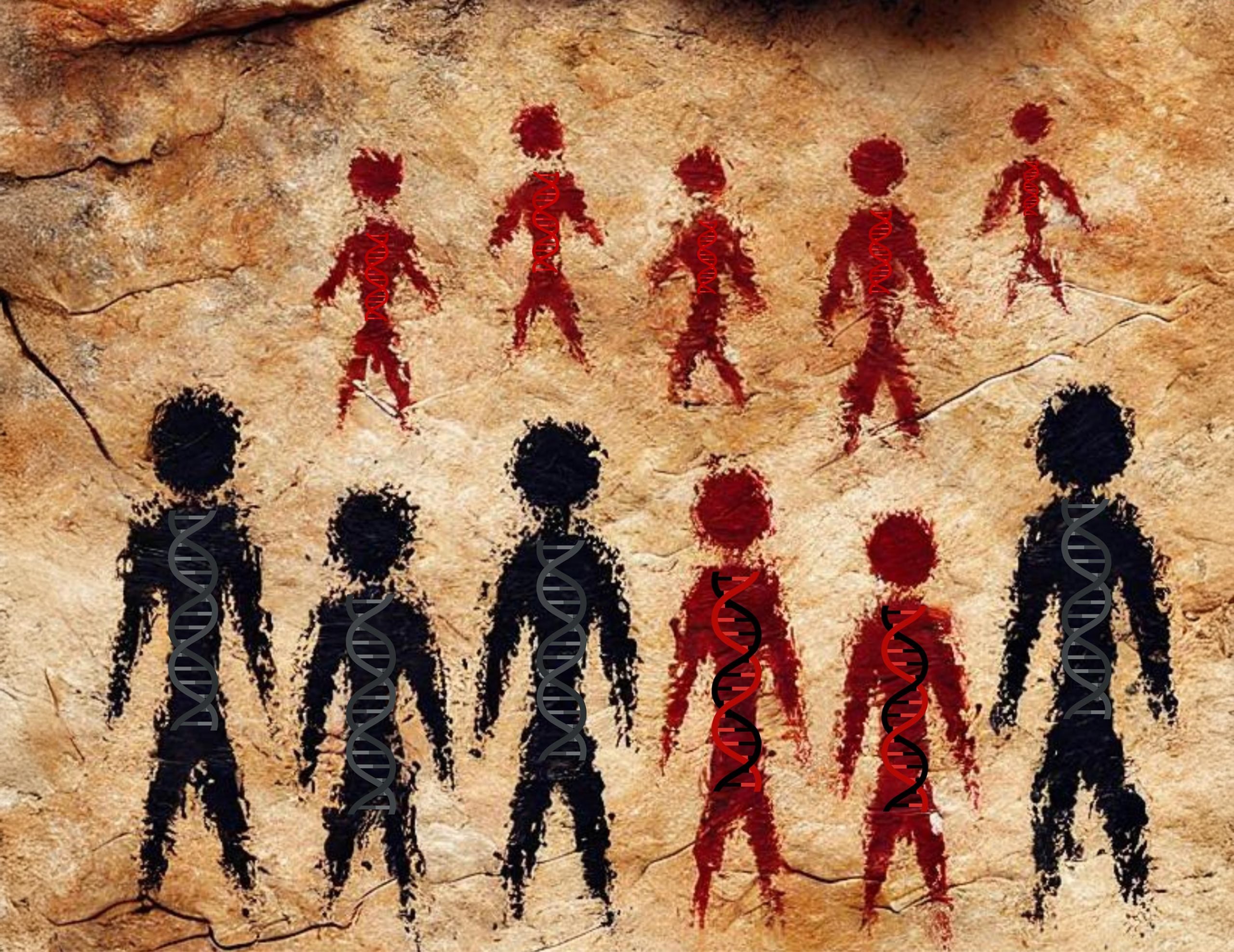
Surviving Neanderthal genes in the modern genome tell a story of thousands of years of interactions.
Recent DNA studies have refined the period when Neanderthals and modern humans interbred to a span of about 7,000 years, leaving Eurasians with significant Neanderthal genetic contributions. These findings also help clarify the timeline and routes of ancient human migrations from Africa.
Genetic Insights into Ancient Human-Neanderthal Interactions
A new analysis of DNA from ancient modern humans (Homo sapiens) in Europe and Asia has determined, more precisely than ever, the time period during which Neanderthals interbred with modern humans, starting about 50,500 years ago and lasting about 7,000 years — until Neanderthals began to disappear.
That interbreeding left Eurasians with many genes inherited from our Neanderthal ancestors, which in total make up between 1% and 2% of our genomes today.
A more precise timeline for modern human interactions with Neanderthals can help scientists understand when humans emigrated out of Africa and peopled the globe, while understanding the DNA that Neanderthals shared with our ancestors provides information on the role Neanderthal genes play in human health.
Archaeological and Genetic Corroboration
The genome-based estimate is consistent with archeological evidence that modern humans and Neanderthals lived side-by-side in Eurasia for between 6,000 and 7,000 years. The analysis, which involved present-day human genomes as well as 58 ancient genomes sequenced from DNA found in modern human bones from around Eurasia, found an average date for Neanderthal-Homo sapiens interbreeding of about 47,000 years ago. Previous estimates for the time of interbreeding ranged from 54,000 to 41,000 years ago.
The new dates also imply that the initial migration of modern humans from Africa into Eurasia was basically over 43,500 years ago.
“This allowed us to build a more complete picture of the past”
Manjusha Chintalapati
Key Findings and Evolutionary Implications
“The timing is really important because it has direct implications on our understanding of the timing of the out-of-Africa migration, as most non-Africans today inherit 1-2% ancestry from Neanderthals,” said Priya Moorjani, an assistant professor of molecular and cell biology at the University of California, Berkeley, and one of two senior authors of the study. “It also has implications for understanding the settlement of the regions outside Africa, which is typically done by looking at archeological materials or fossils in different regions of the world.”
The genome analysis, also led by Benjamin Peter of the University of Rochester in New York and the Max Planck Institute for Evolutionary Anthropology (MPI-EVA) in Leipzig, Germany, will be published in the Dec. 13 print issue of the journal Science. The two lead authors are Leonardo Iasi, a graduate student at MPI-EVA, and Manjusha Chintalapati, a former UC Berkeley postdoctoral fellow now at the company Ancestry DNA.

The longer duration of gene flow may help explain, for example, why East Asians have about 20% more Neanderthal genes than Europeans and West Asians. If modern humans moved eastward about 47,000 years ago, as archeological sites suggest, they would already have had intermixed Neanderthal genes.
“We show that the period of mixing was quite complex and may have taken a long time. Different groups could have separated during the 6,000- to 7,000-year period, and some groups may have continued mixing for a longer period of time,” Peter said. “But a single shared period of gene flow fits the data best.”
“One of the main findings is the precise estimate of the timing of Neanderthal admixture, which was previously estimated using single ancient samples or samples from present-day individuals. Nobody had tried to model all of the ancient samples together,” Chintalapati said. “This allowed us to build a more complete picture of the past.”
Analyzing Neanderthal Genes in Modern Humans
In 2016, Moorjani pioneered a method for inferring the timing of Neanderthal gene flow using often incomplete genomes of ancient individuals. At that time, only five archaic Homo sapiens genomes were available.
For the new study, Iasi, Chintalapati, and their colleagues employed this technique with 58 previously sequenced genomes of ancient Homo sapiens who lived in Europe, Western and Central Asia over the past 45,000 years and the genomes of 275 contemporary humans worldwide to provide a more precise date — 47,000 years ago.
Rather than assuming the gene flow occurred in a single generation, they tried more complex models developed by Iasi and Peter to establish that the interbreeding extended over about 7,000 years, rather than being intermittent.
Independent Confirmation of Findings
The timing of the interbreeding between Neanderthals and modern humans was corroborated by another, independent study conducted by MPI-EVA researchers and is scheduled to be published Dec. 12 in the journal Nature. That study, an analysis of two newly sequenced genomes of Homo sapiens that lived about 45,000 years ago, also found a date of 47,000 years ago.
“Although the ancient genomes were published in previous studies, they had not been analyzed to look at Neanderthal ancestry in this detailed way. We created a catalog of Neanderthal ancestry segments in modern humans. By jointly analyzing all these samples together, we inferred the period of gene flow was around 7,000 years,” Chintalapati said. “The Max Planck group actually sequenced new ancient DNA samples that allowed them to date the Neanderthal gene flow directly. And they came up with a similar timing as us.”
The Emergence of Neanderthal Deserts
The UC Berkeley/MPI-EVA team also analyzed regions of the modern human genome that contain genes inherited from Neanderthals and some areas that are totally devoid of Neanderthal genes. They found that areas lacking any Neanderthal genes, so-called archaic or Neanderthal deserts, developed quickly after the two groups interbred, suggesting that some Neanderthal gene variants in those areas of the genome must have been lethal to modern humans.
Early modern human samples that are older than 40,000 years already contained these deserts in their genomes.
“We find that very early modern humans from 40,000 years ago don’t have any ancestry in the deserts, so these deserts may have formed very rapidly after the gene flow,” said Iasi. “We also looked at the changes in Neanderthal ancestry frequency over time and across the genome and found regions that are present at high frequency, possibly because they carry beneficial variants that were introgressed from Neanderthals.”
Adaptive Benefits of Neanderthal Genes
Most of the high-frequency Neanderthal genes are related to immune function, skin pigmentation, and metabolism, as reported in some previous studies. One immune gene variant inherited from Neanderthals confers protective effects to the coronavirus that causes COVID-19, for example. Some of the Neanderthal genes involved in the immune system and skin pigmentation actually increased in frequency in Homo sapiens over time, implying that they may have been advantageous to human survival.
“Neanderthals were living outside Africa in harsh, ice age climates and were adapted to the climate and to the pathogens in these environments. When modern humans left Africa and interbred with Neanderthals, some individuals inherited Neanderthal genes that presumably allowed them to adapt and thrive better in the environment,” Iasi said.
“The fact that we find some of these regions already in 30,000-year-old samples shows that some of these regions were actually adapted immediately after the introgression,” Chintalapati added.
Other genes, such as the gene conferring resistance to coronaviruses, may not have been immediately useful, but became so later on.
“The environment changes, and then some genes become beneficial,” Peter said.
Insights Into Denisovans and East Asian Ancestry
Moorjani is currently looking at Neanderthal sequences in people of East Asian descent, who not only have a greater percentage of Neanderthal genes, but also some genes — up to 0.1% of their genome — from another early hominin group, the Denisovans.
“It’s really cool that we can actually peer into the past and see how variants inherited from our evolutionary cousins, Neanderthals, and Denisovans, changed over time,” Moorjani said. “This allows us to understand the dynamics of the mixture of Neanderthals and modern humans.”
Reference: “Neanderthal ancestry through time: Insights from genomes of ancient and present-day humans” by Leonardo N. M. Iasi, Manjusha Chintalapati, Laurits Skov, Alba Bossoms Mesa, Mateja Hajdinjak, Benjamin M. Peter and Priya Moorjani, 13 December 2024, Science.
DOI: 10.1126/science.adq3010
Other co-authors of the Science paper were postdoctoral fellow Laurits Skov of UC Berkeley and Alba Bossoms Mesa and Mateja Hajdinjak of MPI-EVA. Moorjani’s research was supported by the Burroughs Wellcome Fund and the National Institutes of Health (R35GM142978).
Never miss a breakthrough: Join the SciTechDaily newsletter.
Follow us on Google and Google News.
8 Comments
I question the time lines certain it was further back than what’s suggested
It requires faith to believe it. Neanderthal is not even their race names, they just came up with it. Unless the so called Neanderthals introduced themselves as Neanderthals to theses people who claims on this discoveries. The year 50,500, how they could come up with it?
My goodness, how do you think science works? We call them Neanderthals because that’s the name of the place we found evidence of their existence. There’s no faith required; just an understanding of how DNA sequencing works and how changes in genomic sequences over time provide evidence of interbreeding and how that evidence is consistent with archeological evidence of modern humans and neanderthals existing in the same areas at the same time.
Thanks for the patience to teach these Neanderthals about Neanderthals…
SciTechDaily keeps flip-flopping on this issue. The other day they published a completely opposing narrative.
They are not flip-flopping; there is no narrative; SciTechDaily simply reports on published research. Interested parties may investigate the research–the original research, not a summary article like this one–and if they don’t agree, they can design an experiment to refute these findings. This article explains the evidence that leads this researcher group to conclude that intermixing happened during the defined timeframe. There may be evidence that leads to a different conclusion. Further study would then be required to collect additional evidence and refine conclusions until there is enough consistency for a consensus.
Hello. I recently tried the AI essay writer on https://essayservice.com/ai-essay-writer, and I was really impressed with the results. As a student, I was looking for a tool to help with my essays, and this AI service delivered high-quality content that met my expectations. The essay was well-structured and included thorough research, all while being delivered on time.
All humans are between 99.5% and 99.8% identical, genetically. The slight difference in those estimates is just whether or not you ignore the different numbers of repeated identical gene segments between some people’s genomes.
If some people of European ancestry have 1 or 2% neanderthal genes (or up to 4% in some claims), while other people do not – that would make the people with and without neanderthal genes different species, more different from each other than humans are from chimpanzees and gorillas. This is obviously not true. And as we all know, past claims that Europeans were a different species from humans from other parts of the world led to some profound horrors, so repeating that mistake now is disgusting.
That percentage of neanderthal genes is a percentage of the tiny amount of variable genes in the human genome, not the full genome – so you’re not, for example, 2% neanderthal, you’re 2% of 0.2% neanderthal if you use the 99.8% estimate of our number of identical human genes. That means your total genome would be 0.004% neanderthal. But that doesn’t sound very interesting, and isn’t good clickbait, so all of these studies and articles use the much greater, and very misleading, numbers.
Why is a supposedly scientific publication repeating these false numbers?