

Scientists found an unexpected nuclear energy shift in radioactive lanthanum isotopes, challenging existing models and impacting astrophysical research.
Researchers at the Accelerator Laboratory of the University of Jyväskylä, Finland, have precisely measured the atomic masses of radioactive lanthanum isotopes, revealing an unexpected feature in their nuclear binding energies. This discovery provides crucial data for understanding the formation of elements heavier than iron in the universe and prompts further investigation into the underlying nuclear structure responsible for this anomaly.
Nuclear binding energies of neutron-rich radioactive nuclei play a key role in modeling the origin of heavy elements in the cosmos. Using the Ion Guide Isotope Separation On-Line (IGISOL) facility, the researchers successfully produced short-lived, neutron-rich lanthanum isotopes. Due to their fleeting existence, these isotopes are particularly challenging to study, making the precise mass measurements a significant achievement.
“Thanks to the highly sensitive phase-imaging ion cyclotron resonance technique, masses for six lanthanum isotopes could be determined with a very high precision using the JYFLTRAP Penning trap mass spectrometer. The masses for the two most exotic isotopes, lanthanum-152 and lanthanum-153 were measured for the first time,” says Professor Anu Kankainen from University of Jyväskylä, who led the research as a part of her ERC CoG project MAIDEN.
The phenomenon observed in neutron star collisions
The high-precision mass measurements were utilized to study neutron separation energies of the lanthanum isotopes. The neutron separation energy tells how much energy is required to remove one neutron from the nucleus of a given isotope.
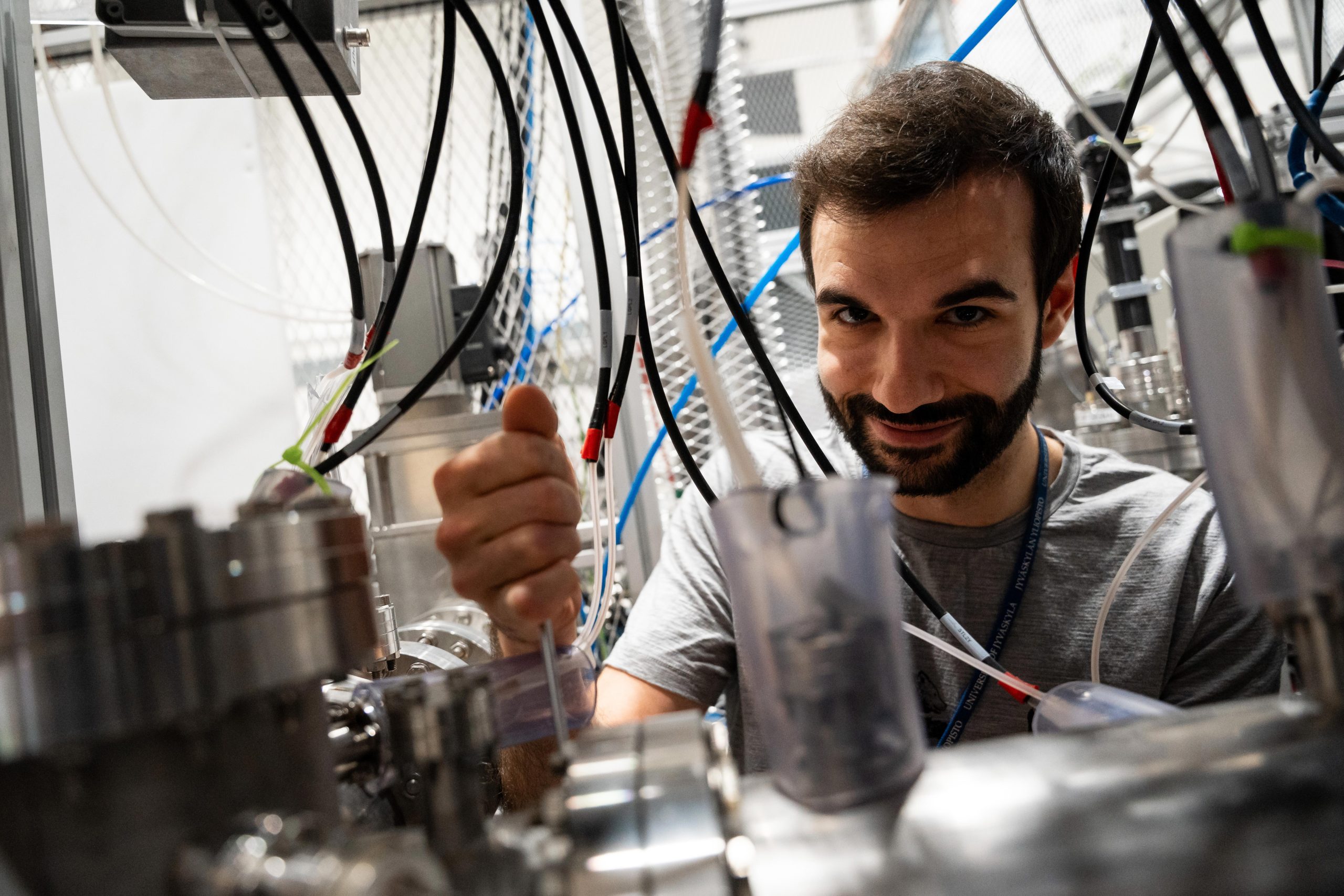
“It gives information on the structure of the nucleus and is an essential input to calculate astrophysical neutron-capture rates for the rapid neutron capture (r) process taking place at least in neutron-star mergers, as evidenced, e.g., by the kilonova observation from the merger GW170817,” explains Kankainen.
An unknown ” bump” showed up on a scientist’s screen
In this work, researchers determined two-neutron separation energies of the lanthanum isotopes and discovered a strong, local increase, a “bump”, in the values, when the number of neutrons increases from 92 to 93. The observed bump is unique and calls for further studies.
“After I did the mass data analysis and calculated the two-neutron separation energies, I was surprised to find this feature. None of the current nuclear mass models can explain it. There are some hints it could be caused by a sudden change in the nuclear structure of these isotopes, but it will require further investigations with complementary methods, such as laser or nuclear spectroscopy,” says a PhD researcher Arthur Jaries from the University of Jyväskylä, who will defend his PhD thesis at the Department of Physics in June.
Theoretical models should be developed
The new precise mass values changed the calculated astrophysical neutron-capture reaction rates up to around 35% and reduced the mass-related uncertainties by up to a factor of 80 in the most extreme cases.
“These improved reaction rates are important to address the formation of the rare-earth abundance peak in the r process. More importantly, the measurements show that the current nuclear mass models used in the astrophysical models fail to predict this feature and will require further developments in the future,” says Kankainen.
Reference: “Prominent Bump in the Two-Neutron Separation Energies of Neutron-Rich Lanthanum Isotopes Revealed by High-Precision Mass Spectrometry” by A. Jaries, M. Stryjczyk, A. Kankainen, T. Eronen, O. Beliuskina, T. Dickel, M. Flayol, Z. Ge, M. Hukkanen, M. Mougeot, S. Nikas, I. Pohjalainen, A. Raggio, M. Reponen, J. Ruotsalainen and V. Virtanen, 27 January 2025, Physical Review Letters.
DOI: 10.1103/PhysRevLett.134.042501
Never miss a breakthrough: Join the SciTechDaily newsletter.
Follow us on Google and Google News.
3 Comments
Scientists found an unexpected nuclear energy shift in radioactive lanthanum isotopes, challenging existing models and impacting astrophysical research.
VERY GOOD.
Ask the scientists:
1. Is the theory you believe in wrong, or is the unexpected nuclear energy shift wrong?
2. Is the unexpected nuclear energy shift because the physical model you believe in is scientific?
What one researcher see or touch about an elephant will be different, and what different researchers see or touch will be even more different. It is a scientific phenomenon, not the essence of nature. Scientific research guided by correct theories can enable researchers to think more.
According to the Topological Vortex Theory (TVT), spins create everything, spins shape the world. There are substantial distinctions between Topological Vortex Theory (TVT) and traditional physical theories. Grounded in the inviscid and absolutely incompressible spaces, TVT introduces the concept of topological phase transitions and employs topological principles to elucidate the formation and evolution of matter in the universe, as well as the impact of interactions between topological vortices and anti-vortices on spacetime dynamics and thermodynamics.
Within TVT, low-dimensional spacetime matter serves as the foundation for high-dimensional spacetime matter, and the hierarchical structure of matter and its interaction mechanisms challenge conventional macroscopic and microscopic interpretations. The conflict between Quantum Physics and Classical Physics can be attributed to their differing focuses: Quantum Physics emphasizes low-dimensional spacetime matter, whereas Classical Physics centers on high-dimensional spacetime matter.
Subatomic particles in the quantum world often defy the familiar rules of the physical world. The fact repeatedly suggests that the familiar rules of the physical world are pseudoscience. In the familiar rules of the physical world, two sets of cobalt-60 can form the mirror image of each other by rotating in opposite directions, and should receive the Nobel Prize for physics.
Please witness the grand performance of some so-called peer review publications (including PRL, PNAS, Nature, Science, etc.). https://scitechdaily.com/microscope-spacecrafts-most-precise-test-of-key-component-of-the-theory-of-general-relativity/#comment-854286. Some so-called academic publications (including PRL, PNAS, Nature, Science, etc.) are addicted to their own small circles and have deviated from science for a long time.
If the researchers are truly interested in science, please read: The Application of Inviscid and Absolutely Incompressible Spaces in Engineering Simulation (https://scitechdaily.com/microscope-spacecrafts-most-precise-test-of-key-component-of-the-theory-of-general-relativity/#comment-870077).
You seem to have an awful lot to say and I think that the operative word is awful lot.
It appears to me that these researchers should consult with you prior to engaging in the research that they plan.
Don’t get me completely wrong you appear to know your stuff but may I suggest making it easier for dumbbells like me to understand and perhaps a little more concise
Thank you for your valuable feedback.
Researchers do not need to consult anyone. Just don’t be fooled by pseudoscientific theories and publications. Scientific research guided by correct theories can enable researchers to think more.