
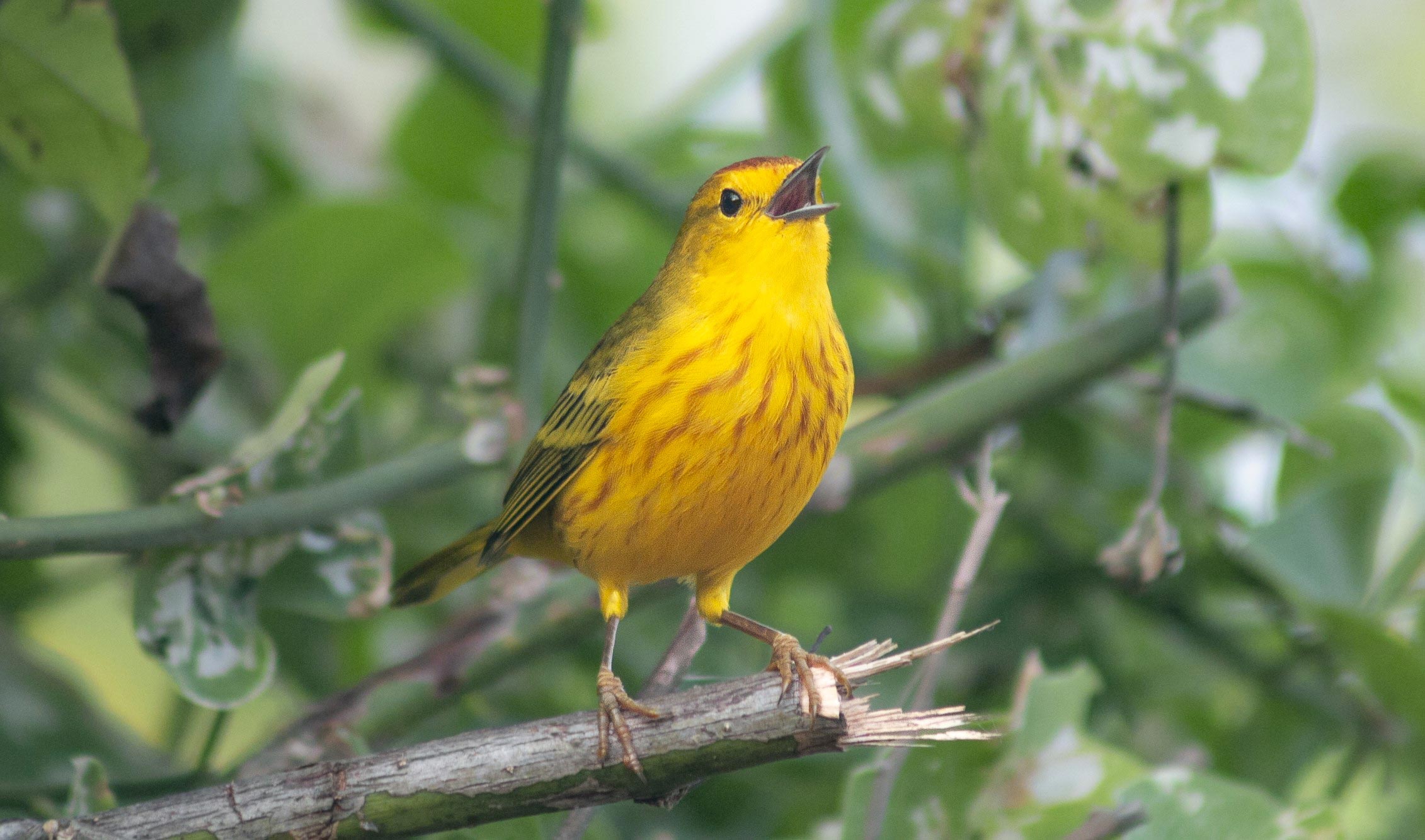
Galápagos songbirds are changing their ways, getting bolder and singing louder, because of human noise.
Warblers near roads display heightened aggression when challenged, while those in quieter zones dial it down. Birds also tweak their tunes, singing at higher frequencies to cut through traffic noise. Even in low-traffic areas, these shifts suggest that human activity has a profound impact on wildlife behavior.
Birds React to Traffic Noise with Aggression
A new study has found that traffic noise is changing the behavior of birds in the Galápagos Islands. Galápagos yellow warblers (Setophaga petechia aureola) that are regularly exposed to vehicle noise show increased aggression compared to those in quieter areas.
The research, published today (March 21) in Animal Behaviour, was conducted by scientists from Anglia Ruskin University (ARU) and the Konrad Lorenz Research Centre at the University of Vienna. It examined how noise pollution from vehicles affects the behavior of these songbirds, which are common throughout the archipelago.
Human Expansion and Rising Noise Pollution
The Galápagos Islands, located over 500 miles off the coast of Ecuador, are home to many unique species found nowhere else in the world. The Galápagos yellow warbler is a genetically distinct subspecies, differing from its relatives found across the Americas.
Charles Darwin’s visit to the Galápagos in 1835 played a key role in shaping his theory of evolution by natural selection. Today, however, the islands are experiencing rapid human population growth, with a permanent population increasing by more than 6% annually. Combined with a rise in tourism, this has led to more vehicles on the roads, introducing new challenges for local wildlife.

Simulating Intruders to Test Bird Behavior
The new study involved researchers playing bird songs from a speaker, simulating an intruder, accompanied by recorded traffic noise at 38 locations populated by Galápagos yellow warblers on the islands of Floreana and Santa Cruz – 20 sites were within 50 meters of the nearest road and 18 were over 100 meters away.
The researchers then measured song, typically used to ward off intruders, and physical, aggressive behaviors such as approaching the speaker closely and making repeated flights across it.
Increased Aggression Near Roads
During trials with traffic noise, the researchers found that Galápagos yellow warblers living in roadside territories showed increased aggression, but those living away from the roads showed decreased aggression relative to trials without noise.
Importantly, the effect of living on a roadside territory was present even on Floreana Island, with only about 10 vehicles present on the island, suggesting even minimal experience of traffic affects responses to noise.
Birds Adapt Their Songs to Be Heard
Additionally, Galápagos yellow warblers on the more populous island of Santa Cruz increased the duration of their song when confronted by traffic noise. These findings support the idea that long-term selection based on noise experience, or an individual bird’s previous experience of noise, allows them to adapt and adjust the features of their songs.
Finally, the birds increased the minimum frequencies of their songs during the noise experiments, regardless of their territory’s proximity to the road, helping to reduce any overlap of their songs with the low-frequency traffic noise.
Why Noise Pollution Matters for Conservation
Co-author Dr. Caglar Akcay, Senior Lecturer in Behavioural Ecology at Anglia Ruskin University (ARU), said: “Birds use song during territorial defence as an aggressive signal. However, if external noise such as traffic interferes with the signaling, effectively blocking this communication channel, increasing physical aggression would be an appropriate response.
“Our results show that the change in aggressive responses in yellow warblers occurred mainly near roads. Birds occupying roadside territories on both islands, and therefore having regular experience of traffic noise, may have learned to increase physical aggression when the territorial intrusion was accompanied by traffic noise.
“We also found some evidence of birds trying to cope with noise by adjusting their song, with yellow warblers in all habitats increasing the minimum frequency of their songs to help them be heard above the traffic noise.
“Our study shows the importance of considering behavioral plasticity in conservation efforts and developing strategies to mitigate the effects of noise pollution on wildlife. It also highlights the significant impact of human activities on wildlife behavior, even in relatively remote locations such as the Galápagos Islands.”
Reference: “Galápagos yellow warblers differ in behavioural plasticity in response to traffic noise depending on proximity to road” by Leon Hohl, Alper Yelimlieş, Çağlar Akçay and Sonia Kleindorfer, 20 March 2025, Animal Behaviour.
DOI: 10.1016/j.anbehav.2025.123119
Never miss a breakthrough: Join the SciTechDaily newsletter.
Follow us on Google and Google News.
2 Comments
So, birds get road rage, too. How ’bout that.
What if chemicals from the cars exhaust also cause the aggression (road rage)?
What if road rage is a chemical poisoning?