
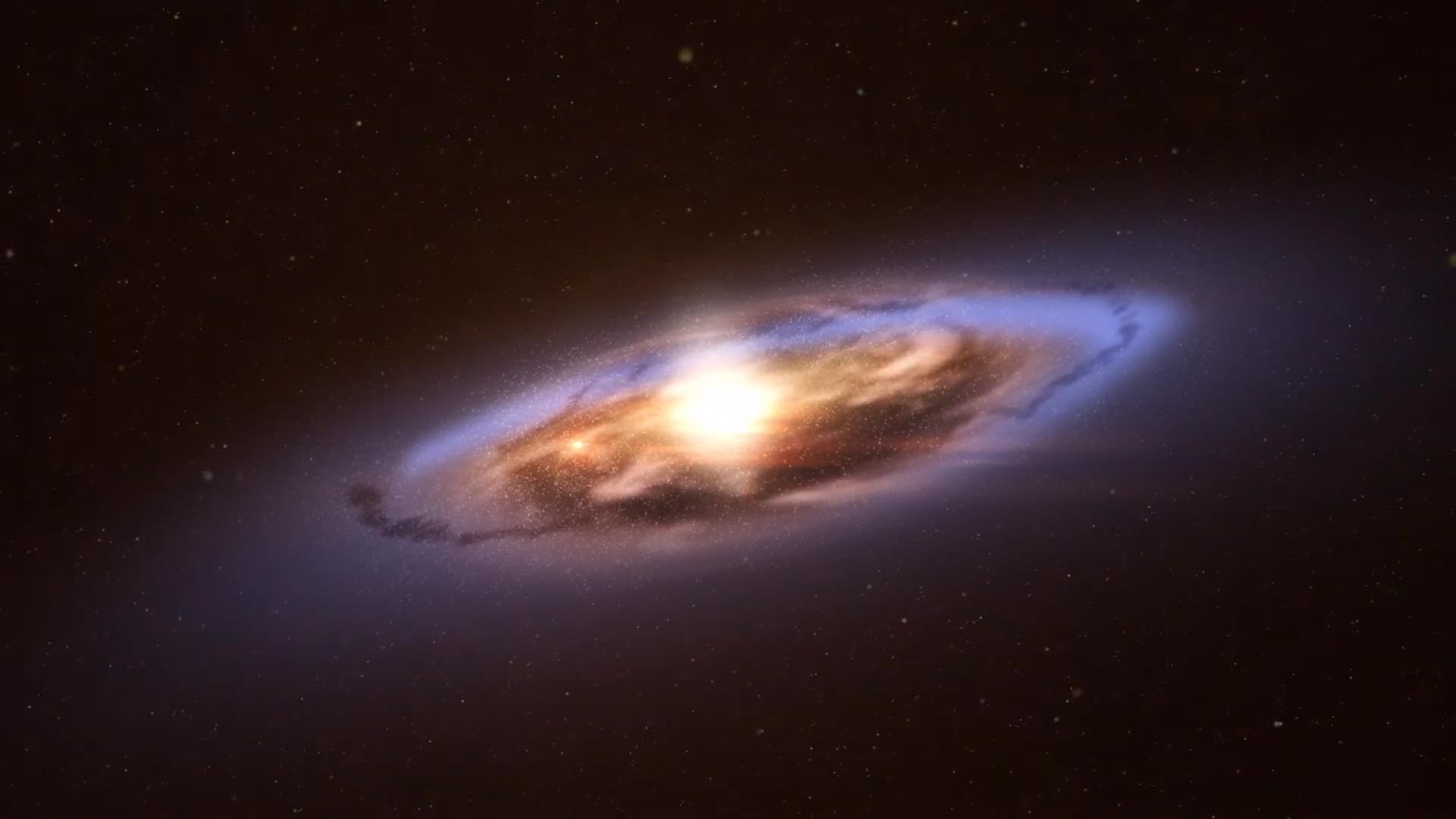
A surprising discovery at the heart of the Milky Way is forcing scientists to rethink how massive structures called Fermi bubbles formed.
Scientists have identified dense pockets of cold gas hidden inside vast, intensely hot clouds known as Fermi bubbles, located at the core of the Milky Way. This discovery contradicts existing theories about how these bubbles formed and suggests they are far younger than once believed.
“The Fermi bubbles are enormous structures of hot gas that extend above and below the disk of the Milky Way, reaching about 25,000 light years in each direction from the galaxy’s center – spanning a total height of 50,000 light years,” says Rongmon Bordoloi, associate professor of physics at North Carolina State University and corresponding author of the research.
“Fermi bubbles are a relatively recent discovery – they were first identified by telescopes that ‘see’ gamma rays in 2010 – there are different theories about how it happened, but we do know that it was an extremely sudden and violent event, like a volcanic eruption but on a massive scale.”
To study the bubbles in greater detail, Bordoloi and his team used the U.S. National Science Foundation’s Green Bank Telescope (NSF GBT). This radio telescope allowed them to collect high-resolution data on both the composition of the gas inside the bubbles and the velocity at which it moves. Their observations were twice as sensitive as earlier surveys, enabling them to uncover much finer details within the giant structures.
A Cold Surprise in a Hot Environment
Most of the gas inside the Fermi bubbles is around 1 million degrees Kelvin. However, the research team also found something surprising: dense clouds of neutral hydrogen gas, each one measuring several thousand solar masses, dotted within the bubbles 12,000 light years above the center of the Milky Way.
“These clouds of neutral hydrogen are cold, relative to the rest of the Fermi bubble,” says Andrew Fox, ESA-AURA Astronomer at the Space Telescope Science Institute and coauthor of the paper.
“They’re around 10,000 degrees Kelvin, so cooler than their surroundings by at least a factor of 100. Finding those clouds within the Fermi bubble is like finding ice cubes in a volcano.”

Their existence is surprising because the hot (over 1 million degrees Kelvin), high-velocity environment of the nuclear outflow should have rapidly destroyed any cooler gas.
“Computer models of cool gas interacting with hot outflowing gas in extreme environments like the Fermi bubbles show that cool clouds should be rapidly destroyed, usually within a few million years, a timescale that aligns with independent estimates of the Fermi bubbles’ age,” Bordoloi says. “It wouldn’t be possible for the clouds to be present at all if the Fermi bubbles were 10 million years old or older.
“What makes this discovery even more remarkable is its synergy with ultraviolet observations from the Hubble Space Telescope (HST),” Bordoloi says. “The clouds lie along a sightline previously observed with HST, which detected highly ionized multiphase gas, ranging in temperatures from a million to 100,000 Kelvin – which is what you’d expect to see if a cold gas is getting evaporated.”
Speed Confirms Recent Origins
The team was also able to calculate the speed at which the gases are moving, which further confirmed the age.
“These gases are moving around a million miles per hour, which also marks the Fermi bubbles as a recent development,” Bordoloi says. “These clouds weren’t here when dinosaurs roamed Earth. In cosmic time scales, a million years is the blink of an eye.”
“We believe that these cold clouds were swept up from the Milky Way’s center and carried aloft by the very hot wind that formed the Fermi bubbles,” says Jay Lockman, an astronomer at the Green Bank Observatory and coauthor of the paper. “Just as you can’t see the motion of the wind on Earth unless there are clouds to track it, we can’t see the hot wind from the Milky Way but can detect radio emission from the cold clouds it carries along.”
This discovery challenges current understanding of how cold clouds can survive the extreme energetic environment of the Galactic Center, placing strong empirical constraints on how outflows interact with their surroundings. The findings provide a crucial benchmark for simulations of galactic feedback and evolution, reshaping our view of how energy and matter cycle through galaxies.
Reference: “A New High-latitude H i Cloud Complex Entrained in the Northern Fermi Bubble” by Rongmon Bordoloi, Andrew J. Fox and Felix J. Lockman, 7 July 2025, The Astrophysical Journal Letters.
DOI: 10.3847/2041-8213/addd16
The work is supported by the National Science Foundation under grant number AST-2206853.
Never miss a breakthrough: Join the SciTechDaily newsletter.
Follow us on Google and Google News.
3 Comments
“Impossible” Cold Clouds Discovered in Milky Way’s Heart Challenge Astronomical Theories.
VERY GOOD!
Please ask the researchers to think deeply:
In today’s physics and so-called peer-reviewed publications, what is possible and what is impossible?
Defying empirical distinctions by defining the manifestly different θ and τ particles as identical. Two sets of artificially counter-rotating Co-60—whether symmetric or not—constitute mirror objects to each other. Perhaps only so-called peer-reviewed publications such as Nature, Science, and the Physical Review series would dare to act with such recklessness and shamelessness. The current state of physics and so-called top-tier or authoritative publications—with their visible and hidden corruptions and ugliness—has become truly shocking. Those peer-reviewed publications that mislead science and the public in the name of academia are even more despicable than ordinary publications.
If researchers believe the evidence, please browse https://zhuanlan.zhihu.com/p/1925124100134790589 and https://zhuanlan.zhihu.com/p/1927657274920383767 (If the link is not blocked).
your antiestablishment bias is showing
Thank you for browsing and commenting.
Most people do not believe that these so-called peer-reviewed publications are systematically disseminating pseudoscience.