
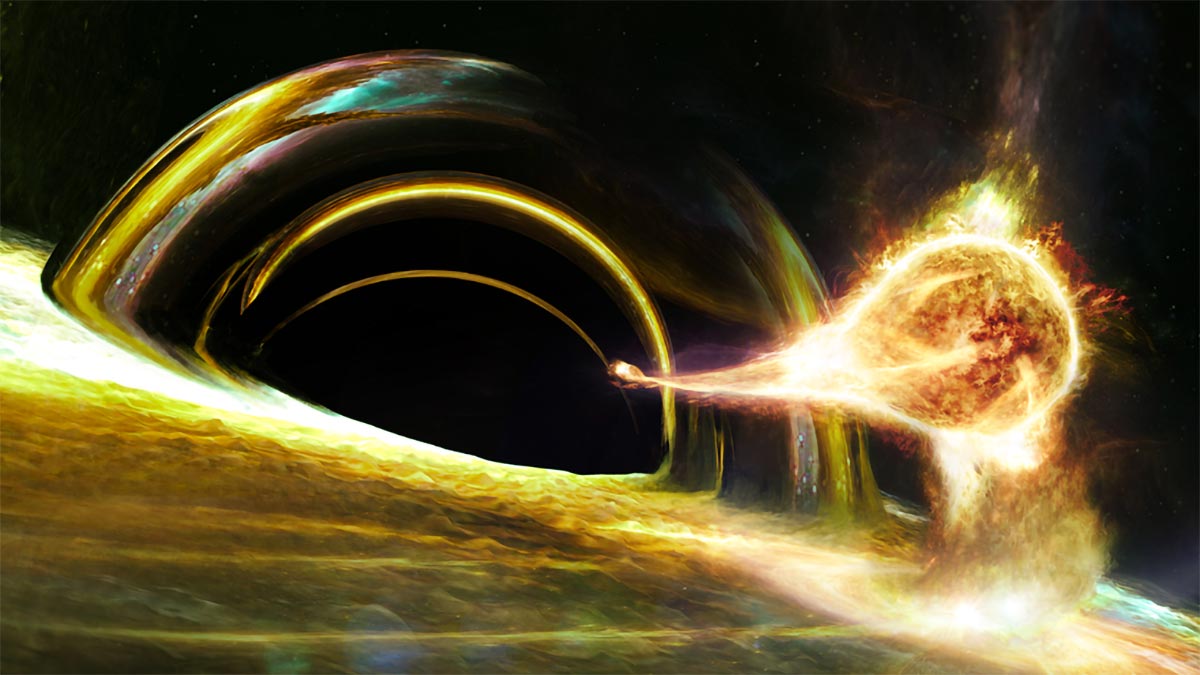
A new discovery challenges the previously accepted understanding of how stars interact with black holes.
While it’s often said that lightning never strikes the same place twice, black holes seem to defy that rule. A team of astronomers, led by researchers from Tel Aviv University, has observed a powerful flare triggered by a star being pulled into a black hole and destroyed. What makes this event remarkable is that a nearly identical flare, named AT 2022dbl, was seen coming from the same region of space just two years earlier.
This marks the first confirmed instance of a star surviving an initial encounter with a supermassive black hole and returning for a second, similar event. The finding challenges long-standing beliefs about tidal disruption events and raises the possibility that these dramatic flares may only be the beginning of a more intricate cosmic process.
The research was headed by Dr. Lydia Makrygianni (a former postdoctoral fellow at Tel Aviv University, now at Lancaster University in the UK), under the guidance of Prof. Iair Arcavi from Tel Aviv University’s Astrophysics Department. Prof. Arcavi also serves as Director of the Wise Observatory in Mizpe Ramon. Additional contributors included Prof. Ehud Nakar, who chairs the department, along with students Sara Faris and Yael Dgany from Arcavi’s research group, and several international collaborators. The study was recently published in The Astrophysical Journal Letters.
The Nature of Supermassive Black Holes
The researchers explain that at the center of every large galaxy lies a black hole that is millions to billions of times the mass of the sun. Such a supermassive black hole exists also in our own Milky Way Galaxy, its discovery was awarded the 2020 Nobel Prize in physics. But beyond knowing they’re there, it’s not well understood how such monsters form, nor how they affect their host galaxies.
One of the main challenges in understanding these black holes is that they are, well, black. A black hole is a region of space where gravity is so strong that not even light can escape. The supermassive black hole in the center of the Milky Way was discovered thanks to the movement of stars in its vicinity. But in other, more distant, galaxies, such movement cannot be discerned.

Luckily, or unluckily, depending on your point of view, once every 10,000 to 100,000 years, a star will wander too close to the supermassive black hole in the center of its galaxy, resulting in it getting ripped to shreds. Half of the star will be “swallowed” by the black hole, and half thrown outward.
When material falls onto a black hole, it does so in a circular fashion, much like water going down the bathtub drain. Around black holes, however, the velocity of the rotating material approaches the speed of light, the material is heated and radiates brilliantly. Such an unlucky star thus “illuminates” the black hole for a few weeks to months, providing astronomers with a brief opportunity to study its properties.
An Unexpected Twist: Two Flares, Same Star?
Strangely, though, these flares have not been behaving as expected. Their brilliance and temperature were much lower than predicted. After about a decade of trying to understand why, AT 2022dbl may have provided the answer. The repetition of the first flare in an almost identical manner two years later implies that at least the first flare was the result of the partial disruption of the star, with much of it surviving and coming back for a (nearly identical) additional passage. These flares are thus more of a “snack” by the supermassive black hole than a “meal.”
“The question now is whether we’ll see a third flare after two more years, in early 2026,” says Prof. Arcavi. “If we see a third flare,” continues Arcavi, “it means that the second one was also the partial disruption of the star. So maybe all such flares, which we have been trying to understand for a decade now as full stellar disruptions, are not what we thought.”
If a third flare does not occur, then the second flare could have been the full disruption of the star. The implication is that partial and full disruptions look almost identical, a prediction made before this discovery by the research group of Prof. Tsvi Piran at the Hebrew University. “Either way,” adds Arcavi, “we’ll have to re-write our interpretation of these flares and what they can teach us about the monsters lying in the centers of galaxies.”
Reference: “The Double Tidal Disruption Event AT 2022dbl Implies that at Least Some “Standard” Optical Tidal Disruption Events Are Partial Disruptions” by Lydia Makrygianni, Iair Arcavi, Megan Newsome, Ananya Bandopadhyay, Eric R. Coughlin, Itai Linial, Brenna Mockler, Eliot Quataert, Chris Nixon, Benjamin Godson, Miika Pursiainen, Giorgos Leloudas, K. Decker French, Adi Zitrin, Sara Faris, Marco C. Lam, Assaf Horesh, Itai Sfaradi, Michael Fausnaugh, Ehud Nakar, Kendall Ackley, Moira Andrews, Panos Charalampopoulos, Benjamin D. R. Davies, Yael Dgany, Martin J. Dyer, Joseph Farah, Rob Fender, David A. Green, D. Andrew Howell, Thomas Killestein, Niilo Koivisto, Joseph Lyman, Curtis McCully, Morgan A. Mitchell, Estefania Padilla Gonzalez, Lauren Rhodes, Anwesha Sahu, Giacomo Terreran and Ben Warwick, 1 July 2025, The Astrophysical Journal Letters.
DOI: 10.3847/2041-8213/ade155
Never miss a breakthrough: Join the SciTechDaily newsletter.
Follow us on Google and Google News.
1 Comment
It’s a proof of white hole.