
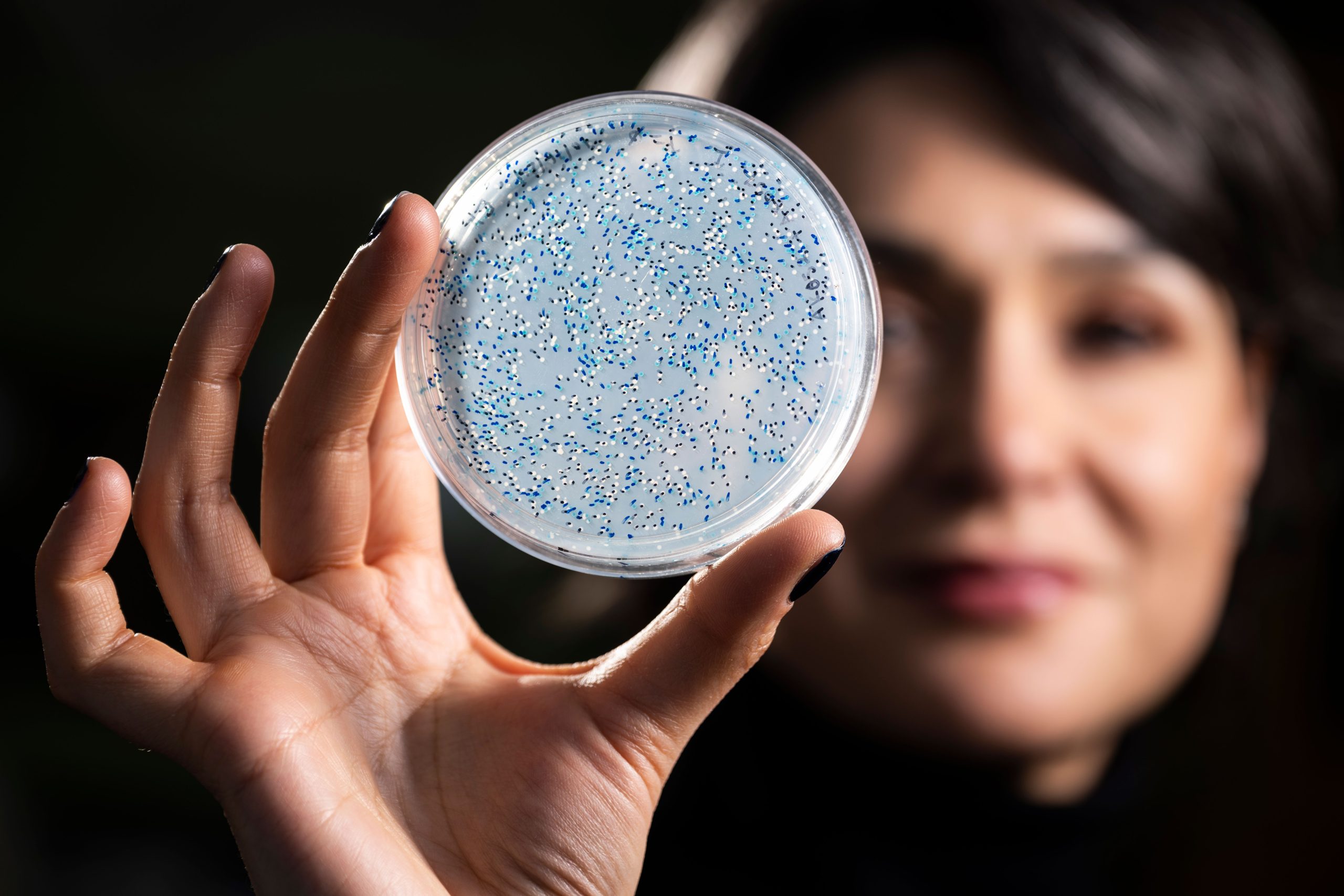
A resurrected ancient enzyme is helping scientists test how reliably Earth’s oldest rocks record signs of life.
Scientists at the University of Wisconsin–Madison have brought a 3.2 billion-year-old enzyme back to life and tested it inside modern microbes, offering a new way to explore how life began on Earth and how it might be detected on other worlds.
The NASA-funded research, published in Nature Communications, relies on synthetic biology to work backward from present-day enzymes and reconstruct versions that likely existed billions of years ago. Betül Kaçar, a professor of bacteriology, and Holly Rucker, a PhD candidate in her lab, centered their work on nitrogenase. This enzyme allows living cells to convert nitrogen gas from the atmosphere into a chemical form they can use.
“We picked an enzyme that really set the tone of life on this planet and then interrogated its history,” Kaçar says. “Without nitrogenase, there would be no life as we know it.”
Although nitrogen makes up most of Earth’s atmosphere, it is not directly usable by most organisms. Nitrogenase solves that problem by transforming atmospheric nitrogen into compounds that support the formation of DNA, proteins, and other essential molecules.
Filling Gaps in the Geological Record
For decades, researchers have depended on ancient rocks and fossils to piece together the story of early life. But well preserved samples from billions of years ago are rare and often difficult to find.
Kaçar and Rucker believe laboratory reconstruction can help address those gaps. By rebuilding ancient enzymes and inserting them into living microbes, they can observe how these molecular systems function and compare them with their modern counterparts.
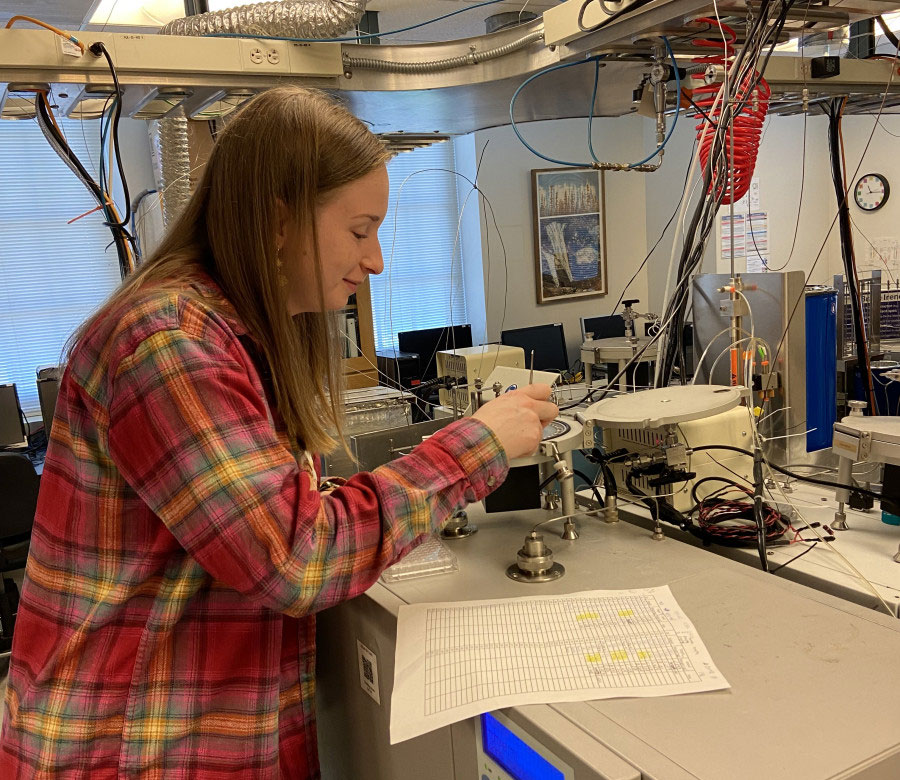
“Three billion years ago is a vastly different Earth than what we see today,” says Rucker. Back before the Great Oxidation Event, she explains, the atmosphere contained more carbon dioxide and methane, and life primarily consisted of anaerobic microbes.
Testing the Rock Record
Enzymes do not fossilize, but their activity can leave chemical fingerprints. In the case of nitrogenase, the process of nitrogen fixation produces distinctive isotopic patterns that can be preserved in ancient rocks.
Scientists have long assumed that nitrogenase in the distant past produced the same isotopic signatures as it does today. Rucker questioned that assumption and asked whether researchers might be misreading the geological evidence.
“It turns out, yes, at least for nitrogenase,” Rucker says. “The signatures that we see in the ancient past are the same that we see today, which then also tells us more about the enzyme itself.”
The team discovered that even though the reconstructed ancient nitrogenase differs from modern versions in its DNA sequence, the underlying mechanism responsible for the isotopic signature has remained consistent over billions of years. Rucker plans to explore why this particular feature stayed stable while other parts of the enzyme changed through evolution.
Implications for Astrobiology
This project connects to Kaçar’s broader work as the leader of MUSE, a NASA-funded astrobiology research consortium based at UW–Madison.
From astrobiologists to geologists across several institutions, MUSE brings researchers together to strengthen NASA space missions through new evolutionary insights into microbiology and molecular biology on Earth.
With nitrogenase-derived isotopes now identified as a reliable biosignature on Earth, MUSE has a clearer framework for evaluating similar signals that may be found on other planets.
“As astrobiologists, we rely on understanding our planet to understand life in the universe. The search for life starts here at home, and our home is 4 billion years old,” Kaçar says. “So, we need to understand our own past. We need to understand life before us, if we want to understand life ahead of us and life elsewhere.”
Reference: “Resurrected nitrogenases recapitulate canonical N-isotope biosignatures over two billion years” by Holly R. Rucker, Kunmanee Bubphamanee, Derek F. Harris, Kurt Konhauser, Lance C. Seefeldt, Roger Buick and Betül Kaçar, 22 January 2026, Nature Communications.
DOI: 10.1038/s41467-025-67423-y
Funding: NASA Interdisciplinary Consortium for Astrobiology Research: Metal Utilization and Selection Across Eons,, NASA Exobiology Program, MUSE, USDA-NIFA Hatch Award, UW-Madison Department of Bacteriology
Never miss a breakthrough: Join the SciTechDaily newsletter.
Follow us on Google and Google News.
5 Comments
Keep up the good work! There’s no reason to believe we can’t replicate non-life to life transitioning in the lab?
Given enough ‘runs’ life is an inevitable conclusion, not unique to ‘an early earth’?
Keep up the good work! There’s no reason to believe we can’t replicate non-life to life transitioning in the lab?
Given enough ‘runs’ life is an inevitable conclusion, not unique to ‘an early earth proposition’?
The man artical about some whale is not a whale it’s a sethapod mimicking a great white shark because it’s hunting them.
The enzyme is suffocated protein because it’s from my ass leeking when people raped me.
More evidence that life, in all of its forms, is distributed throughout the known Universe we inhabit and participate within.