
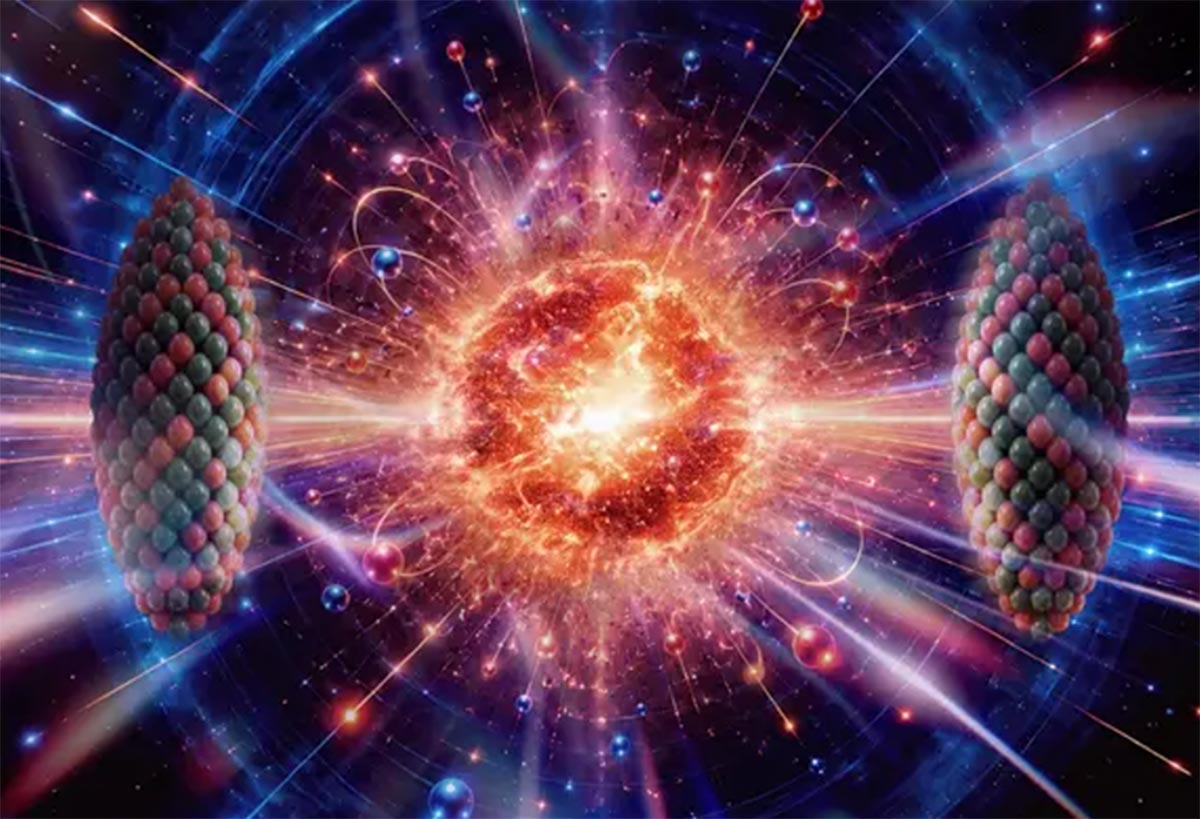
Simulations reveal some of the strongest accelerations ever produced on Earth, opening new avenues for QCD research.
When atomic nuclei smash together at almost the speed of light, their internal matter briefly transforms into quark–gluon plasma, an extremely hot fluid in which quarks and gluons move freely.
Scientists have closely examined the plasma’s intense rotation and electromagnetic fields, but the acceleration driving its rapid expansion has received far less attention. In hydrodynamics, however, acceleration is as fundamental as vorticity, just as electric and magnetic fields are paired in electromagnetism.
Fireball edges generate extreme acceleration
Physicists Yu-Gang Ma and Xu-Guang Huang of Fudan University led a study that combined two established particle transport models, AMPT and UrQMD, with Gaussian smearing. This mathematical technique turns individual particle locations into continuous maps of energy, momentum, and fluid velocity. Using these maps, the researchers followed how acceleration formed and changed across collision energies ranging from 3.5 GeV to 2.76 TeV.
“Acceleration is not merely a kinematic detail—it may act as a thermodynamic control parameter of QCD matter,” explains Professor Huang.
The simulations indicated that proper acceleration, the acceleration measured alongside the moving fluid, can reach several hundred MeV at both the lower and upper ends of the energy range. Acceleration across the fireball consistently pointed outward and peaked near its boundary.
At that edge, pressure falls rapidly while enthalpy density, a measure related to the fluid’s total energy, remains low. According to the relativistic Euler equation, these two conditions intensify the acceleration together.
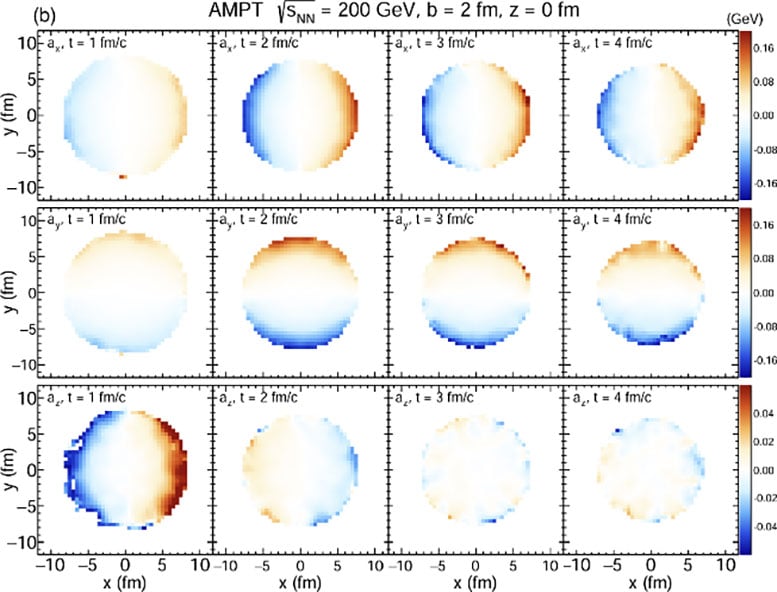
The details changed with collision energy. At lower energies, nuclear stopping caused an early deceleration reaching about 500 MeV. At ultra-relativistic energies, the nuclei passed through one another quickly and pulled the newly created plasma into brief, sharp bursts of acceleration.
The greatest acceleration remained concentrated near the fireball’s outer boundary. Because of that localization, the overall strength of the effect changed relatively little with collision geometry, including whether the nuclei struck each other directly or off center.
Acceleration could reshape QCD physics
The results may have implications beyond the plasma’s motion. Under the Unruh effect, an accelerating observer experiences empty space as though it were a thermal environment. An acceleration of several hundred MeV could therefore correspond to an apparent temperature close to the transition temperature of quantum chromodynamics (QCD), the theory describing the strong force.
This raises the possibility that acceleration could add a new dimension to the phase structure of QCD matter. Along this proposed “acceleration axis,” the effect might influence chiral and deconfinement transitions, which govern how quarks behave and whether they remain confined inside larger particles.
Acceleration could also generate unusual transport effects and influence particle spin in ways that complement vorticity. Such effects may help researchers investigate unresolved spin patterns measured at the Relativistic Heavy Ion Collider (RHIC) and the Large Hadron Collider (LHC).
The researchers next plan to add more realistic hydrodynamic evolution to their models and search for measurable signals, including patterns in the spin polarization of hyperons. These observations could reveal whether the predicted acceleration effects occur in real particle collisions.
“Just as temperature and density define the phase diagram of matter, acceleration may open a new axis of that diagram,” stated Professor Huang. “By mapping this hidden dimension of the quark–gluon plasma, we hope to turn non-inertial quantum effects into signatures that experiments can actually measure.”
Reference: “Fluid acceleration in heavy-ion collisions” by Song-Ze Zhong, Xian-Gai Deng, Xu-Guang Huang and Yu-Gang Ma, 25 July 2026, Nuclear Science and Techniques.
DOI: 10.1007/s41365-026-02044-8
This work was supported by the National Natural Science Foundation of China (Nos. 12547102 and 12225502), the Natural Science Foundation of Shanghai (Nos. 23JC1400200 and 23590780100), and the National Key Research and Development Program of China (No. 2022YFA1604900).
Never miss a breakthrough: Join the SciTechDaily newsletter.
Follow us on Google and Google News.
1 Comment
“Great paper highlighting how edge dynamics drive overall expansion in QGP. Viewing proper acceleration as a thermodynamic control parameter alongside temperature and density (via the Unruh effect near the QCD phase boundary) is a compelling framework. The focus on boundary layer stress rather than just core vorticity feels like a crucial step forward for heavy-ion collision modeling.”