
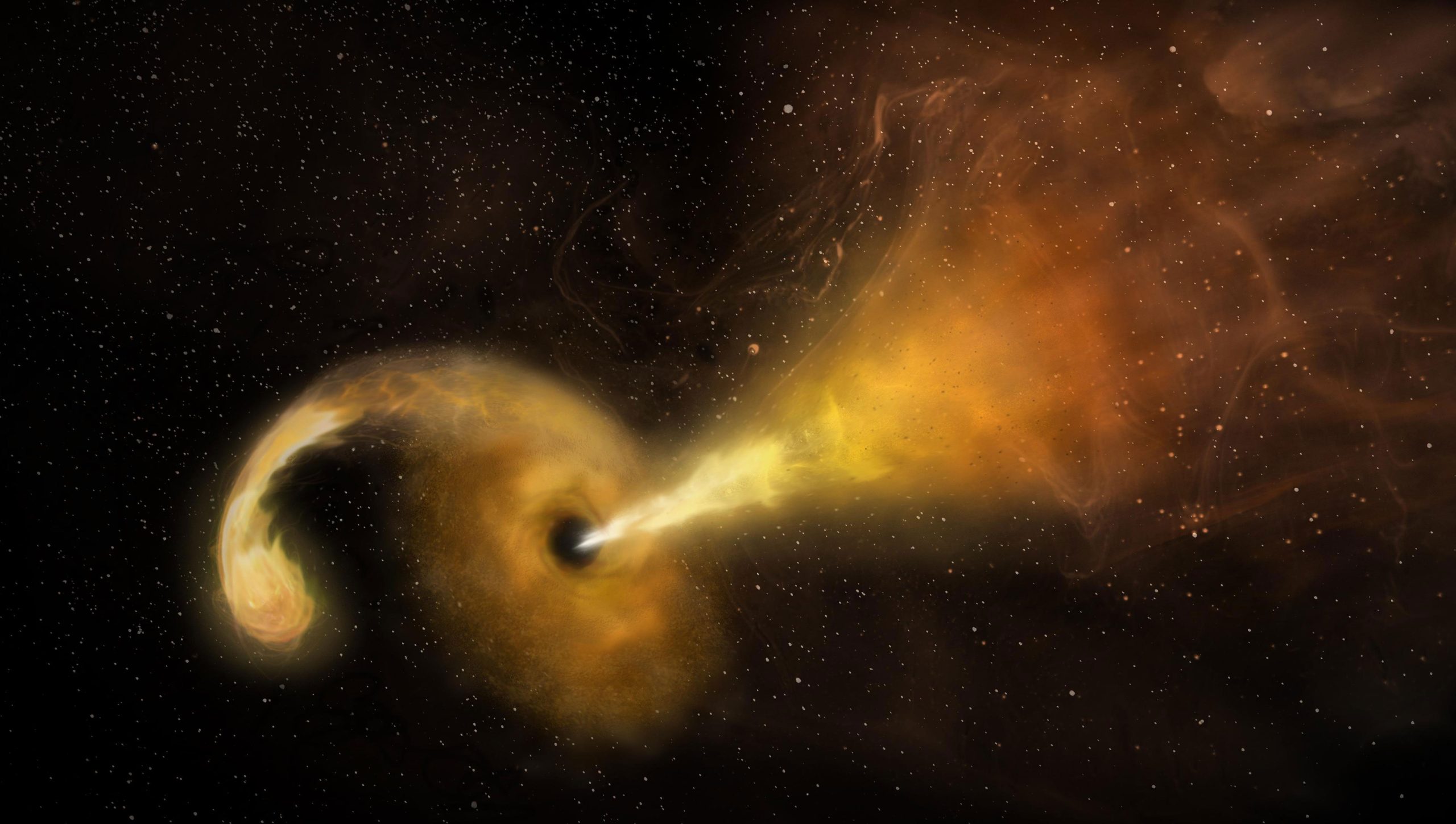
A rare tidal disruption event exposed a massive wandering black hole about 30,000 light-years from its galaxy’s center.
A star was torn apart nearly 30,000 light-years from the center of a massive nearby galaxy, exposing a black hole where astronomers rarely see one. The unusually distant flare revealed an extremely rare “wandering” black hole and may change how scientists understand the movements of massive black holes after galaxies collide.
Astronomers at the University of North Carolina at Chapel Hill traced the discovery to a tidal disruption event, or TDE. These powerful flares occur when a star passes too close to a massive black hole, and gravity pulls it apart.
Such events are rare anywhere in a galaxy, occurring on average once every 100,000 years. Astronomers have detected more than 100 over the past decade, but almost all appeared at galactic centers, where the largest black holes are normally expected. TDE 2025abcr broke that pattern.
The flare appeared approximately 30,000 light-years from the center of its galaxy, making it the most distant offset yet recorded for a tidal disruption event discovered with visible light.
“Almost every tidal disruption event we’ve ever observed has occurred at the center of a galaxy, right where we expect the biggest black holes to be,” said Jonathan Carney, co-author of the paper and PhD student in physics and astronomy at UNC-Chapel Hill. “The tidal disruption event we discovered happened tens of thousands of light-years away from the center, revealing a massive black hole in a place we would not normally expect to find one. We know that wandering black holes exist in massive galaxies, but they are difficult to study because, with the exception of when they briefly disrupt a star, they produce no light.”
A merger may have set it loose
The black hole that produced the flare is estimated to contain roughly one million times the mass of the Sun. It may have been stranded away from the center following a galaxy merger long ago. Another possibility is that gravitational encounters with other black holes near the galactic center pushed it outward.
Black holes produce no light of their own, so astronomers usually cannot detect these isolated objects directly. A rare tidal disruption event can briefly illuminate their location as material from a destroyed star falls toward them.
“These events are essentially cosmic billboards,” said Igor Andreoni, assistant professor of physics and astronomy at UNC-Chapel Hill. “They allow us to find black holes that would otherwise remain completely invisible. Catching these events in the act allows us to study how massive black holes eat material from a disrupted star”
AI searches beyond galactic centers
Artificial intelligence played a key role in identifying the event. The researchers used tdescore, an AI classification tool developed by Robert Stein at the University of Maryland and NASA Goddard, to search enormous collections of telescope observations for promising tidal disruption event candidates.
“This event was identified as a strong candidate tidal disruption event by an AI classifier that we specifically adapted to search for tidal disruption events away from galaxy centers,” said Akash Anumarlapudi, a postdoctoral researcher in physics and astronomy at UNC-Chapel Hill. “By removing the assumption that these events only happen in the galactic center, we were able to find a black hole that might have otherwise been missed. As astronomy enters its ‘big data’ era, AI tools like this one will become increasingly important in our research chasing rare astronomical events at Carolina.”
After the system flagged the flare, the UNC-Chapel Hill researchers used the Southern Astrophysical Research (SOAR) Telescope in Chile to confirm that it was a tidal disruption event. UNC helped build the 4.1-meter telescope and continues to operate it through an international consortium.
“We confirmed the nature of this event using the SOAR telescope in Chile, which UNC is a founding partner of,” said Benjamin C. Kaiser, postdoctoral researcher in physics and astronomy at UNC-Chapel Hill. “SOAR allows us to rapidly follow up these short-lived astronomical phenomena and positions UNC to study large numbers of them as next-generation survey telescopes like Rubin, Roman, and UNC’s own Argus Array come online.”
Visible light could uncover many more
TDE 2025abcr provides the first strong evidence that ground-based visible-light telescopes can reliably reveal wandering black holes. That ability could create new opportunities to investigate how massive black holes form, grow, and travel through galaxies.
Astronomers currently find tens of tidal disruption events each year, mostly in the relatively nearby universe. Future observatories, including the NSF-DOE’s Vera C. Rubin Observatory and the UNC-Chapel Hill-designed and built Argus Array, could increase that number to hundreds or even thousands annually while detecting them across much greater distances.
These flares can reveal more than hidden black holes. They also provide information about the evolution of stars and galaxies and expose matter to gravitational conditions that cannot be reproduced on Earth. By releasing immense amounts of energy, tidal disruption events give astronomers a rare view of extreme physics in action.
Reference: “TDE 2025abcr: A Tidal Disruption Event in the Outskirts of a Massive Galaxy” by Robert Stein, Jonathan Carney, Charlotte Ward, Raffaella Margutti, Xander J. Hall, Itai Sfaradi, Igor Andreoni, Panos Charalampopoulos, Ryan Chornock, Suvi Gezari, Geoffrey Mo, Yuhan Yao, Akash Anumarlapudi, Eric C. Bellm, Joshua S. Bloom, Malte Busmann, Ilaria Caiazzo, S. Bradley Cenko, Matthew J. Graham, Steven L. Groom, Daniel Gruen, Erica Hammerstein, Benjamin C. Kaiser, Mansi M. Kasliwal, Brendan O’Connor, Antonella Palmese, Josiah Purdum, Jillian C. Rastinejad, Reed Riddle, Ben Rusholme, Jesper Sollerman, Jean J. Somalwar and Sylvain Veilleux, 27 July 2026, The Astrophysical Journal Letters.
DOI: 10.3847/2041-8213/ae77f3
Never miss a breakthrough: Join the SciTechDaily newsletter.
Follow us on Google and Google News.
1 Comment
Memo 2608101417_Source 1. Reinterpretation【()】
Source 1.
https://scitechdaily.com/lost-in-space-rare-cosmic-flare-exposes-a-wandering-black-hole-far-from-its-galaxys-center/
1.
_Lost in Space: A rare cosmic flare (*d. revealed a wandering black hole far from the galactic center.)
===========
【(*d.) In our universe, wandering black holes (vixxa) are common, much like subordinates in galaxy clusters. They are not located in specific regions, but
1.) unusually distributed along the outer .vixx.xy (condition satisfied) plane coordinates outside the dominant diagonal vix.zz’ (xyz condition satisfied) and are under the dominance of the vixer. Hmm. 1548.
2.) They are scattered wherever there are stars in the galaxy. Although they have moved away from the galactic center, they can never escape the central main ruler, the black hole.
3.) Black holes (rvixxa) are very common in msbase.galaxy.system(rivery.susqer_2square, y entangle).movezone(*).
4.) They are distributed very precisely in spacetime based on predictable theories. Heh. 1439. It might be possible to implement the distribution of roaming black holes rvixxa.roamer in a model of an arbitrary star cluster using data-driven AI. Heh. 1555.
ㅡㅡㅡㅡㅡㅡ
####Approximately how many roaming black holes are there in a typical star cluster?
<<<<>>>>
5.) The location is outside the diagonal center; the decisive location is rivery.area. If you look at sample1.oms.vix.ain(*), it is already well-organized in my cosmology. Heh. 08101421.35.37.1601.
**】**
_This illustration visualizes the tidal disruption phenomenon that occurs when a star makes a fatal approach to a supermassive black hole. The shattered fragments of the star swirl around the black hole, heating up and producing light observable from far away in space, while the black hole emits jets of relativistic speed into the universe.
** A rare tidal disruption has revealed a massive wandering black hole located about 30,000 light-years from the center of a galaxy.
1-1.
A star shattered about 30,000 light-years from the center of a nearby massive galaxy, revealing a black hole that astronomers had rarely observed. This flash, occurring at an unusually long distance, revealed a very rare ‘wandering’ black hole and could change scientists’ understanding of the movement of massive black holes after galactic collisions.
Astronomers at the University of North Carolina at Chapel Hill have identified that this phenomenon originated from a tidal disruption event (TDE). (*a. These powerful flashes occur when a star passes too close to a massive black hole, and the black hole’s gravity shatters the star.)
==============
【(*a.) To define a rogue black hole group in my cosmology, one must understand rivery.vix.str and susqer.str.
1.) There is a place where black hole vixers are originally formed. If we call that place the center of the galaxy, it is the diagonal.
For a new black hole to form here, an ordinary star in the black hole position must be destroyed, causing a neutron star vixxa from the susqer region to move to the rivery region, where the neutron star vixxa becomes a quasi-black hole, and then vixxa transforms back into a black hole vixer. 2608101402.
2.) This looks like a hierarchy where a commoner vixxa transforms from a susqer to a power elite rivery, and then, if the opportunity arises, can become a power holder vixer.blackhole. Hmm. 1409.
1-2.
_(*b. Such phenomena occur very rarely anywhere in the galaxy, on average about once every 100,000 years. Astronomers have observed over 100 TDEs in the last decade, but almost all of them occurred in the galactic center, where the largest black holes are generally expected to be located.
_(*c. However, TDE 2025abcr broke this pattern.
_ This flash occurred about 30,000 light-years away from the galactic center, making it the farthest tidal disruption event ever recorded observed in visible light.)
^^^^
3.) My qpeoms sample1. According to the oms.vix.ain(*) map, wandering black holes refer to river-type sub-black holes vixxa, and they are very widely distributed. Hmm. 1415.
sample1.
msbase12.qpeoms.2square.vector
oms.vix.a’6,vixx.a(b1,g3,k3,o5,n6)
b0acfd|0000e0
000ac0|f00bde
0c0fab|000e0d
e00d0c|0b0fa0
f000e0|b0dac0
d0f000|cae0b0
0b000f|0ead0c
0deb00|ac000f
ced0ba|00f000
a0b00e|0dc0f0
0ace00|df000b
0f00d0|e0bc0a
】
1-2.
“Almost all the tidal disruption we observed occurred in the galactic center, where the largest black hole is expected to be,” said Jonathan Carney, a co-author of the paper and a Ph.D. student in physics and astronomy at the University of North Carolina at Chapel Hill. _(*h. The tidal disruption we discovered occurred tens of thousands of light-years away from the galactic center, meaning we have found a massive black hole in a location where we generally do not expect to find one.
_We know that black holes wandering in massive galaxies exist, but they are difficult to study because they do not emit light, except when they briefly destroy a star.
_Mergers may have caused that problem.
The black hole that caused this flash is estimated to have a mass of about one million times that of the Sun.
1-3.
_It is possible that this black hole became isolated far from the center after a galactic merger long ago. Another possibility is that it may have been pushed outward due to gravitational interactions with other black holes near the galactic center.
_(*g. Since black holes do not emit light themselves, astronomers generally cannot directly observe such isolated celestial objects. However, due to rare tidal disruptions, material from destroyed stars may fall toward the black hole, causing its location to temporarily brighten. (Exists.)
2.
“These phenomena are essentially like cosmic billboards,” said Igor Andreoni, assistant professor of physics and astronomy at the University of North Carolina at Chapel Hill.
(*f. “Through these phenomena, we can discover black holes that we would otherwise never have seen. By capturing these phenomena, we can study how massive black holes absorb matter from destroyed stars.”)
2-1. AI Explores Beyond the Galactic Center.
Artificial intelligence played a key role in identifying this phenomenon. The research team used tdescore, an AI classification tool developed by Robert Stein at the University of Maryland and NASA’s Goddard Space Flight Center, to find candidate tidal disruption events in a vast dataset of telescope observations.
“This event was identified as a strong candidate tidal disruption event through an AI classifier specifically developed to detect tidal disruptions occurring far from the galactic center,” said Akash Anumalapudi, a postdoctoral researcher in physics and astronomy at UNC-Chapel Hill.
2-2.
_(*e.”By eliminating the assumption that this phenomenon occurs only at the galactic center, we were able to discover a black hole that we might have otherwise missed. )
==========
【(*e.~i.) Since quasi-black holes rivery.vixxa are spread throughout the universe, there is no way to predict at any moment when one might grow within the diagonal of the galactic center. It is similar to a vixer, a powerful figure, appearing among the subordinates of the ruling class (rivery status). Heh. 2608110433.
1.) Years ago, junggoolee, the Taoist of Jeokjeoksan, already sensed that such interesting and entertaining stories of the universe creation myths found in epic novels are ‘sample1.oms.vix.ain(*) stories’.
^.) Probably, something grander and more mathematically and scientifically perfectly entertaining than any myth of the birth of a space agency. I guarantee it.
^^.)sample1.oms.vix.ain(*) The story of its birth is the myth of the birth of our Space Nation, and here, countless black holes and their subordinates—neutrinos and stars—gather to form the Space Nation. Haha. 08110453.57.
2.) The universe originally formed a spherical body of vixxa. One day, a single vixxa crossed the river and created a massive fortress nation of polygonal oms.ain(*) (oms.vix.ain)…
3.) vix.ain.king(*) creates countless subordinates and subjects to defend against external invasions by barbarians.
They form a local nation or galaxy that exquisitely defends perfectly against enemies, or a broad sample1.omsful.magicsum likened to a wide-ranging cosmic system. Uh-huh. 08110444.
】