
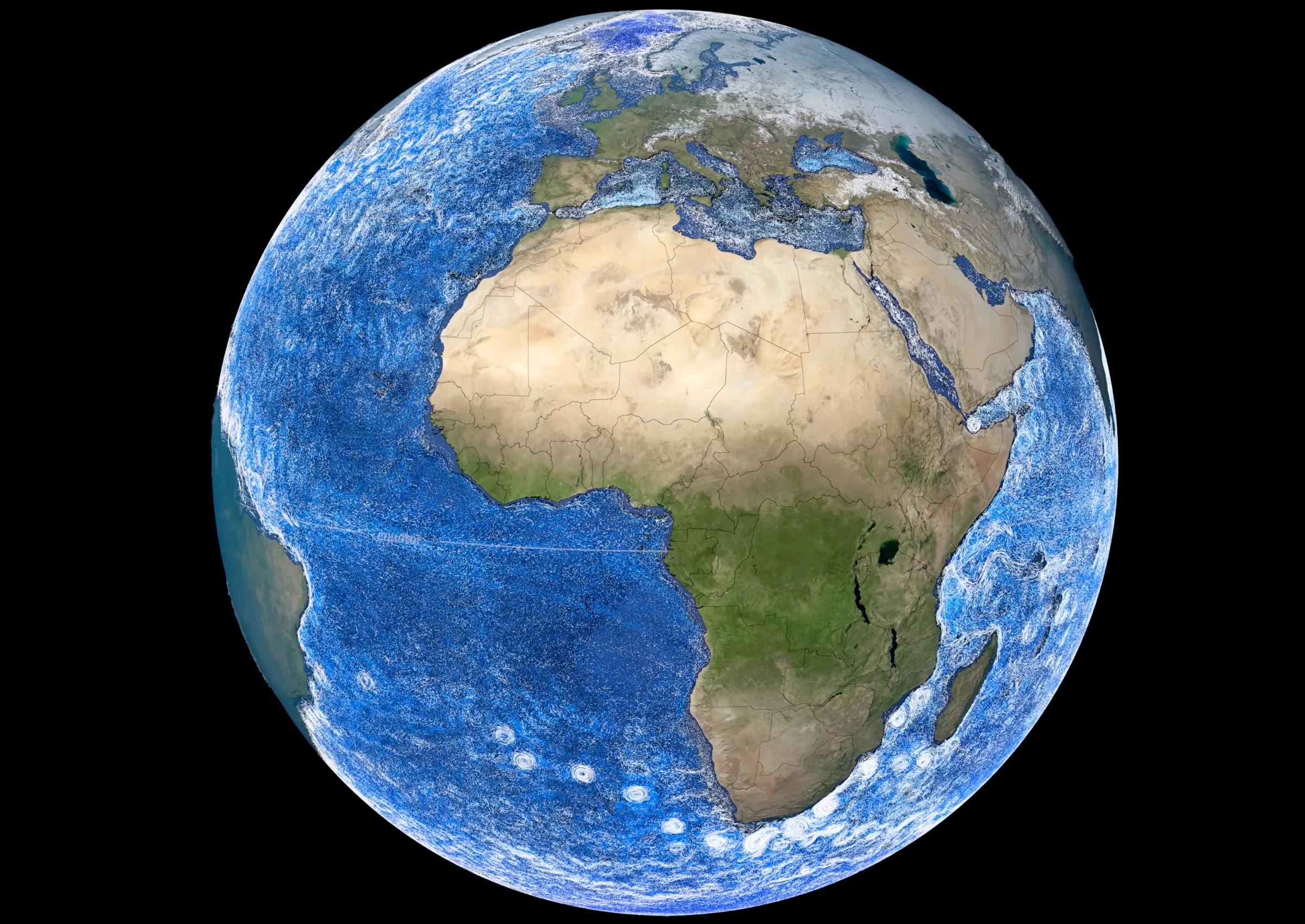
Scientists thought they knew what helped keep the Atlantic’s vast circulation system running, but evidence from millions of years ago has revealed a surprising exception.
Sediments deposited on the seafloor millions of years ago reveal an unexpected episode in Earth’s climate history.
As the flow of warm, salty Indian Ocean water around South Africa weakened dramatically, a key part of the Atlantic Meridional Overturning Circulation (AMOC) did not weaken with it. Instead, deep-water formation in the North Atlantic intensified.
The finding challenges a long-standing explanation for how the AMOC is maintained and suggests that the forces controlling this enormous ocean circulation can change as Earth’s climate and geography change.
How Agulhas Leakage Could Shape Atlantic Circulation
The AMOC is a vast system of currents that moves warm surface water north through the Atlantic while returning colder, denser water southward in the deep ocean. In doing so, it redistributes heat and strongly influences climate around the North Atlantic and Europe.
One piece of this system has long attracted particular attention: Agulhas Leakage.
Near the southern tip of Africa, some warm and salty water from the Indian Ocean escapes into the Atlantic instead of continuing eastward. Scientists have proposed for decades that this influx of salt helps make North Atlantic waters dense enough to sink, supporting the formation of North Atlantic Deep Water and helping sustain the AMOC.
That explanation is intuitive because salinity affects seawater density. All else being equal, saltier water is denser and more likely to sink.
Ancient Climate Tests a Long-Standing Theory
But Earth’s past appears to offer an important exception.
“This was basically the first textbook concept that I learned when I was a bachelor student. It was surprising to find geological evidence showing that it isn’t universally true. The AMOC can remain strong even when Agulhas Leakage weakens,” explains lead author Dr. Suning Hou from Utrecht University.
Hou and an international research team examined the late Pliocene, between 3.6 and 2.6 million years ago. The interval is especially useful because it included a pronounced glacial episode followed by the mid-Piacenzian Warm Period, when global climate conditions were warmer than today.
That transition effectively gave researchers a natural experiment for investigating how major ocean currents behaved as climate conditions changed.
Seafloor Sediments Reveal Past Ocean Changes
Their evidence came partly from International Ocean Discovery Program Site U1475 on the Agulhas Plateau, about 500 km (311 miles) south of South Africa. The site contains a long sedimentary archive deposited near an important gateway between the Indian and Atlantic oceans. Drilling there has recovered sediments spanning millions of years of ocean history.
Instead of directly measuring currents that vanished millions of years ago, the researchers reconstructed them from traces preserved in those sediments.
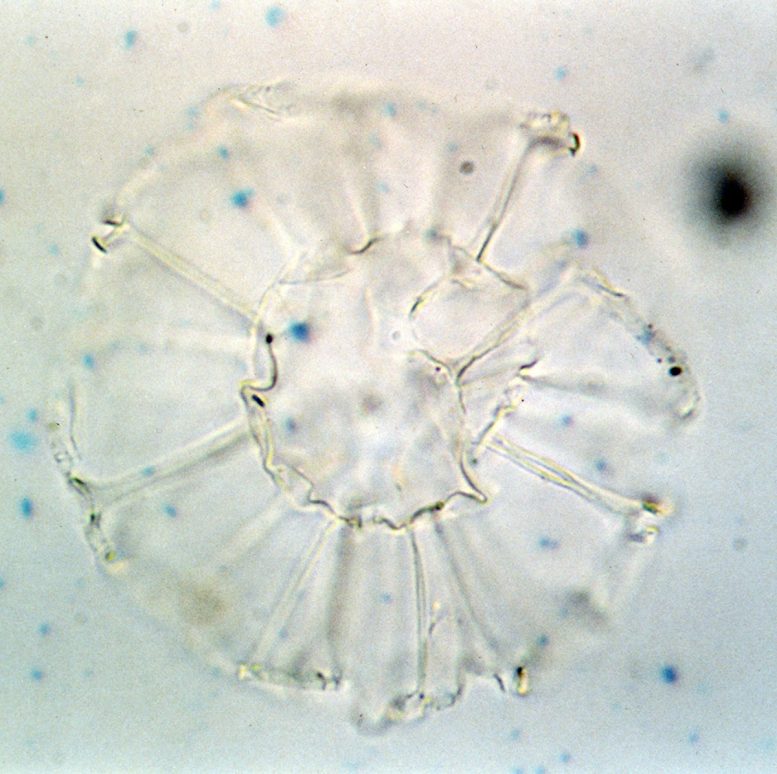
Among the most useful clues were dinocysts, microscopic fossils produced by certain kinds of plankton. Different species favor different water conditions, so changes in the mix of fossils can reveal shifts in ocean temperature and the location of major water boundaries. The team also analyzed organic lipid biomarkers that preserve additional information about past temperatures.
Tracking a Shifting Southern Ocean Boundary
Together, these indicators allowed the researchers to track movements of the Southern Ocean subtropical front, a major ocean boundary whose position helps control how easily Indian Ocean water can escape around South Africa and enter the Atlantic.
Hou: “If you find a change in the dinocyst assemblage in the sediment, this means that the front shifted. For instance, if you find more of the warmer species and less of the colder ones, the front has moved south. A more southerly front generally opens a wider pathway for Indian Ocean water to leak into the Atlantic, and vice versa.”
The resulting reconstruction showed how the potential strength of Agulhas Leakage changed through the late Pliocene.
Agulhas Leakage Nearly Disappears
Beginning about 3.4 million years ago, the subtropical front migrated north as glacial conditions developed. The Agulhas region cooled by roughly 3 degrees Celsius (5.4 degrees Fahrenheit), and Site U1475 experienced subpolar conditions.
Those changes point to a major reduction in Agulhas Leakage. At its weakest, the flow may have come close to shutting down.
According to the conventional explanation, this should have deprived the Atlantic of an important salt source and weakened the AMOC.
The AMOC Did the Unexpected
That is not what the researchers found.
To see what was happening elsewhere in the Atlantic, they reconstructed temperatures at Ocean Drilling Program Site 625 in the northern Gulf of Mexico and compared them with previously published records from the Caribbean Sea, equatorial Atlantic, and North Atlantic. They also tested the emerging picture using numerical climate simulations.
The combined evidence showed a large-scale rearrangement of the Atlantic.
Although the North Atlantic Current did not extend as far into high northern latitudes during the glacial period, North Atlantic Deep Water formation strengthened. Overturning at lower latitudes also intensified, while the thermocline, the boundary separating warmer surface water from colder, deeper water, became shallower across much of the Atlantic.
A Key AMOC Connection Breaks Down
Co-author Carolien van der Weijst, a previous PhD student with Utrecht University, had first noticed part of this unusual pattern years earlier in a single sediment record. On its own, however, the evidence was difficult to interpret.
“When the same pattern was discovered in the Agulhas Plateau, we realized we were looking at a basin-wide reorganization of the ocean thermocline rather than a local anomaly. Then we confirmed this with climate model simulations,” says Prof. Francien Peterse from Utrecht University. “The whole story suddenly made sense.”
The full study found that Agulhas salt transport declined from roughly 3.6 million to 3.3 million years ago even as the AMOC intensified, leading the researchers to conclude that the usual causal relationship between the two had effectively become disconnected during this period.
Today, the exchange of water around southern Africa forms part of a major connection between the Indian and Atlantic oceans, and previous research has linked changes in that pathway to Atlantic circulation. Site U1475 itself was selected partly to investigate possible feedbacks between Agulhas Leakage and the AMOC.
What the Findings Could Mean Today
Scientists are investigating how warming and increasing freshwater input into the North Atlantic could alter its strength, and a major weakening or collapse would have far-reaching consequences for regional climate
The researchers stress that ocean geography, Arctic freshwater inputs, and other boundary conditions during the late Pliocene differed from those of the modern world.
Those differences are important when considering how the findings might apply today. A future southward shift of the subtropical front could increase the flow of salty Indian Ocean water into the Atlantic, but the AMOC is also influenced by modern Arctic freshwater and salt inputs that differ from those during the period studied.
Reference: “Disconnection of the late Pliocene Agulhas Leakage from Atlantic Meridional Overturning Circulation” by Suning Hou, Alejandra Cartagena-Sierra, Ning Tan, Carolien M. H. van der Weijst, Malte Stockhausen, Fenghao Liu, Melissa A. Berke, Isla S. Castañeda, Aidan Starr, Francien Peterse, Francesca Sangiorgi, Anna S. von der Heydt, Appy Sluijs and Peter K. Bijl, 3 August 2026, Nature Geoscience.
DOI: 10.1038/s41561-026-02055-5
This research was part of a larger research project called “OCEAN ICE,” funded by the European Research Council.
Never miss a breakthrough: Join the SciTechDaily newsletter.
Follow us on Google and Google News.
1 Comment
“… the usual causal relationship between the two had effectively become disconnected during this period.”
In other words it was probably a spurious correlation that no one had bothered to prove before now, being willing to accept an apparent causal conjecture.