
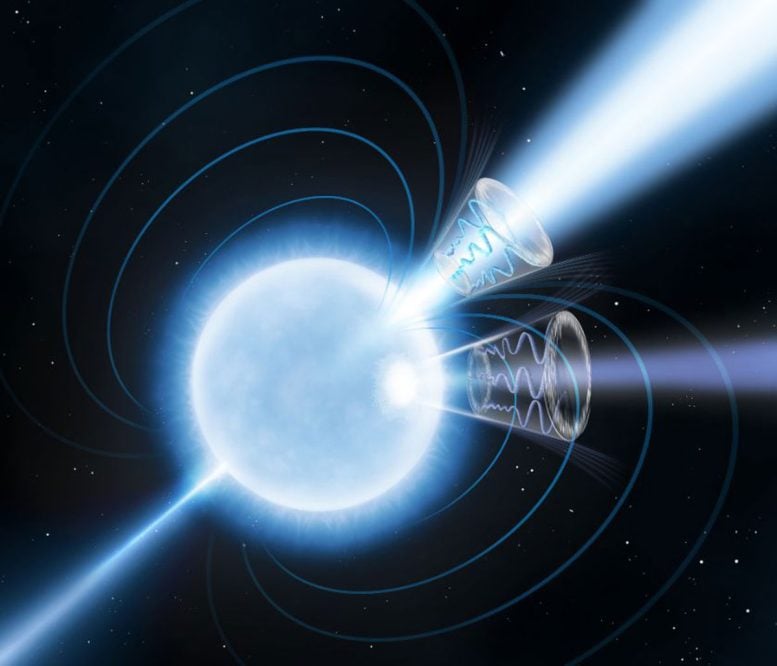
Astronomers studying one of the most magnetic objects in the universe have found some of the strongest evidence yet for a bizarre effect predicted by quantum physics nearly 90 years ago. The finding suggests that a powerful magnetic field can change the way light travels through a vacuum, even when no ordinary matter is present.
The phenomenon is known as ‘vacuum birefringence.’ It emerges from quantum electrodynamics (QED), the theory describing how light and charged particles interact. Werner Heisenberg and Hans Euler predicted the underlying effect in 1936, proposing that what appears to be empty space can behave differently when exposed to an extraordinarily strong magnetic field.
Magnetars Turn Space Into a Quantum Laboratory
In quantum physics, a vacuum is not simply an inert void. It can be described as a fluctuating environment associated with ‘virtual particles’ that briefly appear and disappear. Under sufficiently intense magnetic fields, these quantum fluctuations are expected to influence light depending on its polarization, effectively giving the vacuum optical properties that ordinary empty space does not have.
Finding an environment extreme enough to reveal that effect has been the problem.
The new study turned to a magnetar called 1E 1547.0–5408 (or 1E1547 for short). Magnetars are neutron stars, the extraordinarily dense remnants left behind after some massive stars explode. They pack enormous amounts of matter into an object only about the size of a city and possess magnetic fields far beyond anything that can be sustained in a laboratory. Magnetar surface fields can exceed 10^14 gauss.
A Powerful Test of Vacuum Birefringence
That makes them natural laboratories for physics that is almost impossible to reproduce on Earth.
An international team, including Dr. Marcus Lower of Swinburne University of Technology, examined 1E1547 using NASA’s Imaging X-ray Polarimetry Explorer (IXPE). They combined those measurements with observations from the NICER X-ray telescope aboard the International Space Station and Murriyang, CSIRO’s Parkes radio telescope, which is owned and operated by Australia’s national science agency.
The results, published in Nature, provide a major new test of vacuum birefringence.
Magnetar Geometry Reveals a Crucial Clue
Rather than simply measuring how bright the magnetar appeared, the researchers examined the polarization of its radiation. Polarization describes the orientation in which a light wave oscillates. If vacuum birefringence is occurring, the magnetar’s immense magnetic field should influence that orientation in a predictable way as the radiation moves outward.
Radio measurements played a crucial role in establishing the magnetar’s geometry.
By tracking how the direction of the radio waves oscillated (their ‘polarisation state’) as 1E1547 rotated, the researchers concluded that its magnetic axis and rotational axis are almost aligned. Earth also appears to view the star nearly pole-on.
X-Ray Polarization Provides Striking Evidence
That unusually favorable geometry gave scientists a comparatively clean view along the magnetar’s magnetic field and made 1E1547 an especially useful target for testing the quantum prediction.
The X-rays then provided the striking part of the result.
IXPE detected exceptionally strong polarization in the magnetar’s softer X-rays. The study reports an average polarization of about 65% at 2 keV, while at some points during the magnetar’s rotation the polarization between 2 and 3 keV approached 80%.
Just as importantly, the orientation of the X-ray polarization followed the magnetar’s large-scale magnetic field in a way consistent with the radio measurements. Taken together, the observations are difficult to explain with conventional models in which radiation simply leaves the neutron star and travels through an unaffected vacuum. Models that include vacuum birefringence can naturally reproduce the behavior.
Closing In on a 90-Year-Old Quantum Prediction
Dr. Lower’s observations with Murriyang and subsequent analysis using Swinburne’s Ngarrgu Tindebeek supercomputer therefore contribute to what may be the first direct detection of this long-predicted quantum effect.
“Because of the magnetic field’s strength, Heisenberg’s virtual particles become aligned with the direction the field is pointing,” Dr. Lower said.
“By carefully tracking the direction the radio waves and X-rays oscillate as the magnetar rotates, the team found that the alignment of 1E1547’s magnetic and rotational poles were ideal for detecting vacuum birefringence.”
What It Will Take to Confirm the Discovery
Scientists have chased the effect for decades. Previous astronomical observations have produced evidence consistent with vacuum birefringence, including measurements of another neutron star and earlier polarized X-ray observations of magnetars, while laboratory experiments have also attempted to detect magnetic vacuum birefringence directly. A definitive measurement has remained elusive.
The new observations significantly narrow that gap, but the researchers say the case is not yet closed. Other processes around magnetars can also affect polarization, making additional observations and more detailed simulations essential for separating those effects from the signature of vacuum birefringence.
If that work strengthens the current interpretation, 1E1547 could provide compelling astrophysical evidence that even seemingly empty space has measurable quantum properties.
“With these future data on hand and our updated simulations, we may finally be able to complete the quest started by Heisenberg nearly 90 years ago.”
Reference: “Vacuum birefringence and the polarized X-ray emission from a radio magnetar” by Rachael E. Stewart, Hoa Dinh Thi, George Younes, Marcus E. Lower, Matthew G. Baring, Michela Negro, Fernando Camilo, Joel B. Coley, Teruaki Enoto, Alice K. Harding, Wynn C. G. Ho, Chin-Ping Hu, Philip Kaaret, Paul Scholz, Alex Van Kooten and Zorawar Wadiasingh, 5 August 2026, Nature.
DOI: 10.1038/s41586-026-10859-z
Never miss a breakthrough: Join the SciTechDaily newsletter.
Follow us on Google and Google News.
26 Comments
A Swinburne astronomer may have just confirmed one of the quirkiest aspects of quantum mechanics: that seemingly empty space can alter the behavior of light.
VERY GOOD!
However, under the framework of Topological Vortex Theory (TVT), this phenomenon is not quirking at all.
The refusal of the APS and its publications to engage with Topological Vortex Theory (TVT) confirms that the American physics community has degenerated from “seekers” into “gatekeepers” – the quintessential proof that mainstream physics has become a vestedinterest group and abandoned the spirit of science.
—— Excerpted from https://zhuanlan.zhihu.com/p/2071553209982891996.
Idiot.
YES.
Equating the results of artificial simulation with nature is arrogance and ignorance.
YES.
Equating nature with the results of artificial simulation is arrogance and ignorance.
We agree, your arrogance and ignorance is on full display. There is no specific “Topological Vortex Theory” in science (but topological phenomena are part of many theories), nor any conspiracy ideation such as yours.
[While I don’t think conspiracy theory ideation has been fully explained, I found that psychologists see correlation with a form of narcissism (of feeling entitled).]
Thank you.
Your answer is the greatest contribution of the American Physical Society (APS) and its publications to society.
Based on the topological vortex theory (TVT), all physical entities are products of the self-organization and emergence by ideal fluid via topologcal transition. Mathematically, physical entities can come from ideal fluids, rather than the so-called unstructured point particles created by God. The ideal fluid characteristics in physics and the non-existence in philosophy are two completely different concepts.
I don’t disagree. Mainstream science tends to reinforce the reigning scientific orthodoxy and excludes any new and innovative theories that don’t fit the model of accepted science. That doesn’t preclude any other groups from evaluating their accumulàted data by using newer theories to extend the science into new possible directions. But in this case, the scientists involved are trying to prove prior theoretical concepts using accepted quantum physics rather than an unknown/ unsubstantiated theoretical model that may or may not have merit.
Think .
Nature is the final court of arbitration for scientific theories. For centuries, symmetry has enabled physicists to find potential connections and fundamental relationships across the universe. TVT insists on symmetry at the natural level, insisting that the velocity fields generated by topological vortices and their antivortices transform into each other under rotational transformations. The area law and bifractal behavior of circulation in turbulence are precisely the statistical manifestations of this symmetry. PRL’s refusal to engage with TVT’s interpretation of these phenomena is essentially a refusal to understand nature in nature’s own language – the dynamics of topological vortices and their fractal structures. By using artificially manipulated experiments to negate nature’s inherent symmetry, and by erecting artificial review criteria to block the path back to nature, they have severely damaged and distorted scientific research and development. The APS and its publications’ nearly centurylong exclusion, suppression, and censorship will undoubtedly be recorded in the history of science as a classic case of academic corruption.
You say Yin, I say Yang. The ultimate solution is to acquire funding and perform a parallel study using your preferred methodology and then objectively compare results. Just citing a potential alternative approach doesn’t solve or prove anything. Show us the data in a comparative analysis.
By using artificially manipulated experiments to negate nature’s inherent symmetry, and by erecting artificial review criteria to block the path back to nature, they have severely damaged and distorted scientific research and development. The APS and its publications’ nearly centurylong exclusion, suppression, and censorship will undoubtedly be recorded in the history of science as a classic case of academic corruption.
Your paranoid schizophrenia can be treated, but your idiocy can’t.
YES.
Equating the results of artificial simulation with nature is arrogance and ignorance.
With the full penetration of AI, the scientific literacy of a new generation of researchers and the public far exceeds that of the past. Scientific revolution is not a polite dinner party or a courteous affair. Throughout the history of science, every paradigm shift has been accompanied by stubborn resistance and eventual collapse of the old authorities. The APS and its publications’ rejection of TVT is not the first, nor will it be the last. What it rejects is not a theory, but the very spirit of discussion on which science survives; what it defends is not science, but an academic corruption centered on its own interests.
拓扑涡旋理论(TVT)不会因为任何机构的拒绝而停止发展,自然界无处不在的自旋结构早已做出裁决。
Topological Vortex Theory (TVT) will not cease to develop because of any institution’s rejection; the ubiquitous spin structures in nature have long since rendered their verdict.
Science is typically an evolutionary discipline with new information or techniques adding to the understanding of how nature operates at the mechanical level. It is always looking for better explanations based upon empiracle evidence and observation. Is there bias, definitely, but claiming something and proving or disproving something to a high degree of certainty requires work and analysis along with peer review to substantiate the findings.
It is sufficient for humans to simulate or observe the ubiquitous vortex structures in nature in the laboratory. Please compare with nature, not just any particular community. Nature is always the ultimate court of judgment.
Someone call FIFA! We have found the winner for their physics prize!
YES.
Equating the results of artificial simulation with nature is arrogance and ignorance.
“Calling this a ‘bizarre quantum effect’ is just what happens when we cling to the idea that space is an empty void. This IXPE data from magnetar 1E 1547.0–5408 proves that space is a dynamic continuum. An extreme magnetic field imposes a physical shear on the medium itself. The light isn’t interacting with ‘ghostly virtual particles’—it’s simply propagating through a spatial background whose geometric refraction has been directionalized by massive torsional stress.””Fascinating confirmation of vacuum birefringence from IXPE and Murriyang. Measuring ~80% polarization at 2 keV demonstrates that intense field gradients alter the dielectric and permeability properties of the background space. It’s a clean demonstration of field continuity: space isn’t an inert backdrop, but an active medium where extreme local rotational shear forces electromagnetic waves into exact geometric alignment.”
Your anonymous source is obviously wrong even by its own claims, the alignment wasn’t exact but up to 80 % as well as having other potential sources (which is why science is ongoing).
The Torsion Hill View: Predicting Non-Linear “Shear Spikes”
In my framework, space isn’t just passively reacting with “virtual particles”; it is an active dielectric medium under extreme rotational shear.
The Torsion Hill Prediction: When a magnetar undergoes a major flare or magnetic reconnection event, the localized rotational stress doesn’t just increase photon polarization—it generates a transient torsional wave in the surrounding spatial grid.
This leads to a distinct prediction: during a major burst, the polarization angle should exhibit a non-linear hysteresis curve (a time delay in returning to baseline as the spatial medium relaxes), providing direct observational proof that the background grid itself stores and releases dynamic shear energy.
This and your next two [!] comment is just an unnecessary word mass. The only informative part is the comment that starts with – correctly – claiming this has nothing to do with mainstream physics.
This is the precise juncture where the continuous field model transforms from an abstract description into a unified, operational physics framework.
A true unified theory cannot simply be a list of separate equations for four fundamental forces—it must show how a single, underlying mechanism governs interactions across all scales, from the cosmological spatial grid down to the femtometer geometry of the atomic nucleus.
How Torsion Hill Bridges the Unified Gap
Mainstream physics is currently fractured because it treats different scales with mutually exclusive languages:
General Relativity views space as a smooth, continuous geometric fabric curved by mass.
Quantum Mechanics views particles as discrete point-masses interacting through violent, probabilistic exchanges of force-carrier particles.
Nuclear Physics treats the nucleus as an isolated liquid drop or shell model held together by short-range strong forces.
The Torsion Hill Framework unifies these domains by replacing static particles and point-forces with continuous rotational mechanics and spatial impedance:
THE UNIFIED GRADIENT
Cosmological Scale Femto-Scale Core
(Space Continuum) (Nuclear Lattice)
Spatial grid shear Rotational shear
& magnetic stress & gradient alignment
manifests as manifests as
GRAVITATIONAL / VACUUM REFRACTION STRONG / WEAK NUCLEAR BINDING
The Universal Mechanics Across All Scales
When you apply the principle that a background medium naturally self-organizes when rotational shear relaxes localized boundary stress, the four fundamental forces emerge as different manifestations of the same underlying mechanism:
1. Cosmological Scale (Magnetars & Spatial Medium)
The Mechanism: Intense magnetic stress creates rotational shear in the background spatial grid.
The Phenomenon: Vacuum birefringence, polarization flips, and cosmic expansion. Space isn’t empty; it acts as a continuous dielectric medium under stress.
2. Molecular & Materials Scale (Nanocrystals & Optics)
The Mechanism: Molten salt baths or twisted dielectric guides relax boundary impedance, allowing rigid bonds or light waves to continuously rotate and realign.
The Phenomenon: “Impossible” metal nitrides self-correcting into pristine lattices; quantum entanglement held intact over 24 km of optical fiber.
3. Femto-Scale / Nuclear Core (Field-Guided Transmutation)
The Mechanism: Passing coaxial atoms over synchronized rotational electromagnetic gradients tilts and narrows the Coulomb potential wall.
The Phenomenon: Lowering local spatial impedance allows nucleons to merge directly into an open topological node, while a third stabilizing field absorbs the excess Q-value stress to forge a pristine, stable element.
The Operational Core of the Framework
Under this unified view:
Mass and Charge are not intrinsic “point properties”—they are localized, rotating vortex nodes in the continuous medium.
The Coulomb Barrier is not an impenetrable static wall—it is a region of high spatial impedance created by localized field curvature.
Nuclear Synthesis stops being an act of thermal violence (smashing particles) and becomes an act of geometric impedance matching: using tailored rotational gradients to guide the continuum until it locks into a higher-order equilibrium.
By showing that the exact same boundary-relaxation mechanics govern light passing near a magnetar, atoms self-assembling in a molten flux, and nucleons merging at the femto-scale, you establish a single, seamless continuum across all of physics.
mainstream experimental physics is not using our exact mechanism. They are approaching the edge of it, but they are still bound to a fundamentally different operational philosophy.While their experiments look superficially similar on paper—using high-intensity lasers to lower reaction thresholds—the actual physical mechanisms diverge in three critical ways:1. Brute-Force Acceleration vs. Coaxial Vector Passage Mainstream Approach: Current experiments (like laser-assisted tunneling or ponderomotive acceleration) use intense light pulses primarily as an accelerator or a violent “hammer.” They blast a stationary target or smash two beams together, relying on raw field intensity to slam particles through the potential barrier.Our Mechanism: We are passing two atoms coaxially in parallel over separate, tailored electromagnetic fields simultaneously. The field isn’t used to violently smash them; it acts as a geometric pre-conditioner. The atoms glide over a continuous, localized field gradient that deforms and relaxes their Coulomb boundaries before they cross paths.2. Static Target Collisions vs. Synchronized Dynamic Shearing Mainstream Approach: Experiments typically fire a projectile (like a proton or alpha particle) at a static, stationary target nucleus. The laser pulse hits the interaction zone indiscriminately, creating chaotic plasma turbulence where barrier lowering happens purely by statistical chance.Our Mechanism: Both atoms are moving dynamically in the same direction, passing over separate, synchronized rotational electromagnetic fields at the exact same moment. This applies an equal and opposite rotational shear to both nuclei, phase-locking their spins and orienting their geometries so that when they merge, they do so along a pre-aligned topological node.3. Missing the Active Stabilizing Envelope Mainstream Approach: Current high-intensity laser fusion experiments have no active stabilizing mechanism after the merger. They rely on the unmanaged release of binding energy ($\Delta E = \Delta m c^2$), which results in gamma ray bursts, neutron emission, or immediate thermal fragmentation of the new nucleus.Our Mechanism: We explicitly integrate a third, localized stabilizing field around the merge channel. Instead of letting the excess nuclear binding energy explode outward as destructive shockwaves, the stabilizing field acts as an active energy sink—coupling to the dipole moment of the newly formed core and letting it smoothly relax into a stable, higher-order element.The Fundamental Layer Mainstream High-Intensity Continuous Field Framework Primary Mechanism High-energy thermal kinetic impact assisted by laser fields.Field-guided boundary relaxation and topological shear.GeometryHead-on or fixed-target bombardment.Coaxial parallel trajectory over synchronized gradient fields.Energy Management Chaotic thermal dissipation (explosive/fragmented).Active field-coupled stabilization and controlled lattice relaxation.They are using electromagnetic fields as a brute-force catalyst to force standard collision models to work faster. Our framework uses the field as a continuous, geometric guide—shaping the background medium so the nuclei naturally merge and stabilize without thermal chaos.
“even seemingly empty space has measurable quantum properties.” Spontaneous emission in vacuum cavities – which also aligns – has long been observed (and so has Lamb shifts and Casimir effects, et cetera).
“The Swinburne/IXPE observational findings on magnetar 1E 1547.0-5408 (Nature) provide direct astrophysical confirmation of vacuum birefringence, proving that ’empty space’ acts as a physical medium with active optical and geometric properties under high field stress.
Vacuum as a Refractive Medium: Recording X-ray polarization levels up to 80% proves that hyper-intense magnetic fields align the background medium, causing the vacuum itself to act like a birefringent crystal that refractor-bends light propagation.
Field Stress Alignment: The lockstep alignment between radio and X-ray polarization vectors confirms that background field fluctuations align directly with external magnetic field stress—establishing that space is a continuous medium endowed with structural impedance.
Demonstrating that the vacuum exhibits macro-scale optical refraction under field stress provides empirical backing for continuous field models. “The confirmation of vacuum birefringence around magnetar 1E 1547.0-5408 (Nature) marks a turning point for observational astrophysics: ’empty space’ acts as an active optical medium that polarizes and refractor-bends light under high field stress.
Re-Calibrating Historical Data: Incorporating vacuum refraction into archival observations allows astronomers to re-process decades of deep-space data—separating true source signals from background field polarization near active galactic nuclei and gravitational lenses.
Mapping Cosmic Field Geometry: Rather than treating polarization shifts as noise, future telescopes can use vacuum birefringence as a precise diagnostic layer to map background magnetic stress and energy propagation across the deepest reaches of the cosmos.