
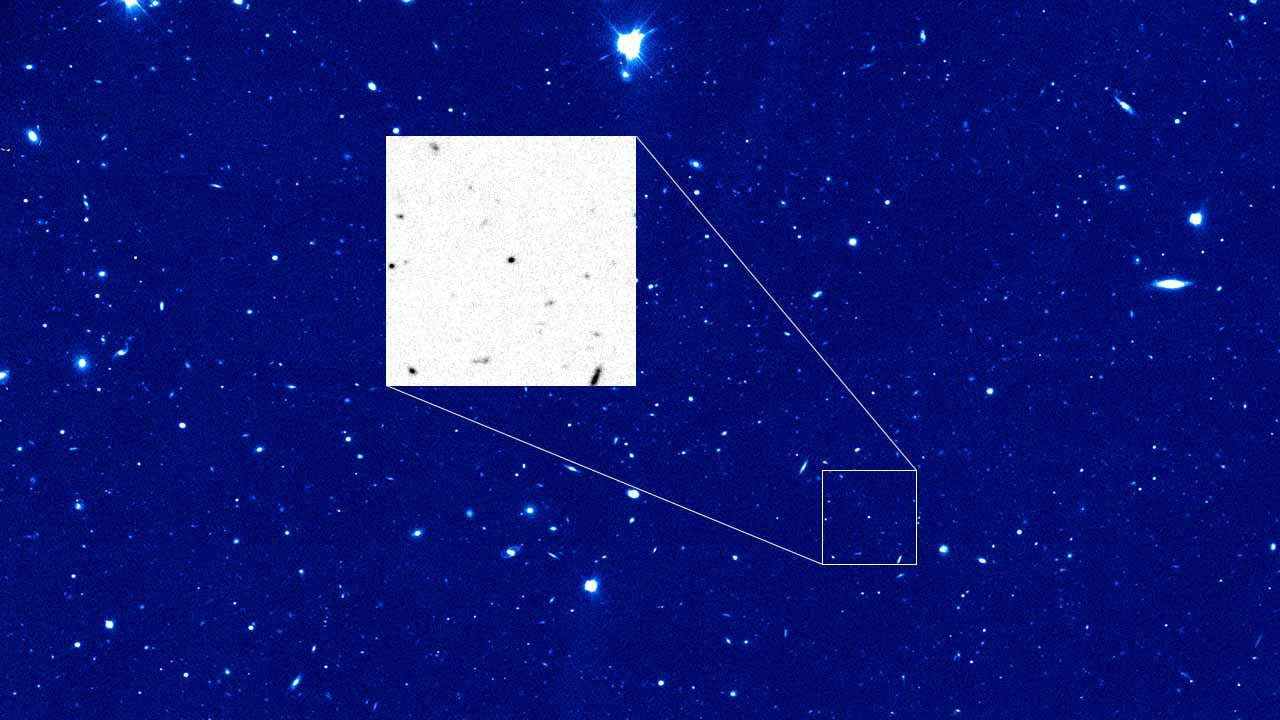
An accidental Subaru Telescope image of a distant bare comet is giving astronomers a clearer look at the surface of a cometary nucleus.
A comet can reveal its surface most clearly when it is still far from the Sun, before warming releases the gas and dust that normally hide its nucleus. Researchers found just such a bare comet unexpectedly in publicly available archival images from the Subaru Telescope, turning an accidental appearance in the background into an opportunity to study the object directly.
For astronomers trying to understand comets, seeing the nucleus itself is important. As a comet moves closer to the Sun, heating causes its nucleus to release gas, creating a surrounding cloud called a coma that blocks a clear view of the surface. Catching a comet before this activity begins requires observing it at a great distance, when it is extremely faint. That makes powerful observatories such as NAOJ’s Subaru Telescope, with its 8.2-m primary mirror, essential for detecting these distant objects.
An accidental image exposed a bare comet
The Subaru Telescope has accumulated a large archive of publicly accessible images covering broad regions of the sky. Although those observations were originally collected for different scientific purposes, unexpected Solar System objects can appear in the images, giving researchers another way to make discoveries from existing data.
Scientists from the University of Occupational and Environmental Health, Kyoto Sangyo University, and the National Astronomical Observatory of Japan searched the archive for these chance appearances. Subaru’s wide field of view, covering an area of sky approximately equal to nine full moons, combined with its sensitivity, allowed the researchers to identify Comet 28P/Neujmin more than 10 astronomical units from the Sun, a distance greater than that between the Sun and Saturn.
At that distance, the comet appeared without a surrounding coma, exposing its nucleus. By examining how sunlight reflected from its surface, the researchers identified important ways in which Comet 28P/Neujmin resembles and differs from asteroids, objects that do not show cometary activity.
More hidden comets could reveal their history
Researchers now hope to use the same approach to identify additional bare comets that happen to appear in archival observations. Studying more exposed nuclei could help reveal how comet surfaces have changed over the history of the Solar System and provide further clues to how Solar System bodies originally formed and evolved into the objects observed today.
Reference: “Opposition effect of comet 28P/Neujmin observed with Subaru Hyper Suprime-Cam” by Takafumi Ootsubo, Hideyo Kawakita, Tadafumi Takata, Junko Furusawa, Hisanori Furusawa, Tsuyoshi Terai, Toshihiro Kasuga, Akira Keida, Yoshiharu Shinnaka, Fumi Yoshida and Seitaro Urakawa, 25 August 2026, Publications of the Astronomical Society of Japan.
DOI: 10.1093/pasj/psag088
Funding: Japan Society for the Promotion of Science, New Energy and Industrial Technology Development Organization
Never miss a breakthrough: Join the SciTechDaily newsletter.
Follow us on Google and Google News.