

Newly identified CHL1 fibroblasts may help lung cancers escape immune attack by recruiting regulatory T cells around tumors.
A previously unknown population of fibroblasts appears to help lung tumors hide from the immune system by drawing suppressive T cells to the edge of the cancer. Columbia University researchers found that these CHL1-expressing cells can create an immune environment that protects tumors, while disrupting the signaling pathway involved allowed immune attacks against lung cancer in mice.
The same fibroblasts were also found in human lung cancers. Patients whose tumors contained more of them had weaker immune responses against their cancers and lower progression-free survival rates, suggesting that the cells themselves, or the immune-suppressing process they support, could eventually become treatment targets.
The work was published in Nature Immunology. Lung cancer remains the leading cause of cancer-related death in the United States.
Fibroblasts are seemingly normal cells commonly found around solid tumors, but research over the past several years has increasingly shown that some can support cancer rather than simply surround it.
“In the past five or ten years, a lot of research has shown these fibroblasts are helping the cancer and their activity is linked to patient outcomes,” says Olivia Ringham, a graduate student at Columbia’s Vagelos College of Physicians and Surgeons and lead investigator on the project.
“Much of the earlier work on these cancer-associated fibroblasts has focused on pancreatic cancer, but little is known about the cells in lung cancer,” says Nicholas Arpaia, associate professor of microbiology and immunology, senior author of the study, and Ringham’s adviser.
A hidden fibroblast population emerges
Ringham uncovered the cells while profiling fibroblasts from a mouse model of lung cancer using single-cell transcriptomics, a technique that measures gene activity in individual cells and can expose previously hidden cell populations.
“Single-cell transcriptomics has really had a huge development on the field over the last decade,” says Ringham. “It’s a great way to find hidden cell types and understand what those cells do.”
The analysis identified fibroblasts expressing a gene called CHL1, which is not normally found on fibroblasts in healthy lungs.
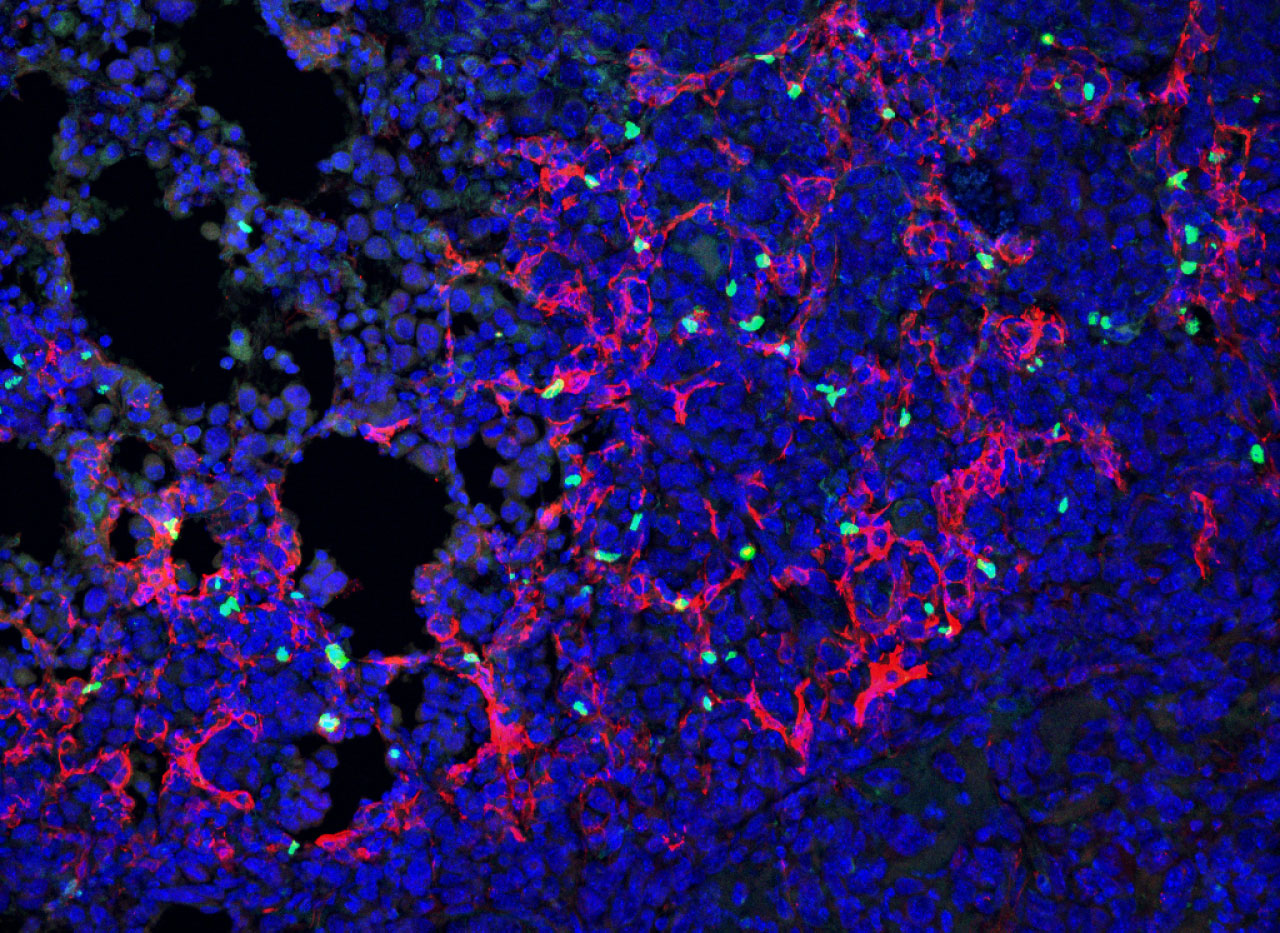
Further experiments showed how these cells could help tumors evade immune attack. The CHL1 fibroblasts recruited regulatory T cells to the tumor border. Under normal conditions, regulatory T cells help prevent excessive inflammation in the lungs by keeping immune responses under control.
“There are all these different environmental antigens that come into your lung at any given moment,” says Ringham.
Without regulatory T cells maintaining that balance, every breath could trigger a strong inflammatory response. In lung cancer, however, the same immune-suppressing function can work in the tumor’s favor by shielding it from attack.
Blocking the signal restores immune attack
Working with colleagues at Columbia and the University of Toronto, Ringham and Arpaia traced this recruitment to a signaling protein called CXCL9. When the researchers inactivated the relevant genes and blocked the signaling system in mice, fewer regulatory T cells accumulated around the cancer, allowing an immune response to attack the tumor.
The results suggest that attracting immunosuppressive T cells is an important survival strategy used by lung tumors to avoid elimination by the immune system.
Human tumors show the same pattern
The researchers then found the same CHL1 fibroblasts in human lung cancers. Analysis of tumor specimens and patient data from Columbia’s tissue bank showed that people whose tumors contained more of these cells also had reduced immune responses against their cancers and lower progression-free survival.
Arpaia says one potential strategy would be to target the regulatory T cells recruited by these fibroblasts, potentially allowing the immune system to mount a stronger response against the cancer.
The CHL1 fibroblasts themselves could offer another target because they do not appear in normal lungs. Researchers still do not know where the cells originate or what causes them to form.
“Where do these cells come from? How are they formed?” asks Ringham. “If we could stop that transformation, it could provide a great benefit.”
Reference: “A novel CAF population coordinates hyper-suppressive regulatory T cell recruitment and localization in lung cancer” by Olivia R. Ringham, Monica Rivera, Lucas F. Loffredo, Melih Arda Ozsoy, Christina M. Healy, Maye F. Cheng, Yinuo Jin, Noah Chen, Kenia de los Santos-Alexis, Elham Azizi, Anjali Saqi, Matthew B. Buechler, Carla P. Concepcion-Crisol and Nicholas Arpaia, 11 August 2026, Nature Immunology.
DOI: 10.1038/s41590-026-02607-2
The research was supported by the U.S. National Institutes of Health (grants T32AI106711, R01HL148718, R01CA304090, R21AI149657, and P30CA013696, which partly funded services provided by the Molecular Pathology Shared Resource at Columbia’s Herbert Irving Comprehensive Cancer Center.
Never miss a breakthrough: Join the SciTechDaily newsletter.
Follow us on Google and Google News.