

A study found that just seven days of strength training activated processes that help break down fat in mice.
People starting a new workout routine often look to the bathroom scale for immediate validation. When the numbers refuse to budge after a week of lifting weights, it is easy to assume the effort was wasted. But researchers at the State University of Campinas have found that short-term strength training activates mechanisms to break down visceral fat, the dangerous adipose tissue packed around internal organs, well before any overall weight loss occurs.
The study, published in the journal Life Sciences, isolated the biological impacts of exercise from the secondary changes triggered by dropping pounds. Researchers fed male mice a high-fat diet to induce obesity, then divided them into a sedentary group and an exercising group. Both groups continued eating the high-fat diet to ensure physical activity was the only difference between them.
“When we’re able to maintain the same body weight and observe what happened in the body, we can directly isolate what physical exercise contributed to before weight loss,” explains Leandro Moura, a physician, physical education professional, and professor at the university.
The experiment also included a group of mice fed a standard diet. To simulate strength training, the exercising animals climbed a staircase 70 centimeters, or about 28 inches, high with weights attached to their tails. They trained at 70% of their maximum carrying capacity, completing 20 climbs per session with rest intervals of 60 to 90 seconds. In total, they completed seven sessions over seven days.
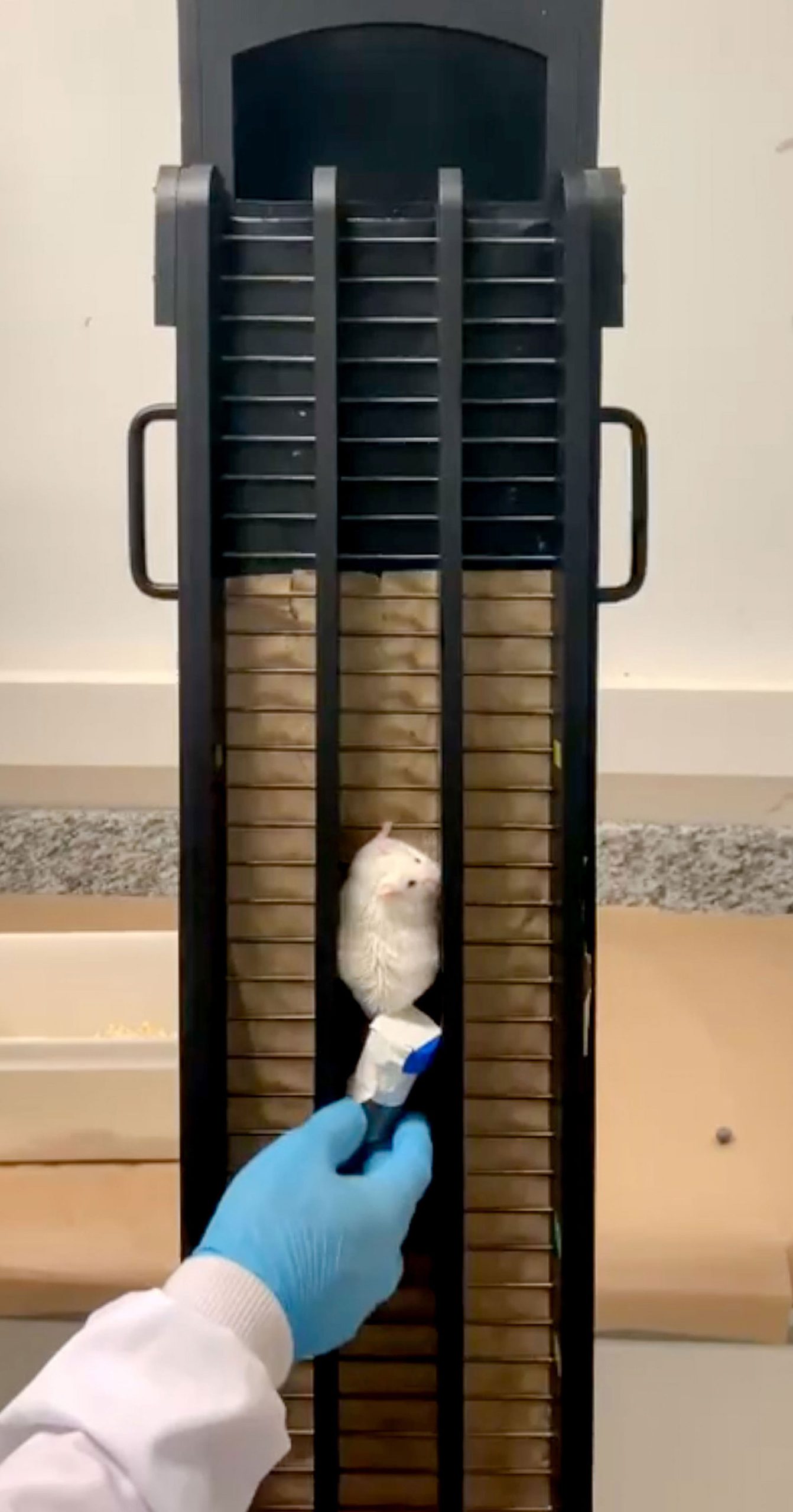
“We calculated how much weight each mouse could carry while climbing a staircase. Obviously, it isn’t possible to replicate the exact strength training exercises performed by a person, but we were able to induce a similar effort in the body, with more intense contractions, effectively mimicking a strength training session for humans,” Moura explains.
Weightlifting shrinks inflamed abdominal fat cells
The researchers focused on mesenteric adipose tissue, the fat surrounding the intestines, which Moura describes as a primary counterpart to human visceral fat. The exercised mice had less of this tissue and smaller fat-storing cells, called adipocytes, than the sedentary obese mice.
In obesity, adipocytes can become so enlarged that they experience chronic stress and release inflammatory substances into the bloodstream. These substances can disrupt metabolism throughout the body, helping explain why excess visceral fat is more harmful than subcutaneous fat beneath the skin. The team interpreted the smaller cells as a sign that the tissue was becoming less inflamed and metabolically healthier.
Moura coordinates the university’s Exercise Cell Biology Lab, which investigates how the body adapts to exercise. The FAPESP-supported study is part of research on exercise, obesity, and diabetes that began in 2007. Advances in molecular analysis have allowed the group to examine the cellular processes behind visible outcomes such as weight loss and muscle growth.
“We’ve always heard that physical exercise burns fat and helps you lose weight. But we rarely stop to think about how that happens, how much exercise is needed, and what that fat burning actually means,” Moura says.
Exercise reactivates stalled fat-clearing proteins
Before stored fat can be used for energy, cells must break it down through a process called lipolysis. A protein called PLIN1, or perilipin-1, helps control access to those fat stores. In response to exercise, PLIN1 changes and releases another protein, ABHD5. Once released, ABHD5 can activate ATGL, an enzyme that begins breaking down triglycerides, the fat stored inside the cell.
The sedentary obese mice had less ABHD5 available to help activate ATGL. Strength training increased the interaction between the two proteins, restoring part of the fat breakdown process that obesity had impaired. Other molecular signals associated with lipolysis also became more active.
Exercise affected fat production as well. The trained mice showed lower activity of Scd1, a gene involved in making fat molecules. The researchers interpret that decrease as a sign that the body may become less likely to store calories from food as fat.
“People tend to think that if they’ve been strength training for two months and haven’t lost weight, it hasn’t done any good. But what we saw in this study is that after just seven days of strength training – even when there was still no weight loss – the molecular pathways that promote fat accumulation were less active, while those that stimulate fat breakdown were more active,” Moura comments.
Cellular health benefits precede visible weight loss
The findings remain experimental. The study included only male mice, examined a single fat deposit, and assessed genes, proteins, and molecular signals related to fat breakdown. It does not establish that a week of strength training would produce the same effects in people.
Moura says the results challenge the idea that strength training only builds muscle while aerobic exercise is responsible for weight loss.
“Both types of exercise activate similar pathways – at different intensities – as well as different pathways. Therefore, combining the two remains the best recommendation and the best strategy for those who want to lose weight,” says Moura.
For people who have just begun exercising, he adds, “Even if we aren’t seeing anything yet with the naked eye, metabolically, inside our bodies, various signals that are beneficial to health – including weight loss – are taking place. That’s why we shouldn’t get discouraged by the lack of visible results after a short period of strength training,”
The team plans to monitor longer training periods to understand how these early responses develop as weight loss begins. Researchers are also investigating how exercise affects other fat deposits, including those around the heart.
Reference: “Strength training induces ABHD5-ATGL axis to counteract mesenteric fat accumulation in obese Swiss mice” by Diego Gomes de Melo, Camila Oliveira Ramos, Vivian Cristina da Cruz Rodrigues, Gustavo José de Sá Pereira, Rafael dos Santos Brícola, Dennys Esper Corrêa Cintra and Leandro Pereira de Moura, 23 June 2026, Life Sciences.
DOI: 10.1016/j.lfs.2026.124546
This study was supported by CNPQ, CAPES, and FAPESP (project numbers 2021/14385-8, 2021/00880-7, and 2024/00996-7)
Never miss a breakthrough: Join the SciTechDaily newsletter.
Follow us on Google and Google News.