
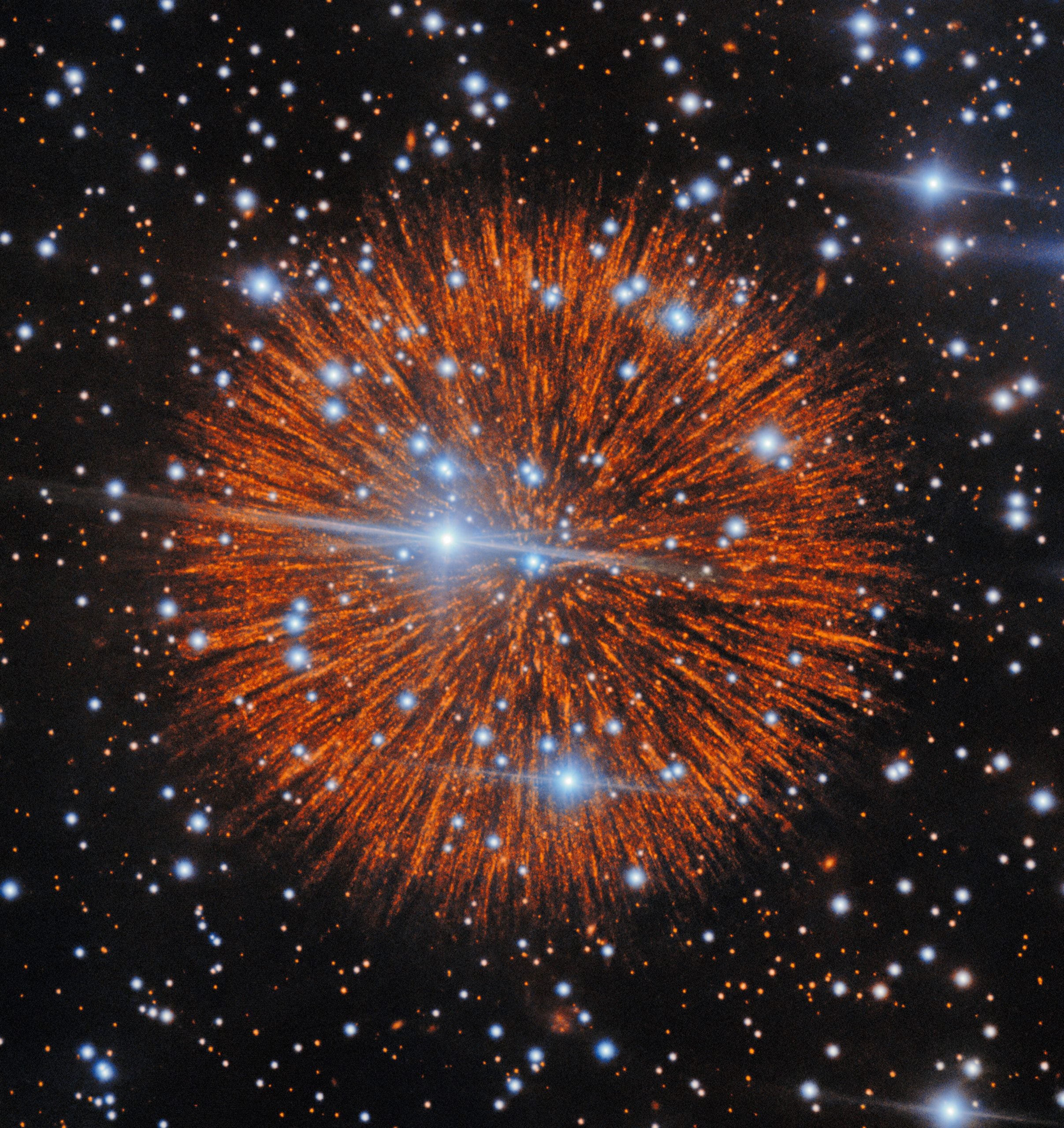
With roughly ten times as many gas filaments now resolved, the supernova remnant Pa 30 could guide searches for other stellar explosions that left surviving stars.
A star survived the explosion that left behind Pa 30, a dandelion-shaped cloud of debris. The sharpest images yet show that the apparently smooth streaks around this “zombie star” are tight chains of gas knots resembling pearls on a string.
A citizen scientist first identified Pa 30 in 2013. Astronomers later connected it to a supernova witnessed in 1181, nearly 850 years ago, and independently documented in Japanese, Chinese, and Arabic historical sources. That association linked Pa 30 to one of just five supernovae recorded before the telescope era whose remnants had long remained unidentified.
An international team captured the images using NOIRLab’s Gemini North telescope. The work was co-led by Tim Cunningham from the Center for Astrophysics | Harvard & Smithsonian and Ilaria Caiazzo, assistant professor at the Institute of Science and Technology Austria (ISTA), and the findings were published in The Astrophysical Journal.
Ten times as many gas filaments
At about 7,500 light-years from Earth, Pa 30 is relatively close on the scale of the universe. For comparison, the center of the Milky Way lies about 26,000 light-years away.
“We can see this much detail because of Pa 30’s proximity to Earth,” says Caiazzo. “This proximity makes Pa 30 uniquely valuable for study.”
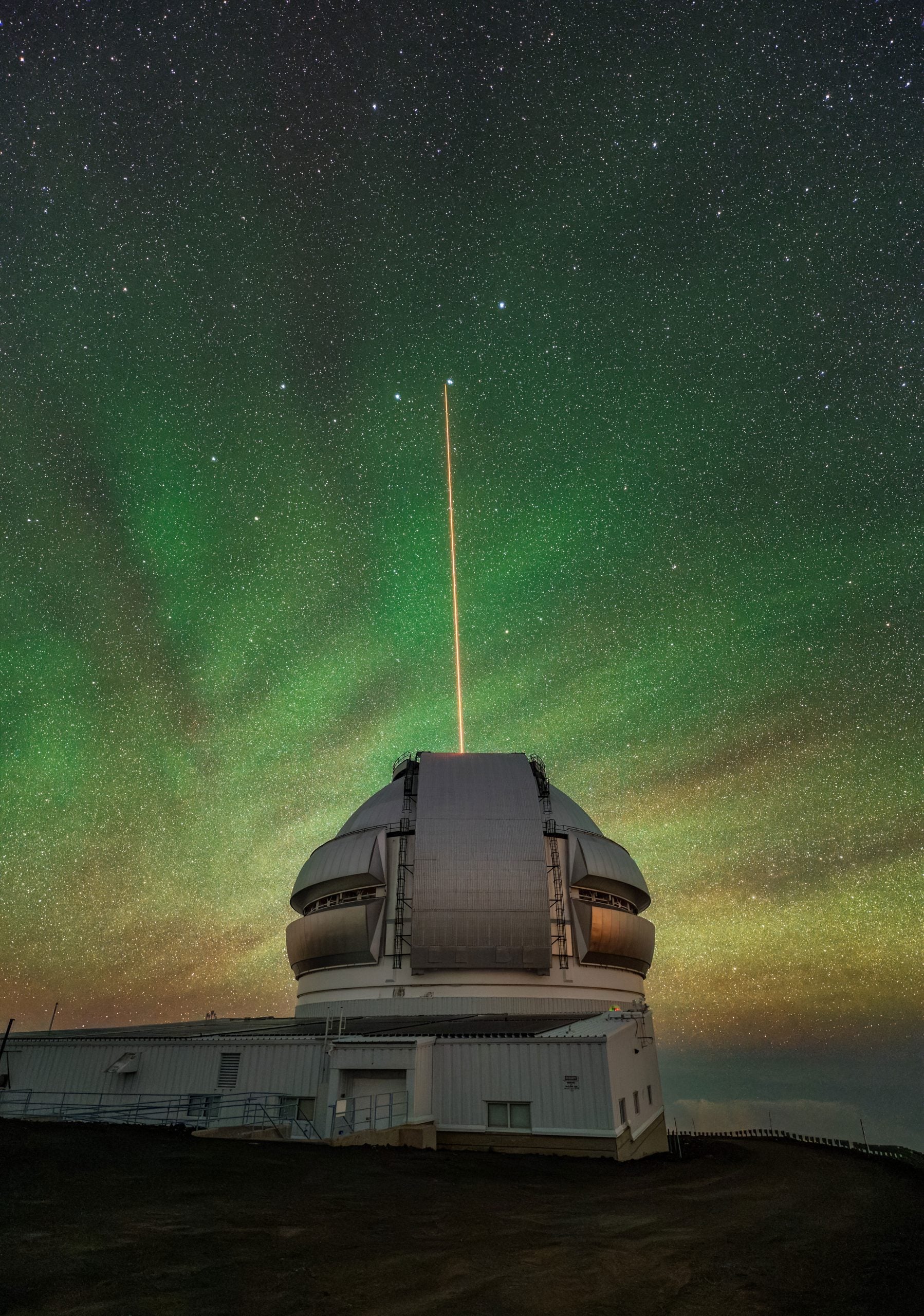
Gemini North’s capabilities and its location on Mauna Kea in Hawaii helped the researchers obtain their detailed view. The telescope stands more than 4,200 meters, or roughly 13,800 feet, above sea level at one of the world’s leading astronomical observing sites. It forms one half of the International Gemini Observatory, alongside its twin, Gemini South, in Chile. Gemini North is partly funded by the U.S. National Science Foundation (NSF) and operated by NSF NOIRLab.

The researchers analyzed emission lines, specific wavelengths of light released by gas, from ionized sulfur (S II) in the red part of the visible spectrum. They also examined emission from doubly ionized oxygen (O III), displayed in blue-green tones. The sulfur observations revealed roughly ten times as many filamentary features as previous images could resolve.
“The planetary region of our solar system could fit in each knot about ten times with room to spare,” says Caiazzo, referring to the region extending out to Neptune’s orbit, the solar system’s outermost planet. “The knots are quite strikingly uniform. We are excited to try to model them.”
Little sideways recoil for the surviving star
The star inside this intricate cloud survived a Type Iax supernova, a rare kind of incomplete stellar explosion. Pa 30 is the only known remnant of its kind in the Milky Way. Astronomers have identified a few similar objects in other galaxies, but Pa 30 is the only one in which telescopes can see the surviving stellar remnant at the core. Researchers have proposed that it formed when two white dwarfs collided. These extremely dense, Earth-sized stellar remnants have exhausted their fuel and shed their outer layers.
The new observations placed the surviving star almost perfectly at the nebula’s center. In many supernovae, an asymmetric explosion gives a surviving star a kick that sends it away from the explosion site. The team investigated that possibility by constraining the star’s transverse speed, meaning how fast it moves across the sky.
“Explosions conserve momentum. If the explosion itself was perfectly symmetric, the ejecta should also be symmetric, and the surviving star should not receive a substantial kick,” says Caiazzo. “We were able to measure a precise upper limit of the remnant star’s transverse kick speed, showing that it was surprisingly small. We practically don’t see the star moving away at all.”
More Type Iax remnants may await discovery
Despite the rarity of Type Iax supernovae, the team does not consider the identification of such a remnant unexpected.
“Reliable historical records of stellar explosions extend back only about a thousand years. For all we know, there might well be similar remnants still lurking in the dark in our own galaxy,” Cunningham says. “Today, we are lucky to study an intriguing object we know was observed by astronomers who made three independent historical records of the event centuries before the invention of the telescope.”
“We will likely identify more similar objects as new telescopes continue to inspect the depths of our night sky,” adds Cunningham, who is now an assistant professor at the University of Warwick in the United Kingdom.
Questions about Pa 30 remain, including how to explain its remarkably uniform knots. The observations also provide a detailed example against which astronomers can compare potential remnants in large surveys.
“Astronomy has entered the big data era,” says Cunningham. “Our findings will help us screen through the enormous datasets.”
Caiazzo adds, “In general, the farther into space we look, the more difficult it is to detect faint signals and interpret them. While we can see Type Iax supernovae in distant galaxies as point sources of light, resolving the remnants of such explosions is only possible in our own galaxy and in very few nearby ones. Eventually, we plan to use Pa 30’s distinctive properties to search the Milky Way and nearby galaxies for similar objects.”
Reference: “Detection of Knots in the Type Iax Supernova Remnant Pa 30” by Tim Cunningham, Ilaria Caiazzo, John C. Raymond and Scott J. Kenyon, 6 October 2026, The Astrophysical Journal.
DOI: 10.3847/1538-4357/ae9cb2
This project was supported by NASA through the NASA Hubble Fellowship grant HST-HF2-51527.001-A awarded by the Space Telescope Science Institute, which is operated by the Association of Universities for Research in Astronomy, Inc., for NASA, under contract NAS5-26555.
Never miss a breakthrough: Join the SciTechDaily newsletter.
Follow us on Google and Google News.