
Close Menu
    Facebook X (Twitter) Instagram
    SciTechDaily
    • Biology
    • Chemistry
    • Earth
    • Health
    • Physics
    • Science
    • Space
    • Technology
    Facebook X (Twitter) Pinterest YouTube RSS
    SciTechDaily
    Home»Space»Map of the Entire Sky in X-Rays Recorded by NASA’s NICER
    Space

    Map of the Entire Sky in X-Rays Recorded by NASA’s NICER

    By Francis Reddy, NASA's Goddard Space Flight CenterJune 1, 2019No Comments3 Mins Read
    Facebook Twitter Pinterest Telegram LinkedIn WhatsApp Email Reddit
    Share
    Facebook Twitter LinkedIn Pinterest Telegram Email Reddit

    NICER’s Night Moves Trace the X ray Sky

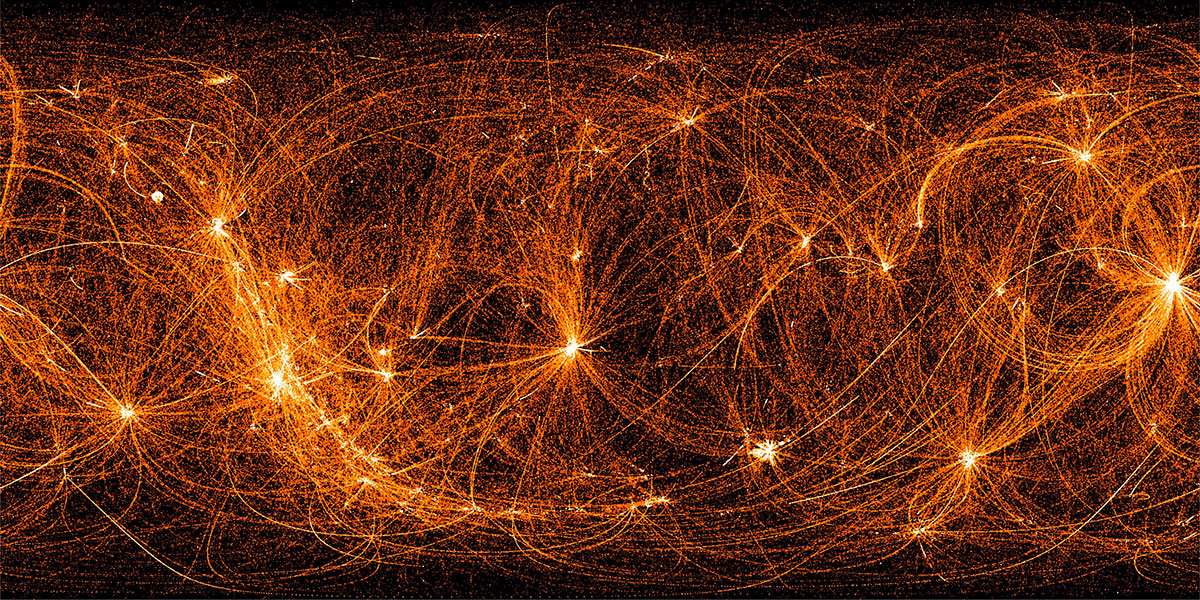
    In this image, numerous sweeping arcs seem to congregate at various bright regions. You may wonder: What is being shown? Air traffic routes? Information moving around the global internet? Magnetic fields looping across active areas on the Sun?

    In fact, this is a map of the entire sky in X-rays recorded by NASA’s Neutron star Interior Composition Explorer (NICER), a payload on the International Space Station. NICER’s primary science goals require that it target and track cosmic sources as the station orbits Earth every 93 minutes. But when the Sun sets and night falls on the orbital outpost, the NICER team keeps its detectors active while the payload slews from one target to another, which can occur up to eight times each orbit.

    The map includes data from the first 22 months of NICER’s science operations. Each arc traces X-rays, as well as occasional strikes from energetic particles, captured during NICER’s night moves. The brightness of each point in the image is a result of these contributions as well as the time NICER has spent looking in that direction. A diffuse glow permeates the X-ray sky even far from bright sources.

    NICER’s Moves Trace the X ray Sky
    This image of the whole sky shows 22 months of X-ray data recorded by NASA’s Neutron star Interior Composition Explorer (NICER) payload aboard the International Space Station during its nighttime slews between targets. Credit: NASA/NICER

    The prominent arcs form because NICER often follows the same paths between targets. The arcs converge on bright spots representing NICER’s most popular destinations — the locations of important X-ray sources the mission regularly monitors.

    “Even with minimal processing, this image reveals the Cygnus Loop, a supernova remnant about 90 light-years across and thought to be 5,000 to 8,000 years old,” said Keith Gendreau, the mission’s principal investigator at NASA’s Goddard Space Flight Center in Greenbelt, Maryland. “We’re gradually building up a new X-ray image of the whole sky, and it’s possible NICER’s nighttime sweeps will uncover previously unknown sources.”

    NICER’s primary mission is to determine the size of dense remains of dead stars called neutron stars — some of which we see as pulsars — to a precision of 5%. These measurements will finally allow physicists to solve the mystery of what form of matter exists in their incredibly compressed cores. Pulsars, rapidly spinning neutron stars that appear to “pulse” bright light, are ideally suited to this “mass-radius” research and are some of NICER’s regular targets.

    Other frequently visited pulsars are studied as part of NICER’s Station Explorer for X-ray Timing and Navigation Technology (SEXTANT) experiment, which uses the precise timing of pulsar X-ray pulses to autonomously determine NICER’s position and speed in space. It’s essentially a galactic GPS system. When mature, this technology will enable spacecraft to navigate themselves throughout the solar system — and beyond.

    Never miss a breakthrough: Join the SciTechDaily newsletter.
    Follow us on Google and Google News.

    Astronomy Cosmology NICER
    Share. Facebook Twitter Pinterest LinkedIn Email Reddit

    Related Articles

    Scientists Chart Environment Surrounding a Stellar-Mass Black Hole

    Dark Matter Filament in Galaxy Supercluster Directly Measured

    ESA’s Euclid Mission Receives Final Approval

    Calculations Show the Ideal Time to Study the Cosmos

    New Model May Rule Out the Presence of Dark Matter

    Lyman-Alpha Blobs are Some of the Largest Individual Objects in the Observable Universe

    Links Between Core Collapse Supernovae and Star Formation Established

    The Bolshoi Simulation: Boxing the Universe

    Baryon Oscillation Spectroscopic Survey Measures the Universe’s Expansion and Dark Energy

    Leave A Reply Cancel Reply

    • Facebook
    • Twitter
    • Pinterest
    • YouTube

    Don't Miss a Discovery

    Subscribe for the Latest in Science & Tech!

    Trending News

    The Universe Is Expanding Too Fast and Scientists Can’t Explain Why

    “Like Liquid Metal”: Scientists Create Strange Shape-Shifting Material

    Early Warning Signals of Esophageal Cancer May Be Hiding in Plain Sight

    Common Blood Pressure Drug Shows Surprising Power Against Deadly Antibiotic-Resistant Superbug

    Scientists Uncover Dangerous Connection Between Serotonin and Heart Valve Disease

    Scientists Discover a “Protector” Protein That Could Help Reverse Hair Loss

    Bone-Strengthening Discovery Could Reverse Osteoporosis

    Scientists Uncover Hidden Trigger Behind Stem Cell Aging

    Follow SciTechDaily
    • Facebook
    • Twitter
    • YouTube
    • Pinterest
    • Newsletter
    • RSS
    SciTech News
    • Biology News
    • Chemistry News
    • Earth News
    • Health News
    • Physics News
    • Science News
    • Space News
    • Technology News
    Recent Posts
    • A Common Diabetes Drug May Hold the Key to Stopping HIV From Coming Back
    • Ancient “Syphilis-Like” Disease in Vietnam Challenges Key Scientific Assumptions
    • Drinking Alcohol To Cope in Your 20s Could Damage Your Brain for Life
    • Scientists Crack Alfalfa’s Chromosome Mystery After Decades of Debate
    • Ancient Ant-Plant Alliance Collapses As Predatory Wasps Move In
    Copyright © 1998 - 2026 SciTechDaily. All Rights Reserved.
    • Science News
    • About
    • Contact
    • Editorial Board
    • Privacy Policy
    • Terms of Use

    Type above and press Enter to search. Press Esc to cancel.