
Close Menu
    Facebook X (Twitter) Instagram
    SciTechDaily
    • Biology
    • Chemistry
    • Earth
    • Health
    • Physics
    • Science
    • Space
    • Technology
    Facebook X (Twitter) Pinterest YouTube RSS
    SciTechDaily
    Home»Technology»Augmented Reality Glasses Help People With Low Vision Navigate Their Environment
    Technology

    Augmented Reality Glasses Help People With Low Vision Navigate Their Environment

    By Mary Dacuma, University of Southern CaliforniaAugust 26, 2019No Comments3 Mins Read
    Facebook Twitter Pinterest Telegram LinkedIn WhatsApp Email Reddit
    Share
    Facebook Twitter LinkedIn Pinterest Telegram Email Reddit
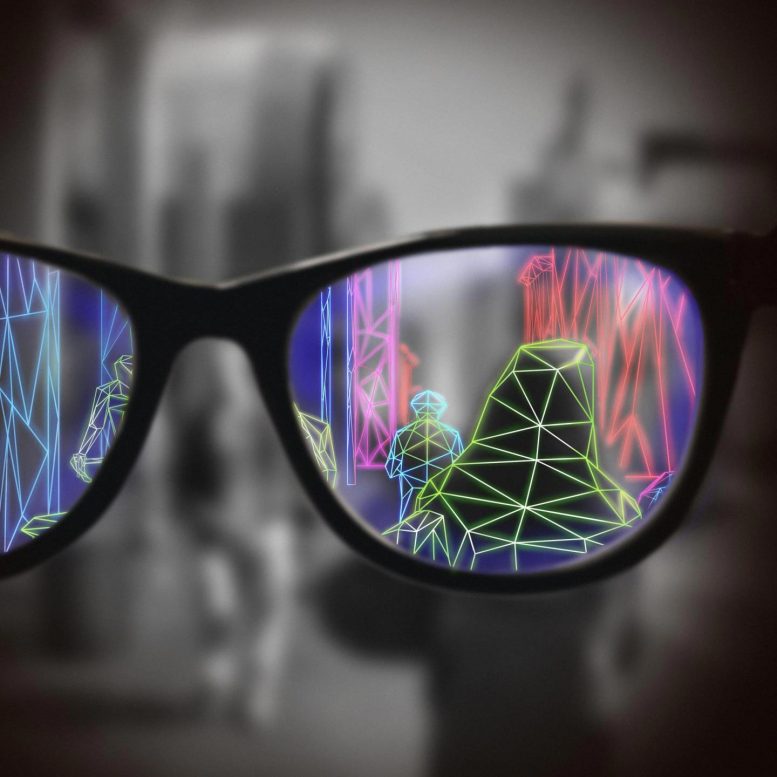
    Artistic Rendering of Augmented Reality Glasses
    Graphic representation of what a patient sees when wearing an augmented reality low vision aid. Credit: Scott Song for USC Roski Eye Institute

    Glasses enhance mobility and function in patients who have difficulty with peripheral vision or seeing in low light.

    Nearly one in 30 Americans over the age of 40 experience low vision — significant visual impairment that can’t be corrected with glasses, contact lenses, medication or surgery.

    In a new study of patients with retinitis pigmentosa, an inherited degenerative eye disease that results in poor vision, Keck School of Medicine of USC researchers found that adapted augmented reality (AR) glasses can improve patients’ mobility by 50% and grasp performance by 70%.

    “Current wearable low vision technologies using virtual reality are limited and can be difficult to use or require patients to undergo extensive training,” said Mark Humayun, MD, PhD, director of the USC Dr. Allen and Charlotte Ginsburg Institute for Biomedical Therapeutics, co-director of the USC Roski Eye Institute and University Professor of Ophthalmology at the Keck School.

    Mark Humayun University of Southern California Health Sciences
    Mark Humayun, MD, Ph.D. Credit: Ricardo Carrasco III, Keck Medicine of USC

    “Using a different approach — employing assistive technology to enhance, not replace, natural senses — our team adapted AR glasses that project bright colors onto patients’ retinas, corresponding to nearby obstacles,” Humayun said.

    Patients with retinitis pigmentosa wore adapted AR glasses as they navigated through an obstacle course based on a U.S. Food and Drug Administration-validated functional test. Using video of each test, researchers recorded the number of times patients collided with obstacles, as well as the time taken to complete the course. Patients averaged 50% fewer collisions with the adapted AR glasses.

    Patients also were asked to grasp a wooden peg against a black background — located behind four other wooden pegs — without touching the front items. Patients demonstrated a 70% increase in grasp performance with the AR glasses.

    “Patients with retinitis pigmentosa have decreased peripheral vision and trouble seeing in low light, which makes it difficult to identify obstacles and grasp objects. They often require mobility aids to navigate, especially in dark environments,” said Anastasios N. Angelopoulos, study project lead in Humayun’s research laboratory at the Keck School.

    “Through the use of AR, we aim to improve the quality of life for low vision patients by increasing their confidence in performing basic tasks, ultimately allowing them to live more independent lives,” Angelopoulos says.

    How the AR system works

    The AR system overlays objects within a 6-foot wireframe with four bright, distinct colors. In doing so, the glasses provide visual color cues that help people with constricted peripheral vision interpret complex environments, such as avoiding obstacles in dimly lit environments.

    To accomplish this, researchers used a process called simultaneous location and mapping, allowing the AR glasses to fully render the 3D structure of a room in real-time. The glasses then translated this information into a semitransparent colored visual overlay, which highlighted potential obstacles with bright colors to help patients with spatial understanding and depth perception. This technology can work on commercially available devices.

    According to Humayun, while major cost and technical issues remain, this type of assistive technology could eventually become more practical for everyday use in the near future.

    Reference: “Enhanced Depth Navigation Through Augmented Reality Depth Mapping in Patients with Low Vision” by Anastasios Nikolas Angelopoulos, Hossein Ameri, Debbie Mitra and Mark Humayun, 2 August 2019, Scientific Reports.
    DOI: 10.1038/s41598-019-47397-w

    Never miss a breakthrough: Join the SciTechDaily newsletter.
    Follow us on Google and Google News.

    Augmented Reality Keck School of Medicine of USC University of Southern California Vision
    Share. Facebook Twitter Pinterest LinkedIn Email Reddit

    Related Articles

    Researchers Link New Neuron Growth to Enhanced Memory and Learning in Adults

    Efficient AI Ahead: USC’s Memristor Breakthrough Transforms Analog Computing

    Metasurface Magic Unlocks the Future of Holographic Displays

    Morning Sickness Mystery Solved: Researchers Identify Key Cause and Potential Treatment

    From Pixels to Paradigms: MIT’s Synthetic Leap in AI Training

    A Visionary Leap: Enhancing Computer Vision for Autonomous Vehicles and Cyborgs

    Unlocking the Lizard’s Secret: A Breakthrough in Cartilage Regeneration

    X-Ray Vision: MIT’s Augmented Reality Headset Enables You To See Hidden Objects

    Advanced Computer Model Enables Improvements to “Bionic Eye” Technology

    Leave A Reply Cancel Reply

    • Facebook
    • Twitter
    • Pinterest
    • YouTube

    Don't Miss a Discovery

    Subscribe for the Latest in Science & Tech!

    Trending News

    Researchers Have Found a Dietary Compound That Increases Longevity

    Scientists Baffled by Bizarre “Living Fossil” From 275 Million Years Ago

    Your IQ at 23 Could Predict Your Wealth at 27, Study Finds

    320 Light-Years Away, a Planet Confirms a Fundamental Cosmic Assumption

    The Crown Jewel of Dentistry? Breakthrough Tech Could Transform Tooth Repair

    Python Blood Could Hold the Secret to Weight Loss Without Side Effects

    Naturally Occurring Bacteria Completely Eradicate Tumors in Mice With a Single Dose

    New “Nanozyme Hypothesis” Could Rewrite the Story of Life’s Origins

    Follow SciTechDaily
    • Facebook
    • Twitter
    • YouTube
    • Pinterest
    • Newsletter
    • RSS
    SciTech News
    • Biology News
    • Chemistry News
    • Earth News
    • Health News
    • Physics News
    • Science News
    • Space News
    • Technology News
    Recent Posts
    • A New Chapter in Chemistry? Scientists Uncover New Way Metals Bind Oxygen
    • New Study Reveals Earth Is Getting Brighter at Night – About 2% Each Year
    • Accidental Deep Ocean Discovery Reveals Hidden Carbon Sink
    • Cooling the Planet Could Come at a Devastating Cost
    • These New Molecules Could Change How We Treat Lupus and Arthritis
    Copyright © 1998 - 2026 SciTechDaily. All Rights Reserved.
    • Science News
    • About
    • Contact
    • Editorial Board
    • Privacy Policy
    • Terms of Use

    Type above and press Enter to search. Press Esc to cancel.