
Close Menu
    Facebook X (Twitter) Instagram
    SciTechDaily
    • Biology
    • Chemistry
    • Earth
    • Health
    • Physics
    • Science
    • Space
    • Technology
    Facebook X (Twitter) Pinterest YouTube RSS
    SciTechDaily
    Home»Space»Gamma-Ray Burst With Highest Energy Ever Seen – A Trillion Times More Powerful Than Visible Light
    Space

    Gamma-Ray Burst With Highest Energy Ever Seen – A Trillion Times More Powerful Than Visible Light

    By NASA's Goddard Space Flight CenterNovember 20, 2019No Comments3 Mins Read
    Facebook Twitter Pinterest Telegram LinkedIn WhatsApp Email Reddit
    Share
    Facebook Twitter LinkedIn Pinterest Telegram Email Reddit
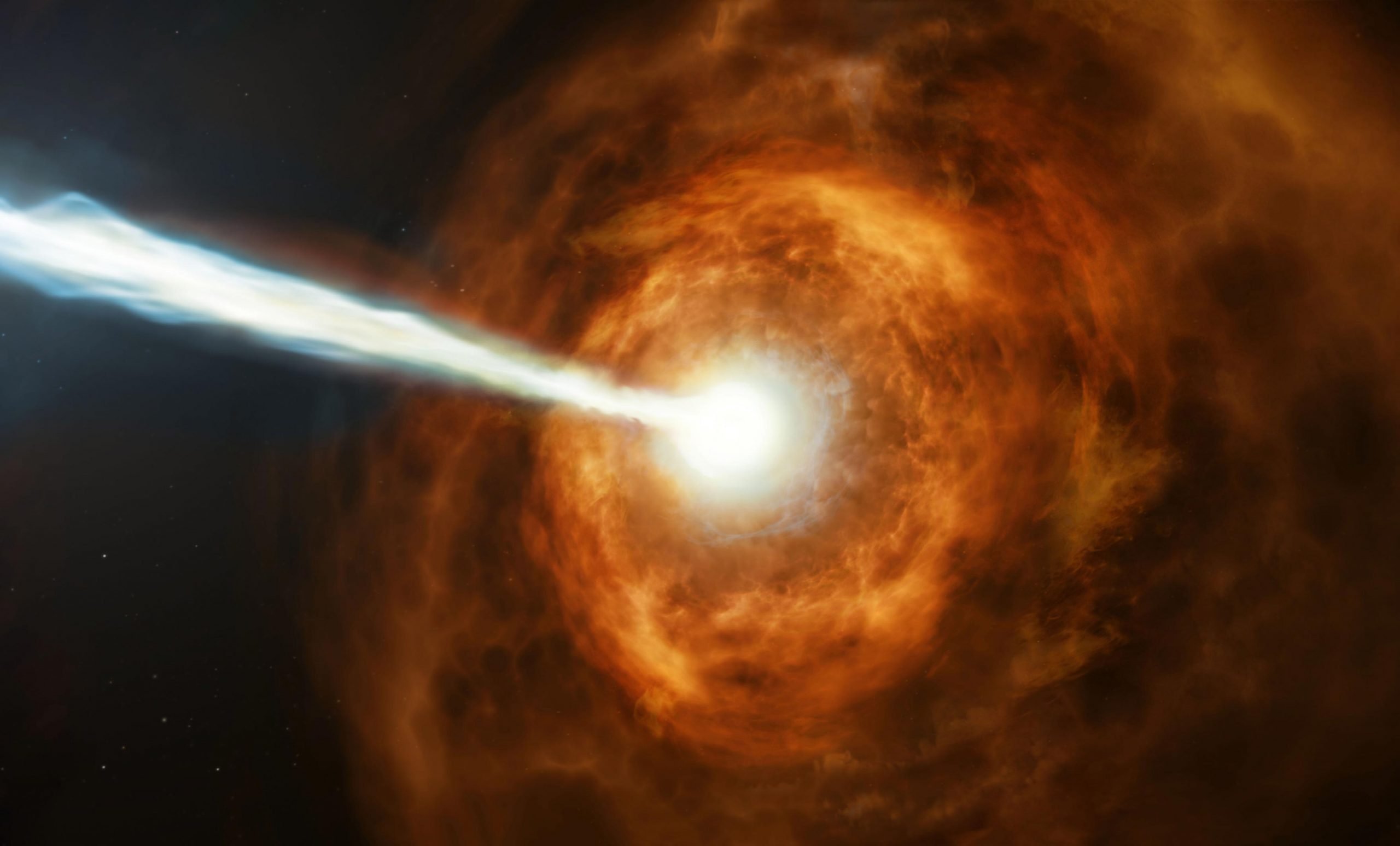
     Powerful Gamma-Ray Burst GRB 190114C
    New observations from NASA’s Hubble Space Telescope have investigated the nature of the powerful gamma-ray burst GRB 190114C by studying its environment. Shown in this illustration, gamma-ray bursts are the most powerful explosions in the universe. They emit most of their energy in gamma rays, light which is much more energetic than the visible light we can see with our eyes. Hubble’s observations suggest that this particular burst displayed such powerful emission because the collapsing star was sitting in a very dense environment, right in the middle of a bright galaxy 5 billion light-years away. Credit: NASA, ESA and M. Kornmesser

    NASA’s Hubble Space Telescope has given astronomers a peek at the location of the most energetic outburst ever seen in the universe — a blast of gamma-rays a trillion times more powerful than visible light. That’s because in a few seconds the gamma-ray burst (GRB) emitted more energy than the Sun will provide over its entire 10-billion year life.

    In January 2019, an extremely bright and long-duration GRB was detected by a suite of telescopes, including NASA’s Swift and Fermi telescopes, as well as by the Major Atmospheric Gamma Imaging Cherenkov (MAGIC) telescopes on the Canary islands. Follow-up observations were made with Hubble to study the environment around the GRB and find out how this extreme emission is produced.

    In a few seconds the gamma-ray burst (GRB) emitted more energy than the Sun will provide over its entire 10-billion year life.

    “Hubble’s observations suggest that this particular burst was sitting in a very dense environment, right in the middle of a bright galaxy 5 billion light-years away. This is really unusual, and suggests that this concentrated location might be why it produced this exceptionally powerful light,” explained one of the lead authors, Andrew Levan of the Institute for Mathematics, Astrophysics and Particle Physics Department of Astrophysics at Radboud University in the Netherlands.

    “Scientists have been trying to observe very high energy emission from gamma-ray bursts for a long time,” explained lead author Antonio de Ugarte Postigo of the Instituto de Astrofísica de Andalucía in Spain. “This new Hubble observation of accompanying lower-energy radiation from the region is a vital step in our understanding of gamma-ray bursts [and] their immediate surroundings.”

    The complementary Hubble observations reveal that the GRB occurred within the central region of a massive galaxy. Researchers say that this is a denser environment than typically observed (for GRBs) and could have been crucial for the generation of the very-high-energy radiation that was observed. The host galaxy of the GRB is actually one of a pair of colliding galaxies. The galaxy interactions may have contributed to spawning the outburst.

    Known as GRB 190114C, some of the radiation detected from the object had the highest energy ever observed. Scientists have been trying to observe such very high energy emission from GRBs for a long time, so this detection is considered a milestone in high-energy astrophysics, say researchers.

    Previous observations revealed that to achieve this energy, material must be emitted from a collapsing star at 99.999% the speed of light. This material is then forced through the gas that surrounds the star, causing a shock that creates the gamma-ray burst itself.

    Never miss a breakthrough: Join the SciTechDaily newsletter.
    Follow us on Google and Google News.

    Astronomy Astrophysics Hubble Space Telescope NASA NASA Goddard Space Flight Center Popular
    Share. Facebook Twitter Pinterest LinkedIn Email Reddit

    Related Articles

    3.7 Billion Miles Away: Hubble Uncovers a Hidden Trio That Could Rewrite Kuiper Belt History

    Historic Discovery: Twin Titans Clash As NASA Unveils Closest Supermassive Black Hole Duo

    Cyclones in Space? See How Hubble Uncovered Extreme Weather on a Distant Planet

    Astronomers Puzzled After Hubble View of Torrential Outflows From Infant Stars Blows Hole in Current Theories

    Hubble Space Telescope Explains Oddball Galaxy’s Missing Dark Matter

    Gas Far Outside of Our Galaxy Illuminated by Enormous Burst of Energy Unleashed by Milky Way’s Black Hole

    Quasar Tsunamis Tear Across Interstellar Space Wreaking Havoc on Galaxies

    ‘Cotton Candy’ Planet Mysteries Unravel – Nothing Like Them Exists in Our Solar System

    Mystery As Hubble Finds Milky Way Raids Intergalactic ‘Bank Accounts’

    Leave A Reply Cancel Reply

    • Facebook
    • Twitter
    • Pinterest
    • YouTube

    Don't Miss a Discovery

    Subscribe for the Latest in Science & Tech!

    Trending News

    Don’t Miss: A Brilliant Venus and Glowing Harvest Moon Light Up the Sky

    New Twist on the Einstein Problem Reveals Unexpected Physics

    JWST Captures Stunning Evidence of How Supermassive Black Holes Feed

    Early Exercise May Permanently Change How Much Energy the Body Uses To Move

    New Molecule Wipes Out Aggressive Lymphoma Tumors in Mice in Just 11 Days

    The Human Family Tree May Need a Major Rewrite

    Scientists Find a Surprising Cancer-Fighting Effect in Dark Sweet Cherries

    New AI Detects Hidden Warning Signs of Solar Eruptions Hours Before They Emerge

    Follow SciTechDaily
    • Facebook
    • Twitter
    • YouTube
    • Pinterest
    • Newsletter
    • RSS
    SciTech News
    • Biology News
    • Chemistry News
    • Earth News
    • Health News
    • Physics News
    • Science News
    • Space News
    • Technology News
    Recent Posts
    • Pomegranates Could Unlock a New Treatment for Heart Failure
    • Africa’s Giant Herbivores Were Disappearing Millions of Years Before Humans Could Hunt Them
    • This Utah Mountain Is Hiding Enough Ice To Fill 600 Olympic Pools
    • Vagus Nerve Stimulation Could Unlock the Brain’s Hidden Learning Potential
    • Your Mother’s Age May Leave a Biological Mark That Lasts for Generations
    Copyright © 1998 - 2026 SciTechDaily. All Rights Reserved.
    • Science News
    • About
    • Contact
    • Editorial Board
    • Privacy Policy
    • Terms of Use

    Type above and press Enter to search. Press Esc to cancel.