
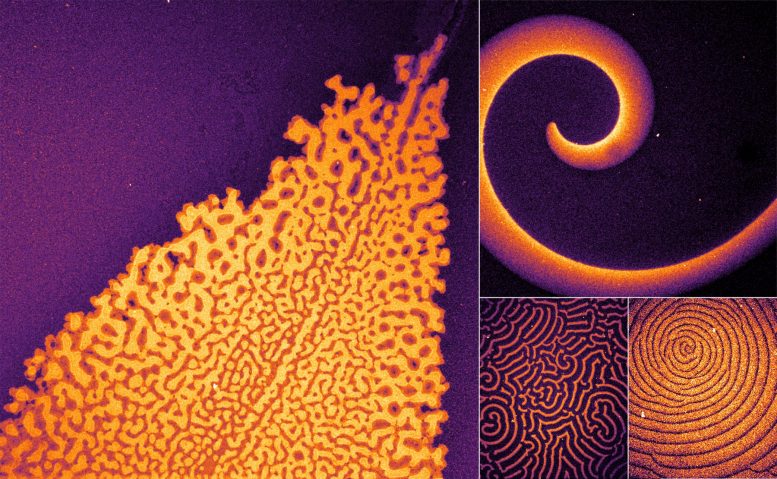
Dissecting self-organizing protein systems step by step may help scientists design the process of biological pattern formation from minimal ingredients.
Probing the functional segments, or ‘motifs,’ of proteins has helped scientists identify the minimal ingredients needed for them to form biological patterns.
Writing in the journal eLife, the researchers describe how they dissected the biological phenomenon of protein pattern formation into its main functional modules, and then rebuilt the process from the ground up in a completely new way.
Proteins self-organize to form patterns in living cells, which are essential for key functions such as cell division, communication, and movement. A striking example is the MinDE system of the bacterium Escherichia coli (E. coli). This system produces oscillations of two protein types, MinD and MinE, between two poles of the rod-shaped bacteria, positioning the machinery for cell division to midcell. It can be reconstituted in the laboratory, allowing scientists to control and manipulate the functional elements needed for pattern formation via protein mutations.
“Because of its simplicity, the MinDE system has been invaluable in understanding the mechanisms of protein-based pattern formation,” says Philipp Glock, a Ph.D. student at the Max Planck Institute of Biochemistry in Munich, Germany, and co-lead author alongside Fridtjof Brauns and Jacob Halatek, both from the Ludwig Maximilians University of Munich. “A key question that remains is whether this structural and functional complexity can be reduced further to reveal a set of minimal ingredients for pattern formation.”
To answer this, Glock and his colleagues created a minimalistic version of MinE, which plays an antagonistic role in the two-protein MinDE system, by dissecting the protein in a set of core functional motifs, guided by theoretical modeling. One motif, the short helical sequence of amino acids which MinE uses to interact with MinD, is not enough to produce patterns on its own. But adding other functional motifs of MinE one at a time enabled the scientists to fully design new minimal pattern-forming protein mutants.
The team found that at least one other functional motif is required to form patterns. This can either be a motif for membrane binding or a dimerizing motif, which binds to other molecules of the same kind. Neither of these motifs needs to be from native MinE, but can be replaced and potentially simplified further.
Mathematical modeling then allowed the authors to explain why these features are required and how they enable patterns to form. Moreover, they predicted how these patterns adapt to the cell shape in E. coli. The team says that testing these predictions is an exciting goal for future experiments.
“Our work provides a starting point for a modular and tunable experimental platform to design protein-based pattern formation from the bottom-up,” says Petra Schwille, PhD, Director of the Department of Cellular and Molecular Biophysics at the Max Planck Institute of Biochemistry, and co-senior author alongside theoretical physicist Erwin Frey, from the Ludwig Maximilians University of Munich. She adds that while the patterns created by the new system are less regular than those formed by the native MinDE system, they are still sufficient for reproducing and studying basic biological processes.
The model can now be used to study which functional features, regardless of a particular protein system, need to be combined to allow for self-organization and pattern formation in biology. “Our modular approach may also provide the necessary data for computer modeling of pattern formation in other types of bacteria, as well as more complex organisms,” Schwille concludes.
Reference: “Design of biochemical pattern forming systems from minimal motifs” by Philipp Glock, Fridtjof Brauns, Jacob Halatek, Erwin Frey and Petra Schwille, 26 November 2019, eLife.
DOI: 10.7554/eLife.48646
Never miss a breakthrough: Join the SciTechDaily newsletter.
Follow us on Google and Google News.