
Close Menu
    Facebook X (Twitter) Instagram
    SciTechDaily
    • Biology
    • Chemistry
    • Earth
    • Health
    • Physics
    • Science
    • Space
    • Technology
    Facebook X (Twitter) Pinterest YouTube RSS
    SciTechDaily
    Home»Biology»Revealing the Structure of Bacterial Hitchhikers on Plastic Trash in the Ocean
    Biology

    Revealing the Structure of Bacterial Hitchhikers on Plastic Trash in the Ocean

    By Marine Biological LaboratoryJanuary 4, 2020No Comments3 Mins Read
    Facebook Twitter Pinterest Telegram LinkedIn WhatsApp Email Reddit
    Share
    Facebook Twitter LinkedIn Pinterest Telegram Email Reddit
    Microbial Communities Colonizing Microplastics
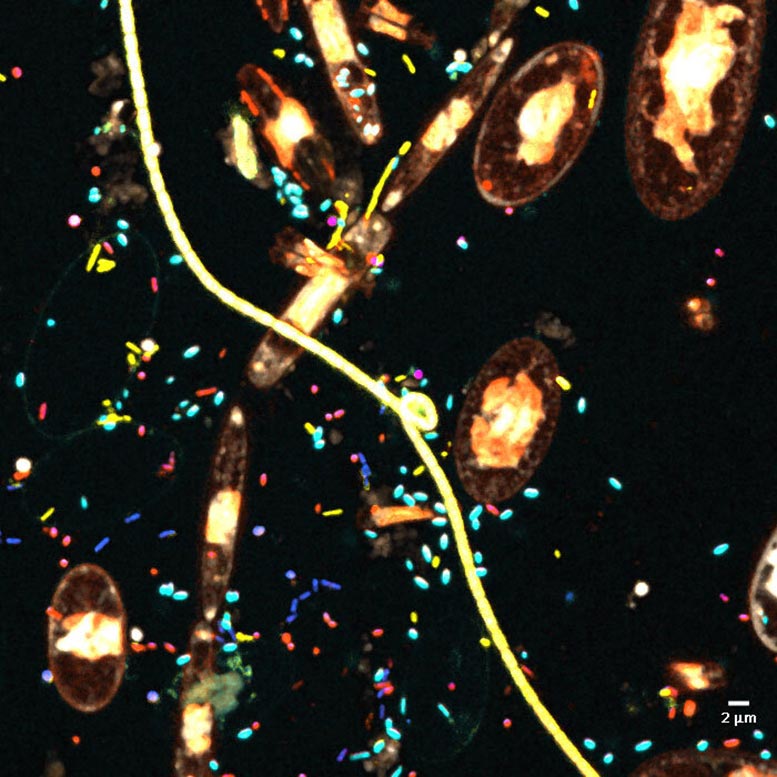
    The structure of microbial communities colonizing microplastics collected from the North Atlantic Ocean (Vineyard Sound, Woods Hole, Mass.) This image reveals the phylogenetic affiliations of different bacterial groups. Large ellipsoid and pennate yellow cells= diatoms; long filamentous cell across center = cyanobacteria; blue= general bacteria; yellow rods = Bacteroidetes; red = Alphaproteobacteria; cyan= Rhodobacteraceae. Scale bar is 2 micrometers. Imaging technology is confocal laser-scanning and CLASI-FISH. Credit: Cathleen Schlundt

    Millions of tons of plastic trash are fouling the world’s oceans, most of them tiny pieces of microplastic less than a quarter-inch in size. Even the smallest marine animals can ingest these microplastics, potentially threatening their survival.

    Marine microplastics aren’t floating solo, either — they quickly pick up a thin coating of bacteria and other microbes, a biofilm known as “The Plastisphere.” These biofilms can influence the microplastics’ fate — causing them to sink or float, or breaking them down into even tinier bits, for example. They can even make the plastic smell or taste like food to some marine organisms. But very little is known about what kinds of microbes are in the Plastisphere, and how they interact with one another and the plastic.

    Now, using an innovative microscopy method developed at the Marine Biological Laboratory (MBL), Woods Hole, scientists have revealed the structure of the microbial communities coating microplastic samples from a variety of ocean sites. The team, led by Linda Amaral-Zettler (who coined the term “Plastisphere”), Jessica Mark Welch, and Cathleen Schlundt, reports its results this week in Molecular Ecology Resources.

    The MBL team built upon a fluorescence imaging technique developed by Mark Welch and colleagues to literally see the spatial organization of microbes on the plastic samples. They did so by designing probes that fluorescently lit up and targeted major, known bacterial groups in the Plastisphere.

    “We now have a toolkit that enables us to understand the spatial structure of the Plastisphere and, combined with other methods, a better future way to understand the Plastisphere’s major microbial players, what they are doing, and their impact on the fate of plastic litter in the ocean,” said Amaral-Zettler, a MBL Fellow from the NIOZ Royal Netherlands Institute for Sea Research and the University of Amsterdam.

    The scientists saw diatoms and bacteria colonizing the microplastics, dominated in all cases by three phyla: Proteobacteria, Cyanobacteria, and Bacteriodetes. Spatially, the Plastisphere microbial communities were heterogeneously mixed, providing the first glimpse of bacterial interactions on marine microplastics.

    Mark Welch and colleagues have previously applied their imaging technology to study microbial communities in the human mouth and in the digestive tract of cuttlefish and vertebrates.

    This study customized and extended the technology, called CLASI-FISH (Combinatorial Labeling And Spectral Imaging Fluorescence In Situ Hybridization). Amaral Zettler finds the technology so powerful, she plans to establish a CLASI-FISH microscopy platform in the Netherlands.

    Reference: “Spatial structure in the “Plastisphere”: Molecular resources for imaging microscopic communities on plastic marine debris” by Cathleen Schlundt, Jessica L. Mark Welch, Anna M. Knochel, Erik R. Zettler and Linda A. Amaral‐Zettler, 29 November 2019, Molecular Ecology Resources.
    DOI: 10.1111/1755-0998.13119

    Never miss a breakthrough: Join the SciTechDaily newsletter.
    Follow us on Google and Google News.

    Cyanobacteria Marine Biological Laboratory Marine Biology Microbiology Microplastics Plastic Pollution
    Share. Facebook Twitter Pinterest LinkedIn Email Reddit

    Related Articles

    Scientists Discover Ocean Bacteria That Feast on Plastic

    New Coral Discovery May Solve the Ocean’s “Missing Plastic” Mystery

    Experiment Proves Bacteria Really Eat Plastic – Broken Down Into Harmless Substances

    Toxic “Dead Zone” – Surge in Nitrogen Has Turned Sargassum Into the World’s Largest Harmful Algal Bloom

    Microbiologists Have Found a Way to Use Bacteria to Remove Microplastics From the Environment

    Microbiologists Modify Bacteria to Produce Climate-Neutral and Rapidly Degradable Bioplastics

    “Deep Biosphere” Microbes: Life Is Bubbling Up From Sediments Deep Below the Ocean Floor

    Deadly Attraction: Why Sea Turtles Eat Ocean Plastics

    Larval Fish Nurseries Invaded by Prey-Size Plastics – Biodiversity and Fisheries Production Threatened

    Leave A Reply Cancel Reply

    • Facebook
    • Twitter
    • Pinterest
    • YouTube

    Don't Miss a Discovery

    Subscribe for the Latest in Science & Tech!

    Trending News

    This Copper Drug Clears Alzheimer’s Brain Toxins and Boosts Memory

    Adults Over 65 Lost Massive Amounts of Weight With Ozempic

    How Flocking Birds “Defy” One of Physics’ Most Fundamental Laws

    Physicists Create a New Kind of Schrödinger’s Cat State From Exotic Quantum Building Blocks

    Your Diet Could Be Missing the Key Ingredient for Heart Protection

    Researchers Warn Widely Prescribed Blood Pressure Drugs Could Be Harming Diabetic Kidneys

    James Webb Spots Something Strange Between Day and Night on an Alien Planet

    How Ancient People Moved a 6-Ton Stone 700 Kilometers to Stonehenge

    Follow SciTechDaily
    • Facebook
    • Twitter
    • YouTube
    • Pinterest
    • Newsletter
    • RSS
    SciTech News
    • Biology News
    • Chemistry News
    • Earth News
    • Health News
    • Physics News
    • Science News
    • Space News
    • Technology News
    Recent Posts
    • Scientists Uncover Cause of Inflammatory Bowel Disease Solving Decades-Old Mystery
    • The Surprising Reason Swimming Could Be Better for Your Heart Than Running
    • Could Vitamin C Be the Secret to Keeping Your Brain Younger?
    • The Surprising Fix for Robot Traffic Jams
    • Near Absolute Zero, This Transistor Starts Acting Like a Brain Cell
    Copyright © 1998 - 2026 SciTechDaily. All Rights Reserved.
    • Science News
    • About
    • Contact
    • Editorial Board
    • Privacy Policy
    • Terms of Use

    Type above and press Enter to search. Press Esc to cancel.