
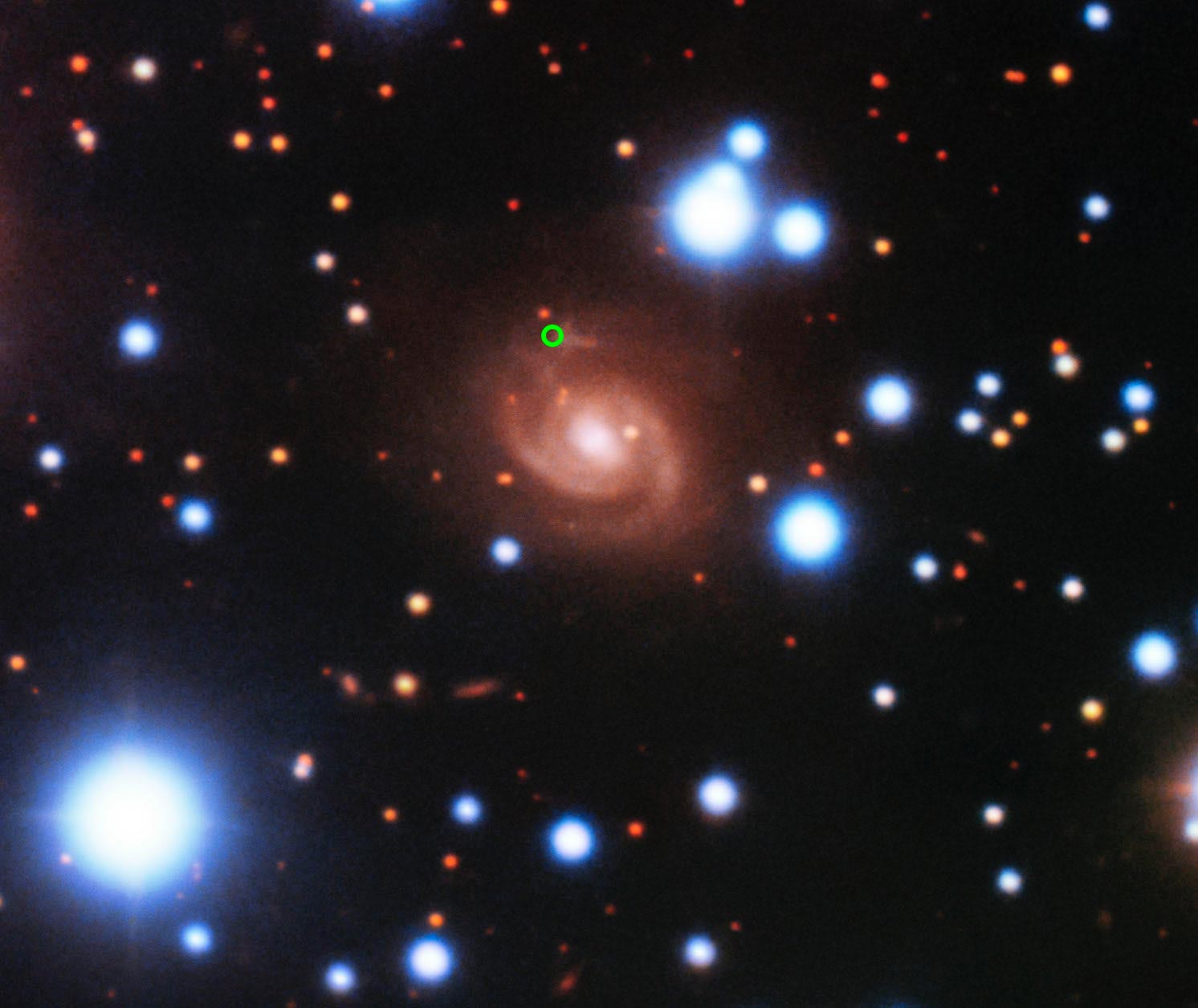
Astronomers have pinpointed the origin of a repeating Fast Radio Burst to a nearby spiral galaxy, challenging theories on the unknown source of these pulses.
Observations with the 8-meter Gemini North telescope, a program of the NSF’s National Optical-Infrared Astronomy Research Laboratory, have allowed astronomers to pinpoint the location of a Fast Radio Burst in a nearby galaxy — making it the closest known example to Earth and only the second repeating burst source to have its location pinpointed in the sky. The source of this burst of radio waves is located in an environment radically different from that seen in previous studies. This discovery challenges researchers’ assumptions on the origin of these already enigmatic extragalactic events.
An unsolved mystery in astronomy has become even more puzzling. The source of Fast Radio Bursts (FRBs) — sudden bursts of radio waves lasting a few thousandths of a second — has remained unknown since their discovery in 2007. Research published on January 6, 2020, in the scientific journal Nature, and presented at the 235th meeting of the American Astronomical Society, has pinpointed the origin of an FRB to an unexpected environment in a nearby spiral galaxy. Observations with the Gemini North telescope of NSF’s Optical-Infrared Astronomy Research Laboratory (OIR Lab) on Maunakea in Hawai‘i, played a vital role in this discovery, which renders the nature of these extragalactic radio pulses even more enigmatic.

The sources of FRBs and their nature are mysterious — many are one-off bursts but very few of them emit repeated flashes. The recently discovered FRB — identified by the unpoetic designation FRB 180916.J0158+65 — is one of only five sources with a precisely known location and only the second such source that shows repeated bursts. Such FRB’s are referred to as localized and can be associated with a particular distant galaxy, allowing astronomers to make additional observations that can provide insights into the origin of the radio pulse.
“This object’s location is radically different from that of not only the previously located repeating FRB, but also all previously studied FRBs,” elaborates Kenzie Nimmo, Ph.D. student at the University of Amsterdam and a fellow lead author of this paper. “This blurs the differences between repeating and non-repeating fast radio bursts. It may be that FRBs are produced in a large zoo of locations across the Universe and just require some specific conditions to be visible.”
Pinpointing the location of FRB 180916.J0158+65 required observations at both radio and optical wavelengths. FRBs can only be detected with radio telescopes, so radio observations are fundamentally necessary to accurately determine the position of an FRB in the sky. This particular FRB was first discovered by the Canadian CHIME radio telescope array in 2018 [1]. The new research used the European VLBI Network (EVN) [2] to precisely localize the source, but measuring the precise distance and local environment of the radio source was only possible with follow-up optical observations with the Gemini North telescope. The international Gemini Observatory comprises telescopes in both the northern and southern hemispheres, which together can access the entire night sky.
“We used the cameras and spectrographs on the Gemini North telescope to image the faint structures of the host galaxy where the FRB resides, measure its distance, and analyze its chemical composition,” explains Shriharsh Tendulkar, a postdoctoral fellow at McGill University in Montreal, Canada who led the Gemini observations [3] and subsequent data analysis. “These observations showed that the FRB originates in a spiral arm of the galaxy, in a region which is rapidly forming stars.”
However, the source of FRB 180916.J0158+65 — which lies roughly 500 million light-years from Earth — was unexpected and shows that FRB’s may not be linked to a particular type of galaxy or environment, deepening this astronomical mystery [4].
“This is the closest FRB to Earth ever localized,” explains Benito Marcote, of the Joint Institute for VLBI European Research Infrastructure Consortium and a lead author of the Nature paper. “Surprisingly, it was found in an environment radically different from that of the previous four localized FRBs — an environment that challenges our ideas of what the source of these bursts could be.”
The researchers hope that further studies will reveal the conditions that result in the production of these mysterious transient radio pulses, and address some of the many unanswered questions they pose. Corresponding author Jason Hessels of the Netherlands Institute for Radio Astronomy (ASTRON) and the University of Amsterdam states that “our aim is to precisely localize more FRBs and, ultimately, understand their origin.”
“It’s a pleasure to see different observing facilities complement one another during challenging high-priority investigations such as this,” concludes Luc Simard, Gemini Board member and Director General of NRC-Herzberg, which hosts CHIME, as well as the Canadian Gemini Office. “We are particularly honored to have the opportunity to conduct astronomical observations on Maunakea in Hawai’i. This site’s exceptional observing conditions are vital to making astronomical discoveries such as this.”
“Understanding the origin of FRBs will undoubtedly be an exciting challenge for astronomers in the 2020s,” said Chris Davis of the US National Science Foundation, Program Officer for Gemini. Davis adds, “We’re confident that Gemini will play an important role, and it seems fitting that Gemini has made these important observations at the dawn of the new decade.”
Read Astronomers Stunned by Repeating Fast Radio Burst in Nearby Galaxy for more on this study.
Notes
[1] The Canadian Hydrogen Intensity Mapping Experiment (CHIME) collaboration operates an innovative radio telescope at the Dominion Radio Astrophysical Observatory in Canada. The CHIME telescope’s novel construction makes it particularly adept at discovering FRBs such as FRB 180916.J0158+65.
[2] Radio observations were made using eight radio telescopes of the European Very Long Baseline Interferometry Network (EVN) following the discovery of FRB 180916.J0158+65 by the CHIME/FRB Collaboration.
[3] The Gemini observations were made between July and September of 2019 using the Gemini Multi-Object Spectrograph (GMOS) on the Gemini North telescope on Hawaii’s Maunakea.
[4] Prior to the observations announced today, the evidence hinted at the possibility that repeating and non-repeating FRBs were formed in very different environments. The only repeating FRB apart from FRB 180916.J0158+65 with a precisely determined location was found to inhabit a region of massive star formation inside a dwarf galaxy. Conversely, the three localized non-repeating FRBs were all found in massive galaxies and appear not to be associated with star-forming regions, leading to speculation that there were two separate types of FRB.
This research was presented in a paper in Nature entitled “A repeating fast radio burst source localized to a nearby spiral galaxy.”
Reference: “A repeating fast radio burst source localized to a nearby spiral galaxy” by B. Marcote, K. Nimmo, J. W. T. Hessels, S. P. Tendulkar, C. G. Bassa, Z. Paragi, A. Keimpema, M. Bhardwaj, R. Karuppusamy, V. M. Kaspi, C. J. Law, D. Michilli, K. Aggarwal, B. Andersen, A. M. Archibald, K. Bandura, G. C. Bower, P. J. Boyle, C. Brar, S. Burke-Spolaor, B. J. Butler, T. Cassanelli, P. Chawla, P. Demorest, M. Dobbs, E. Fonseca, U. Giri, D. C. Good, K. Gourdji, A. Josephy, A. Yu. Kirichenko, F. Kirsten, T. L. Landecker, D. Lang, T. J. W. Lazio, D. Z. Li, H.-H. Lin, J. D. Linford, K. Masui, J. Mena-Parra, A. Naidu, C. Ng, C. Patel, U.-L. Pen, Z. Pleunis, M. Rafiei-Ravandi, M. Rahman, A. Renard, P. Scholz, S. R. Siegel, K. M. Smith, I. H. Stairs, K. Vanderlinde and A. V. Zwaniga, 6 January 2020, Nature.
DOI: 10.1038/s41586-019-1866-z
Never miss a breakthrough: Join the SciTechDaily newsletter.
Follow us on Google and Google News.
1 Comment
Good share! Thanks to https://scitechdaily.com