
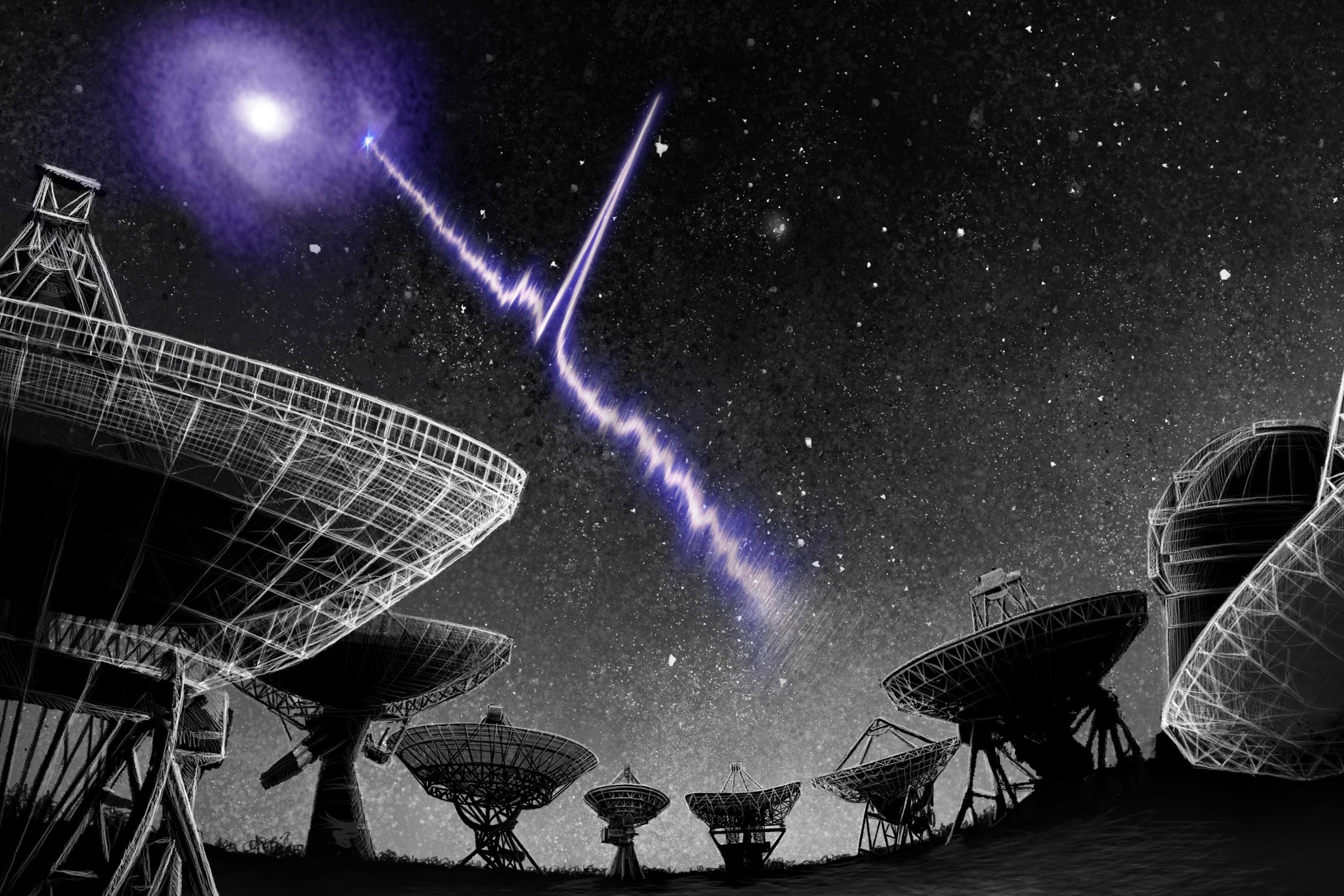
For more than a decade, astronomers across the globe have wrestled with the perplexities of fast radio bursts — intense, unexplained cosmic flashes of energy, light years away, that pop for mere milliseconds.
Despite the hundreds of records of these enigmatic sources, researchers have only pinpointed the precise location of four such bursts.
Now there’s a fifth, detected by a team of international scientists that includes West Virginia University researchers. The finding, which relied on eight telescopes spanning locations from the United Kingdom to China, was published today (Monday, January 6, 2020) in Nature.
There are two primary types of fast radio bursts, explained Kshitij Aggarwal, a physics graduate student at WVU and a co-author of the paper: repeaters, which flash multiple times, and non-repeaters, one-off events. This observation marks only the second time scientists have determined the location of a repeating fast radio burst.

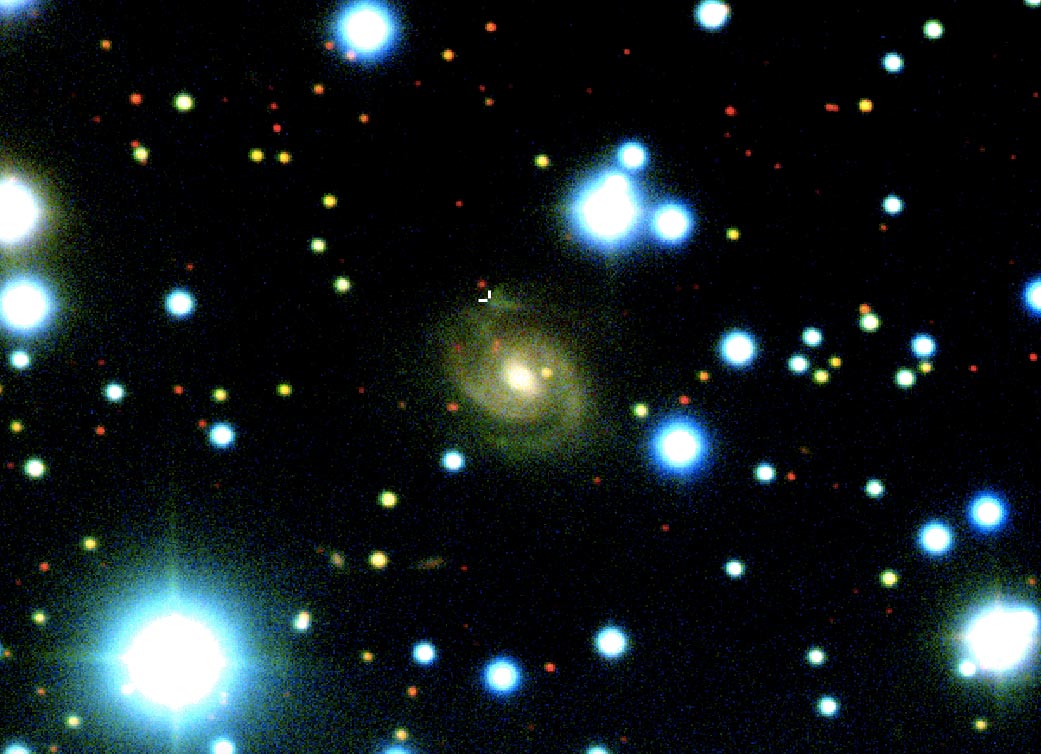
But the localization of this burst is not quite as important as the type of galaxy it was found in, which is similar to our own, said Sarah Burke-Spolaor, assistant professor of physics and astronomy and co-author.
“Identifying the host galaxy for FRBs is critical to tell us about what kind of environments FRBs live in, and thus what might actually be producing FRBs,” Burke-Spolaor said. “This is a question for which scientists are still grasping at straws.”
Burke-Spolaor and her student, Aggarwal, used the Very Large Array observatory in New Mexico to seek pulsations and a persistent radio glow from this burst. Meanwhile, Kevin Bandura, assistant professor of computer science and electrical engineering, and third WVU co-author of the article, worked on the Canadian Hydrogen Intensity Mapping Experiment team that initially detected the repeating fast radio burst.

“What’s very interesting about this particular repeating FRB is that it is in the arm of a Milky Way-like spiral galaxy, and is the closest to Earth thus far localized,” Bandura said. “The unique proximity and repetition of this FRB might allow for observation in other wavelengths and the potential for more detailed study to understand the nature of this type of FRB.”
Using a technique known as Very Long Baseline Interferometry, the team achieved a level of resolution high enough to localize the burst to a region approximately seven light-years across – a feat comparable to an individual on Earth being able to distinguish a person on the moon, according to CHIME.
With that level of precision, the researchers could analyze the environment from which the burst emanated through an optical telescope.
What they found has added a new chapter to the mystery surrounding the origins of fast radio bursts.
This particular burst existed in a radically different environment from previous studies, as the first repeating burst was discovered in a tiny “dwarf” galaxy that contained metals and formed stars, Burke-Spolaor said.

“That encouraged a lot of publications saying that repeating FRBs are likely produced by magnetars (neutron stars with powerful magnetic fields),” she said. “While that is still possible, the fact that this FRB breaks the uniqueness of that previous mold means that we have to consider perhaps multiple origins or a broader range of theories to understand what creates FRBs.”
At half a billion light-years from Earth, the source of this burst, named “FRB 180916,” is seven times closer than the only other repeating burst to have been localized, and more than 10 times closer than any of the few non-repeating bursts scientists have managed to pinpoint. Researchers are hopeful that this latest observation will enable further studies that unravel the possible explanations behind fast radio bursts, according to CHIME.
WVU has remained at the research forefront of fast radio bursts since they were first discovered in 2007 by a team right here at the University that included Duncan Lorimer and Maura McLaughlin, physics professors, and then-student David Narkevic. The trio discovered fast radio bursts from scouring archived data from Australia’s Parkes Radio Telescope.
Read Fast Radio Burst Detected From Unknown Source for more on this discovery.
Reference: “A repeating fast radio burst source localized to a nearby spiral galaxy” by B. Marcote, K. Nimmo, J. W. T. Hessels, S. P. Tendulkar, C. G. Bassa, Z. Paragi, A. Keimpema, M. Bhardwaj, R. Karuppusamy, V. M. Kaspi, C. J. Law, D. Michilli, K. Aggarwal, B. Andersen, A. M. Archibald, K. Bandura, G. C. Bower, P. J. Boyle, C. Brar, S. Burke-Spolaor, B. J. Butler, T. Cassanelli, P. Chawla, P. Demorest, M. Dobbs, E. Fonseca, U. Giri, D. C. Good, K. Gourdji, A. Josephy, A. Yu. Kirichenko, F. Kirsten, T. L. Landecker, D. Lang, T. J. W. Lazio, D. Z. Li, H.-H. Lin, J. D. Linford, K. Masui, J. Mena-Parra, A. Naidu, C. Ng, C. Patel, U.-L. Pen, Z. Pleunis, M. Rafiei-Ravandi, M. Rahman, A. Renard, P. Scholz, S. R. Siegel, K. M. Smith, I. H. Stairs, K. Vanderlinde and A. V. Zwaniga, 6 January 2020, Nature.
DOI: 10.1038/s41586-019-1866-z
Never miss a breakthrough: Join the SciTechDaily newsletter.
Follow us on Google and Google News.
1 Comment
Wonderful science! Magnetars!