
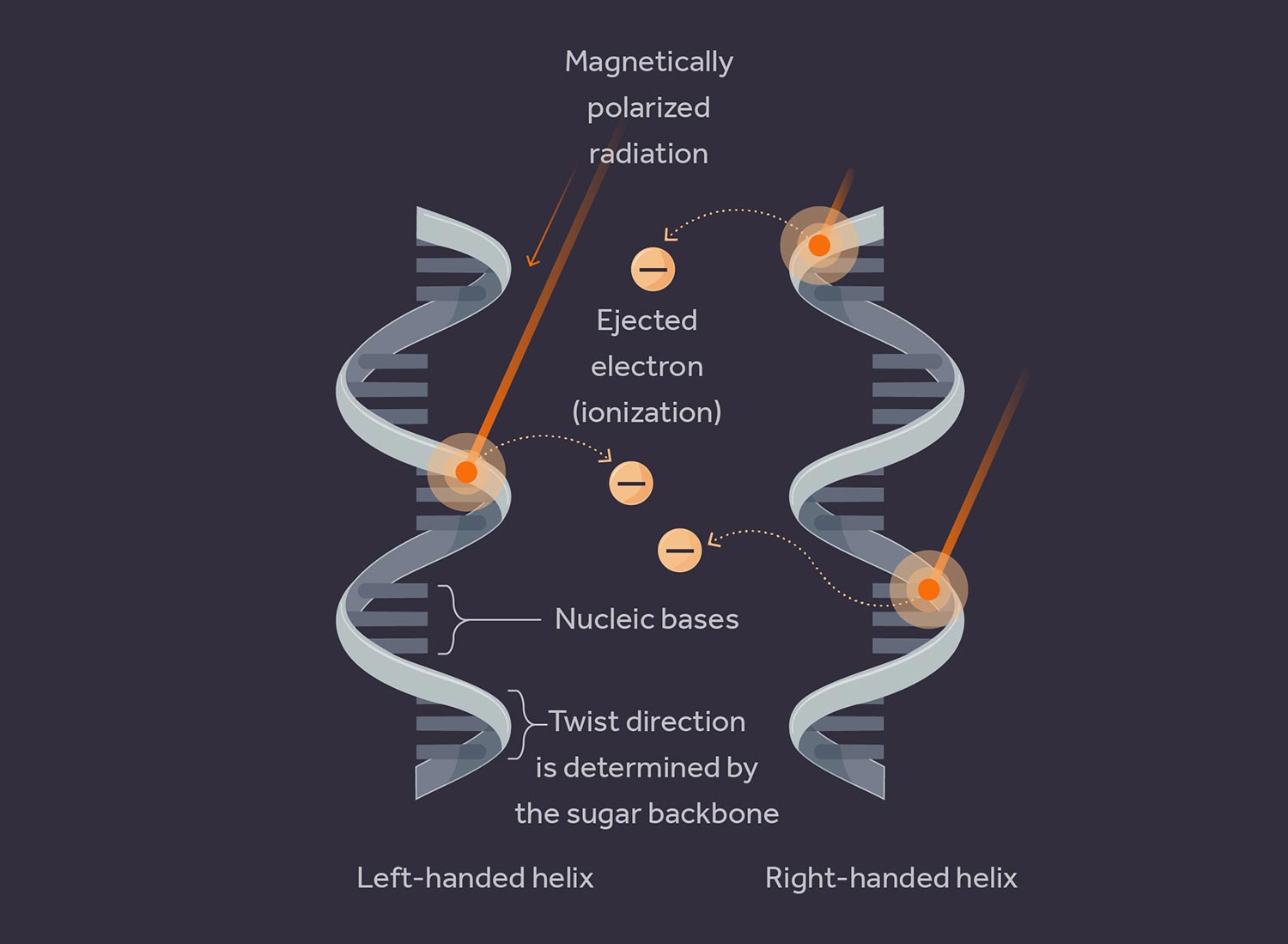
Physicists propose that the influence of cosmic rays on early life may explain nature’s preference for a uniform “handedness” among biology’s critical molecules.
Before there were animals, bacteria or even DNA on Earth, self-replicating molecules were slowly evolving their way from simple matter to life beneath a constant shower of energetic particles from space.
In a new paper, a Stanford professor and a former post-doctoral scholar speculate that this interaction between ancient proto-organisms and cosmic rays may be responsible for a crucial structural preference, called chirality, in biological molecules. If their idea is correct, it suggests that all life throughout the universe could share the same chiral preference.
Chirality, also known as handedness, is the existence of mirror-image versions of molecules. Like the left and right hand, two chiral forms of a single molecule reflect each other in shape but don’t line up if stacked. In every major biomolecule – amino acids, DNA, RNA – life only uses one form of molecular handedness. If the mirror version of a molecule is substituted for the regular version within a biological system, the system will often malfunction or stop functioning entirely. In the case of DNA, a single wrong handed sugar would disrupt the stable helical structure of the molecule.
Louis Pasteur first discovered this biological homochirality in 1848. Since then, scientists have debated whether the handedness of life was driven by random chance or some unknown deterministic influence. Pasteur hypothesized that, if life is asymmetric, then it may be due to an asymmetry in the fundamental interactions of physics that exist throughout the cosmos.
“We propose that the biological handedness we witness now on Earth is due to evolution amidst magnetically polarized radiation, where a tiny difference in the mutation rate may have promoted the evolution of DNA-based life, rather than its mirror image,” said Noémie Globus lead author of the paper and a former Koret Fellow at the Kavli Institute for Particle Astrophysics and Cosmology (KIPAC).
In their paper, published today (May 20, 2020) in Astrophysical Journal Letters, the researchers detail their argument in favor of cosmic rays as the origin of homochirality. They also discuss potential experiments to test their hypothesis.
Magnetic polarization from space
Cosmic rays are an abundant form of high-energy radiation that originates from various sources throughout the universe, including stars and distant galaxies. After hitting the Earth’s atmosphere, cosmic rays eventually degrade into fundamental particles. At ground level, most of the cosmic rays exist only as particles known as muons.
Muons are unstable particles, existing for a mere 2 millionths of a second, but because they travel near the speed of light, they have been detected more than 700 meters below Earth’s surface. They are also magnetically polarized, meaning, on average, muons all share the same magnetic orientation. When muons finally decay, they produce electrons with the same magnetic polarization. The researchers believe that the muon’s penetrative ability allows it and its daughter electrons to potentially affect chiral molecules on Earth and everywhere else in the universe.
“We are irradiated all the time by cosmic rays,” explained Globus, who is currently a post-doctoral researcher at New York University and the Simons Foundation’s Flatiron Institute. “Their effects are small but constant in every place on the planet where life could evolve, and the magnetic polarization of the muons and electrons is always the same. And even on other planets, cosmic rays would have the same effects.”
The researchers’ hypothesis is that, at the beginning of life on Earth, this constant and consistent radiation affected the evolution of the two mirror life-forms in different ways, helping one ultimately prevail over the other. These tiny differences in mutation rate would have been most significant when life was beginning and the molecules involved were very simple and more fragile. Under these circumstances, the small but persistent chiral influence from cosmic rays could have, over billions of generations of evolution, produced the single biological handedness we see today.
“This is a little bit like a roulette wheel in Vegas, where you might engineer a slight preference for the red pockets, rather than the black pockets,” said Roger Blandford, the Luke Blossom Professor in the School of Humanities and Sciences at Stanford and an author on the paper. “Play a few games, you would never notice. But if you play with this roulette wheel for many years, those who bet habitually on red will make money and those who bet on black will lose and go away.”
Ready to be surprised
Globus and Blandford suggest experiments that could help prove or disprove their cosmic ray hypothesis. For example, they would like to test how bacteria respond to radiation with different magnetic polarization.
“Experiments like this have never been performed and I am excited to see what they teach us. Surprises inevitably come from further work on interdisciplinary topics,” said Globus.
The researchers also look forward to organic samples from comets, asteroids, or Mars to see if they too exhibit a chiral bias.
“This idea connects fundamental physics and the origin of life,” said Blandford, who is also Stanford and SLAC professor of physics and particle physics and former director of KIPAC. “Regardless of whether or not it’s correct, bridging these very different fields is exciting and a successful experiment should be interesting.”
Reference: “The Chiral Puzzle of Life” by Noemie Globus and Roger D. Blandford, 20 May 2020, The Astrophysical Journal Letters.
DOI: 10.3847/2041-8213/ab8dc6
This research was funded by the Koret Foundation, New York University and the Simons Foundation.
Never miss a breakthrough: Join the SciTechDaily newsletter.
Follow us on Google and Google News.