
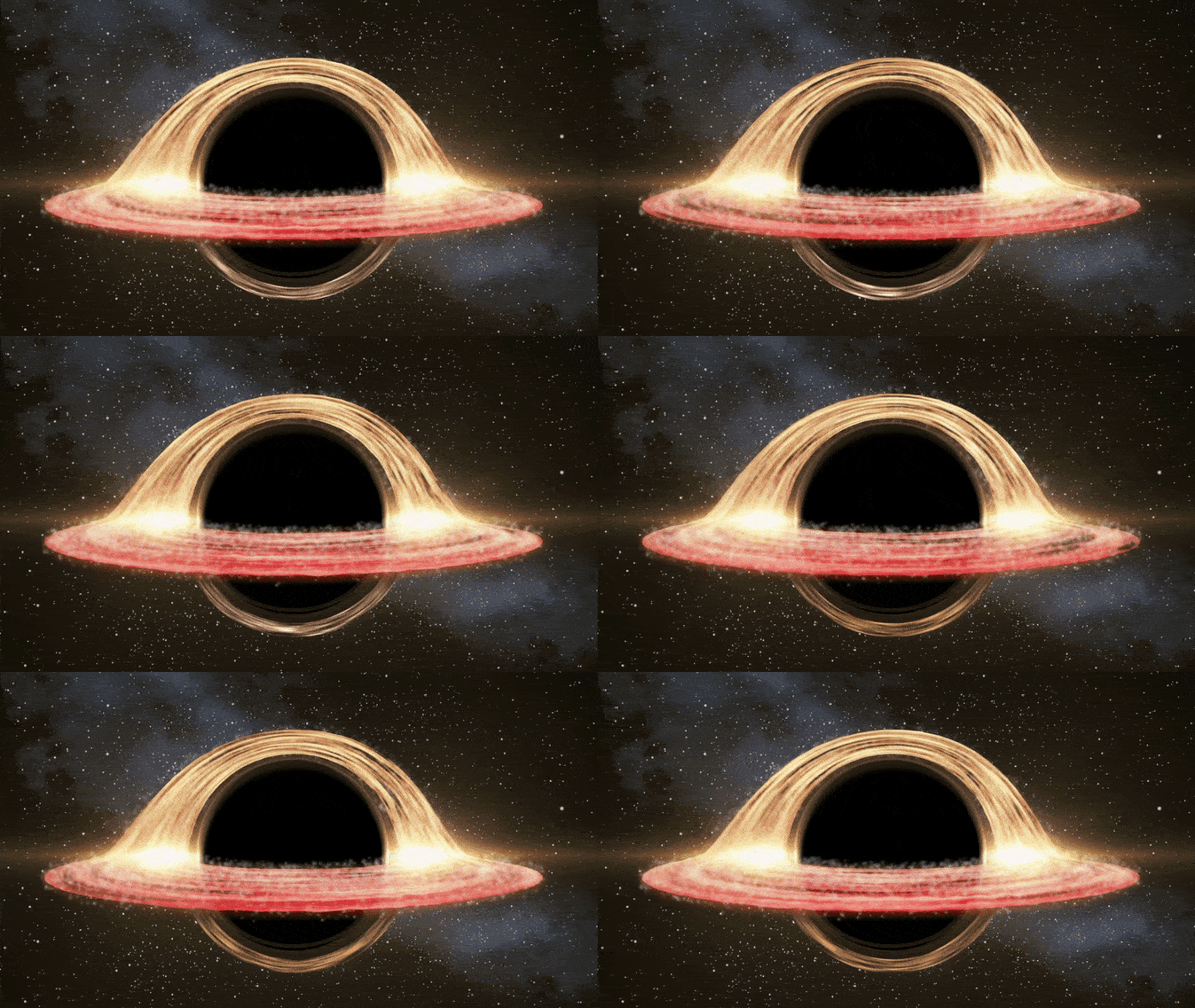
- A new study reveals what happens when a supermassive black hole in the center of a galaxy cluster stops being active.
- By combining data from Chandra, Hubble, and Spitzer data, astronomers found a deluge of star formation in the cluster known as SpARCS1049.
- SpARCS1049 is producing stars at a rate some 300 times that seen in the Milky Way galaxy.
- This result is in contrast with many other clusters that show how active supermassive black holes keep gas too hot to form many stars.
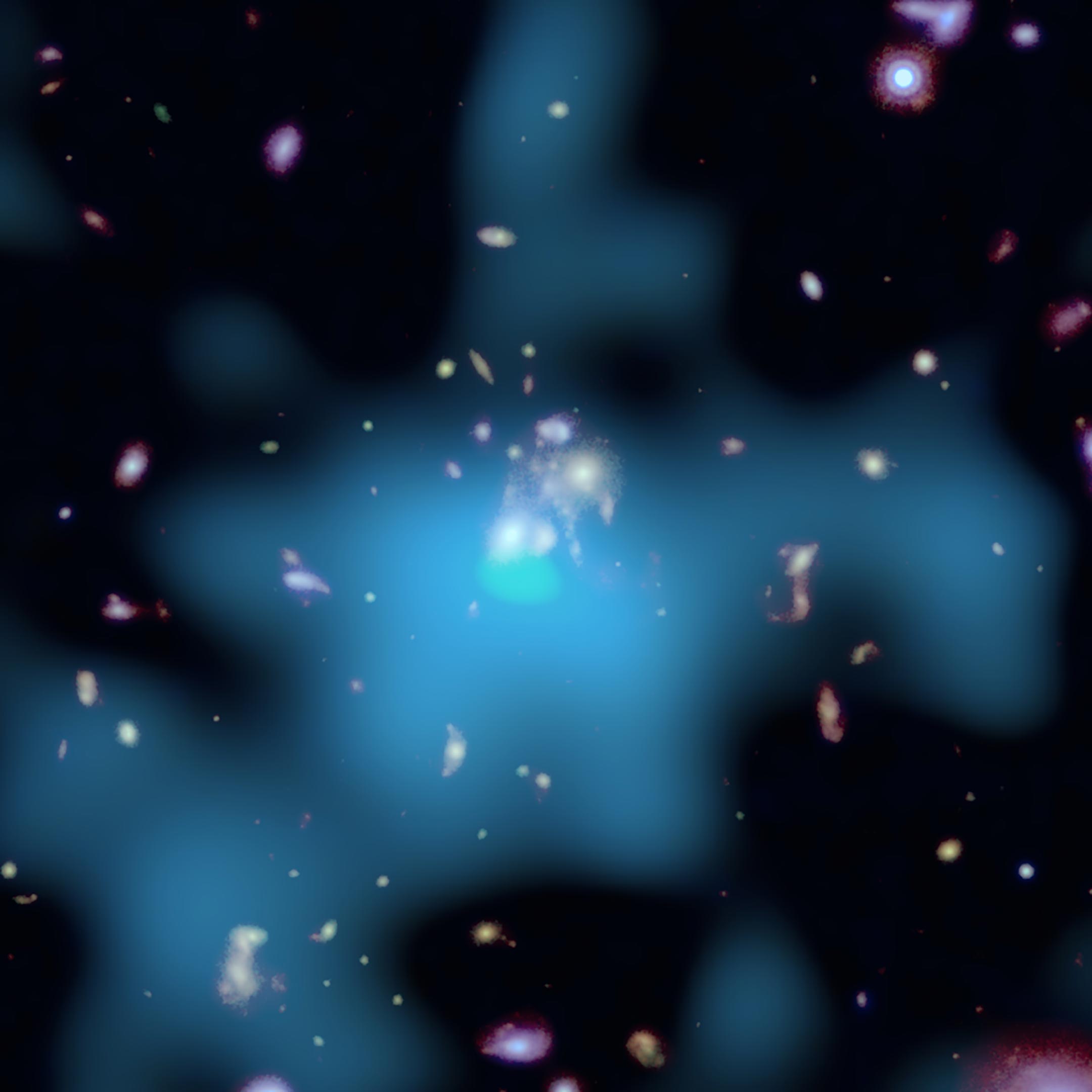
A galaxy cluster is demonstrating what can happen when a supermassive black hole stops being active. SpARCS104922.6+564032.5 (SpARCS1049 for short) is a galaxy cluster located 9.9 billion light years away from Earth. Galaxy clusters contain hundreds or thousands of galaxies pervaded by hot, X-ray emitting gas that outweighs the combined mass of all the galaxies. In this image of SpARCS1049, X-rays from NASA’s Chandra X-ray Observatory (light blue) have been combined with optical and infrared light data from NASA’s Hubble Space Telescope (red, green, and blue).
Astronomers have seen many examples where a supermassive black hole in a cluster’s central galaxy prevents this hot gas from cooling to form vast numbers of stars. This heating allows supermassive black holes to influence or control the activity and evolution of their host cluster.
However, the would-be domineering black hole in SpARCS1049 is behaving differently and is almost completely dormant. This appears to be allowing star formation to run rampant. According to observations from Hubble and NASA’s Spitzer Space Telescope, SpARCS1049 is forming stars at a rate over 300 times our Milky Way galaxy. (At this rate of SpARCS1049, all of the stars in the Milky Way could form in just 100 million years, which is one percent of our Galaxy’s age of more than 10 billion years.)
Researchers tried to determine what is causing this explosion of star formation and why it is located about 80,000 light-years away from the center of SpARCS1049, outside any of the cluster’s galaxies. The Chandra data show that the temperature of the gas in the site of prodigious star formation has cooled to about 10 million degrees. (This is in contrast to most of the rest of the cluster where the gas is hotter at about 65 million degrees.) The presence of this cooler gas suggests that other undetected gas reservoirs have cooled to even lower temperatures that enable huge numbers of stars to form.
An annotated version of the composite image shows the location of the densest hot gas seen with Chandra, along with the galaxy in the center of the cluster. The coolest gas detected by Chandra and the site of the most rapid star formation is located halfway between the densest gas and the central galaxy.

Astronomers do not see any signs that a supermassive black hole in the central galaxy is actively pulling in matter in SpARCS1049. For example, they do not find any evidence for a jet of material blowing away from the black hole at radio wavelengths, or of an X-ray source from the middle of the galaxy indicating that matter was heated as it fell towards a black hole. These are the common signs that a black hole is growing quickly and keeping the gas of a cluster too warm to form many stars. These black holes, however, are typically found in galaxy clusters that are only a few hundred million light-years from Earth and are much older than SpARCS1049. This could mean that black holes in younger and more distant galaxy clusters act differently than their nearer and older counterparts.
For more on this research, read Black Hole Fails to Do Its Job, Unleashing a Remarkable Torrent of Star Formation.
A paper describing these results is appearing in The Astrophysical Journal Letters. The authors are Julie Hlavacek-Larrondo (University of Montreal in Canada), Carter Rhea (University of Montreal), Tracy Webb (McGill University, Canada), Michael McDonald (Massachusetts Institute of Technology), A. Muzzin (York University, Canada), G. Wilson (University of California, Riverside), K. Finner (Yonsei University, Korea), F. Valin (McGill), N. Bonventura (University of Copahagen, Denmark), M. Cooper (University of California, Irvine), Andy Fabian (Institute of Astronomy, Cambridge, United Kingdom), M.-L Gendron-Marsolais (European Southern Observatory), J.M. Lee (Yonsei), C. Lidman (Australian National University), Mar Mezcua (Institute of Space Sciences, Spain), A. Noble (Arizona State University), H.R. Russell (Institute of Astronomy, Cambridge), J. Surace (IPAC, Caltech), A. Trudeau (University of Victoria, Canada), and H.K.C. Yee (University of Toronto).
Reference: “Evidence of Runaway Gas Cooling in the Absence of Supermassive Black Hole Feedback at the Epoch of Cluster Formation” by J. Hlavacek-Larrondo, C. L. Rhea, T. Webb, M. McDonald, A. Muzzin, G. Wilson, K. Finner, F. Valin, N. Bonaventura, M. Cooper, A. C. Fabian, M.-L. Gendron-Marsolais, M. J. Jee, C. Lidman, M. Mezcua, A. Noble, H. R. Russell, J. Surace, A. Trudeau and H. K. C. Yee, 3 August 2020, The Astrophysical Journal Letters.
DOI: 10.3847/2041-8213/ab9ca5
arXiv: 2007.15660
Never miss a breakthrough: Join the SciTechDaily newsletter.
Follow us on Google and Google News.