
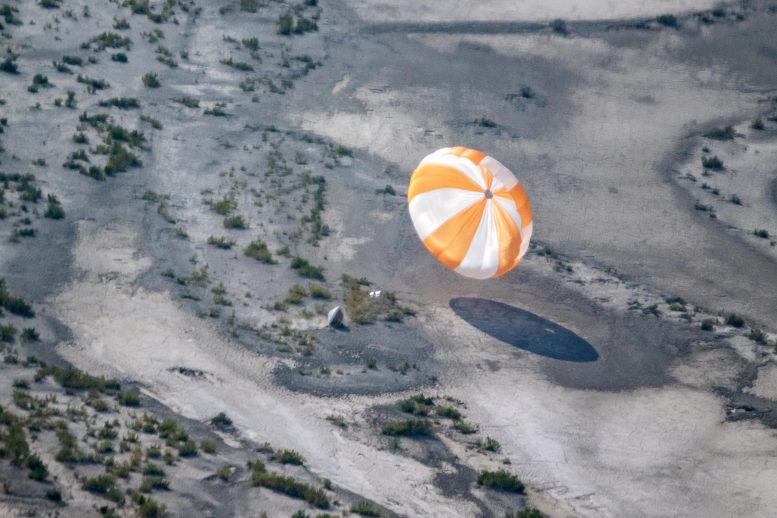
NASA’s OSIRIS-REx will release an asteroid sample capsule this September, aiming for a landing in the Great Salt Lake Desert, with teams ready to address challenges during its descent and recovery.
This September, after traveling billions of miles through our solar system, NASA’s OSIRIS-REx spacecraft will cruise past Earth with an extraordinary delivery. As it passes, it will release a mini-fridge size capsule containing a sample of primordial space rock collected from an asteroid located between the orbits of Earth and Mars.
OSIRIS-REx — the Origins, Spectral Interpretation, Resource Identification, and Security–Regolith Explorer — is the first U.S. mission to collect a sample from an asteroid. Scientists hope the pristine material it collected from asteroid Bennu in 2020 — about half a pound of rubble and dust from the asteroid’s surface — will provide a window into 4.5 billion years ago when the Sun and planets were forming.
Entry Challenges and Preparations
Before it can do that, the sample’s protective capsule will withstand temperatures twice as hot as lava, and the second-fastest velocity ever achieved by a human-made object entering Earth’s atmosphere. After entering Earth’s atmosphere at around 36 times the speed of sound, the capsule may eventually encounter wind, rain, and other weather conditions as it drops closer to the surface. Regardless of weather, it will land in the Great Salt Lake Desert, an arid landscape known for its scorching summer temperatures and its salt flats, the remnants of an ancient lakebed where crusty salt deposits coat the ground.
While much of the focus will be on the technical aspects of the spacecraft and the landing capsule, a team of scientists and meteorologists will also be closely monitoring the weather, which can significantly affect recovery of the capsule.
https://youtu.be/Zcloc-9LfN0
OSIRIS-REx is NASA’s first asteroid sample return mission. It launched in September 2016 on a journey to explore a near-Earth asteroid called Bennu. The mission’s thrilling finale will take place on September 24, 2023, as a capsule containing the Bennu samples touches down in Utah’s West Desert. Credit: NASA
“Before we launched seven years ago, the capsule had to be designed for all the weather conditions we thought were reasonable for Utah in September,” said Eric Queen, a research engineer with the Entry, Descent and Landing (EDL) team at NASA’s Langley Research Center in Hampton, Virginia.
While the hardy capsule was built to be impervious to things like lightning and ice, “winds are probably our biggest concern any time you land under parachute,” said Mark Johnson, who leads the EDL analysis for Lockheed Martin, in Littleton, Colorado. That’s because wind speed and direction could affect where the capsule sets down within a 36-mile by 8.5-mile (58-km by 14-km) target in the Department of Defense’s Utah Test and Training Range, southwest of Salt Lake City.
Desert Conditions and Recovery Planning
The landing range is considered a “safe, controlled area,” said Kenneth Getzandanner, OSIRIS-REx flight dynamics lead. “It was also the landing site for the Stardust mission, so there is heritage.”
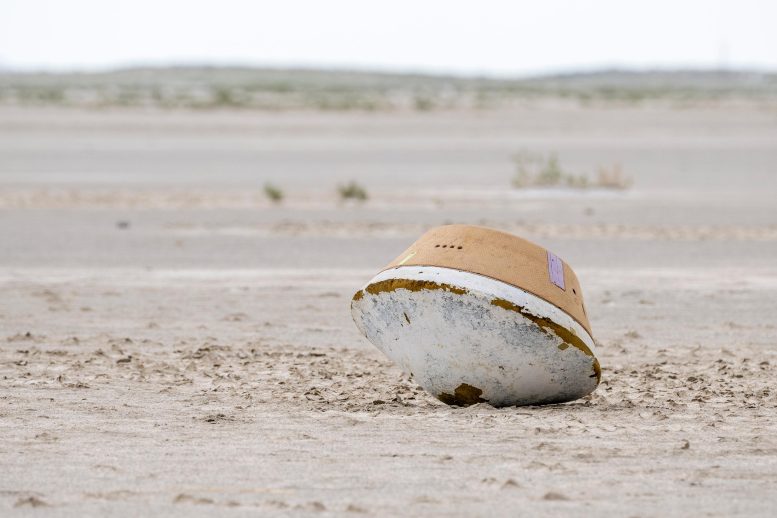
Like Goopy Cement
The OSIRIS-REx team also thought a lot about conditions on the ground itself. Late summer is monsoon season in the desert, so heavy rains could saturate the silty ground. Wet-cement-like mud would make driving difficult if off-road vehicles are required to help helicopters find and transport the capsule.
“We should know by the end of monsoon season how much precipitation we’ve received and the condition of the salt flats,” said Eric Nelson, a U.S. Army meteorologist supporting the mission. “A good indicator is Bonneville Speed Week, an annual racing event in August.” Since it went off without a hitch, “we’re probably okay.”
In support of the OSIRIS-REx mission, the team will deploy weather balloons in the days leading up to the landing. The single-use balloons soar to altitudes around 60,000 feet, or 18,288 meters — about twice as high as a commercial jet flies. Rising 18 feet (5.5 m) per second, they transmit data on temperature, humidity, pressure, and wind before bursting high up in the atmosphere. The mission will use these observations to estimate a likely landing location on the range.
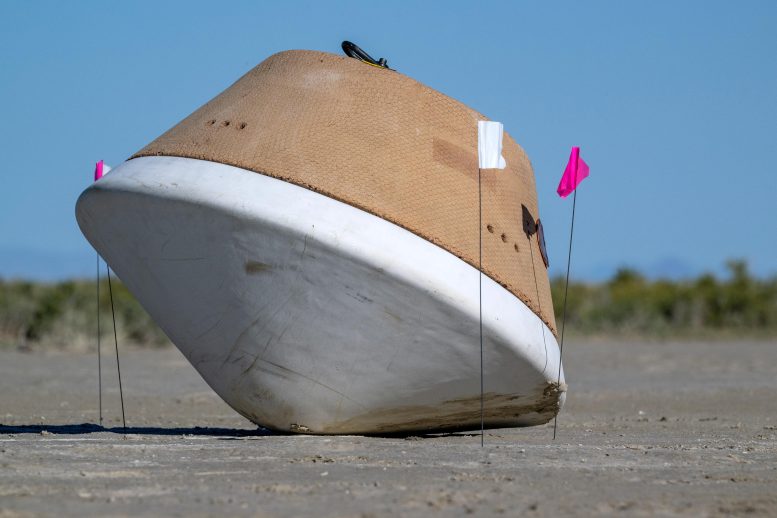
How the Delivery Will Unfold
The last leg of the capsule’s long journey will begin when it separates from the OSIRIS-REx spacecraft and then enters Earth’s atmosphere above the West Coast about four hours later. Traveling at hypersonic speeds, the roughly 100-pound (45 kg) capsule will rely on a protective entry system that includes a heat shield made of a lightweight ablative material invented at NASA’s Ames Research Center in California’s Silicon Valley and designed to withstand extreme temperatures.
Radar and infrared tracking systems will follow the capsule during descent. As it streaks eastward on the morning of September 24, several aircraft, including a high-altitude WB-57 research plane from NASA’s Johnson Space Center in Houston will track its journey with visual and thermal imaging systems.
The capsule will be traveling at around 1,150 mph (1,850 kph) when it deploys its drogue parachute over the training range. A round, main parachute will open closer to the ground to soften the landing. Unlike other designs, the round shape is less likely to be caught by a breeze, increasing drag and stability as the capsule descends. This reduces its chance of being blown off course, which could make it harder to find on the ground.
Once it touches down and is recovered by a specialized team, the sample will be moved to a special laboratory at Johnson, where it will be preserved and studied. The historic landing will be studied, too, in order to inform future space deliveries.
“We are not forecasting anything that we don’t usually forecast, but there are going to be a lot of eyes on our little corner of the desert this fall,” Nelson noted. “That’s a bit more pressure than usual.”
NASA’s Goddard Space Flight Center in Greenbelt, Maryland, provides overall mission management, systems engineering, and the safety and mission assurance for OSIRIS-REx. Dante Lauretta of the University of Arizona, Tucson, is the principal investigator. The university leads the science team and the mission’s science observation planning and data processing. Lockheed Martin Space in Littleton, Colorado, built the spacecraft and provides flight operations. Goddard and KinetX Aerospace are responsible for navigating the OSIRIS-REx spacecraft. Curation for OSIRIS-REx, including processing the sample when it arrives on Earth, will take place at NASA’s Johnson Space Center in Houston. International partnerships on this mission include the OSIRIS-REx Laser Altimeter instrument from CSA (the Canadian Space Agency) and asteroid sample science collaboration with JAXA’s (the Japan Aerospace Exploration Agency) Hayabusa2 mission. OSIRIS-REx is the third mission in NASA’s New Frontiers Program, managed by NASA’s Marshall Space Flight Center in Huntsville, Alabama, for the agency’s Science Mission Directorate in Washington.
Never miss a breakthrough: Join the SciTechDaily newsletter.
Follow us on Google and Google News.
8 Comments
Haven’t these people ever seen “The Andromeda Strain”?
What a fish story.
Luckily “Skynet” will beome conscious on September 29, and will save us.
It is not “billions of miles” that the spacecraft traveled, 1.4 billion miles, that was it.
What it did cost was 1.5 billion dollars, to go get sone dust, why not investing it in people that needs it back on earth to the daily survival? Rent, food, housing, etc…
The internet is awash with end of the world scenario for September 23/24 due to so called hints from movies. Guess we can add this to the list. I do admit that if we were trying to introduce a virus into our world that we have no immunity for this would be a great way to do it.
You are a brainless idiot !
There’s dumbing down and then there are articles like this. What an embarrassment to read. First of all the spacecraft did not travel BILLIONS of miles.
Secondly when it gets to earth its first concern isn’t wind and rain, it’s simply atmosphere, air. Travelling at that speed the very thin air is like a wall.
The wind and rain are only issues in the last few minutes when the parachute deploys. The vehicle also has transponders to help locate it.
Lastly giving the impression that they are “racing against time” is laughable, the timing of these events is well known, the vehicle isn’t in trouble, no lives need be saved. The people collecting it will be on site hours before it’s due. There will be helicopters in the air, collecting it will be very sedate although you will have a bunch of scientists as excited as children at Christmas thats for sure !
The story is its own sensation it doesn’t need over cooked hyperbole to make it interesting. The writer only believes this because they think science is boring. Perhaps a more enlightened writer next time ?
Scientists collecting asteroid particles that they harvested from space and then crashed back to earth, pretty much sounds like the beginning narrative of the next Zombie movie. Just saying.