
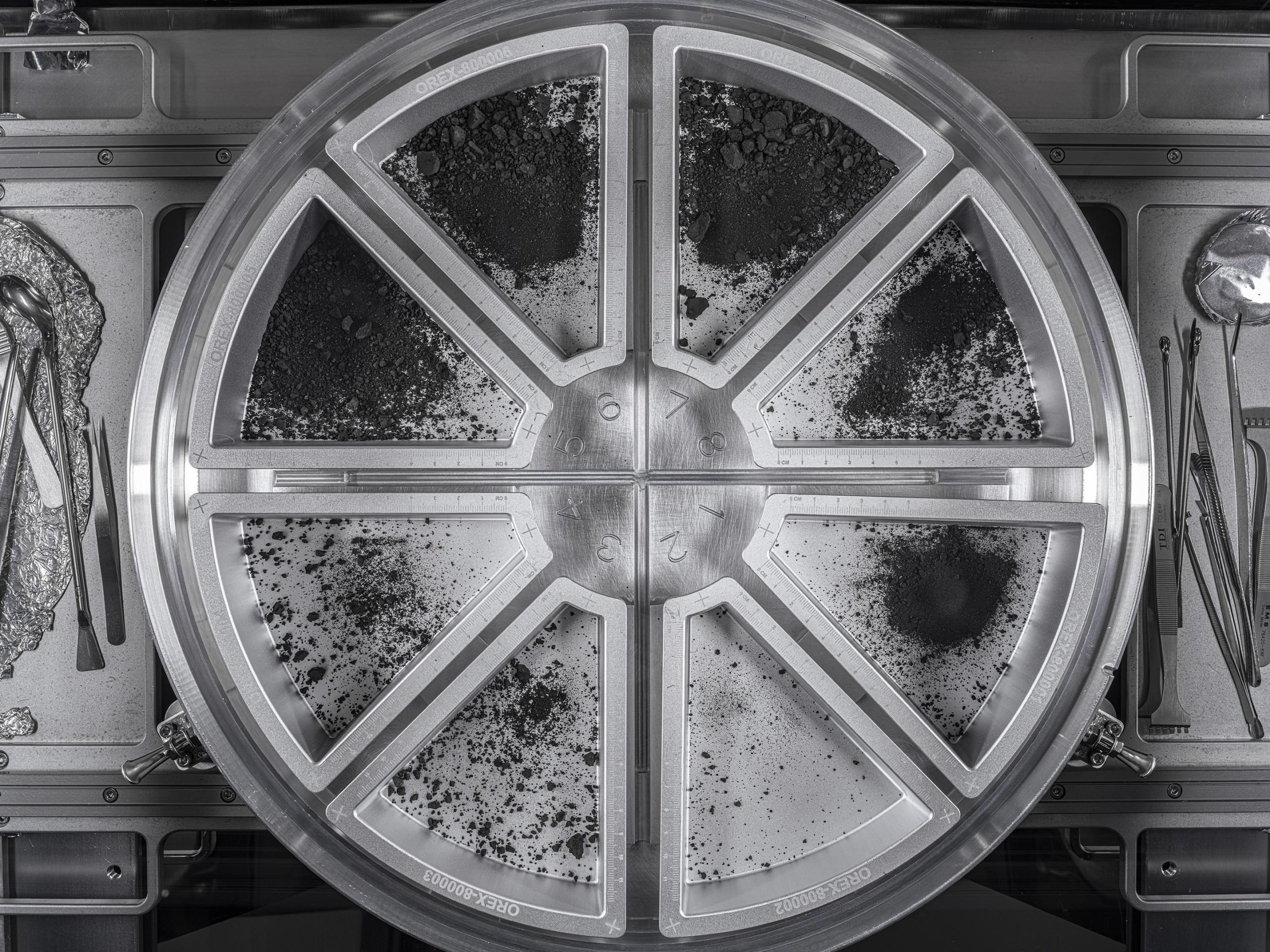
Researchers are unlocking secrets of our solar system by analyzing asteroid Bennu samples, some of the most pristine ever collected.
These fragments date back 4.5 billion years and contain salts, including halite (common table salt), suggesting past briny environments. Such conditions, known to support organic molecule development, provide a glimpse into the chemistry that may have influenced life’s origins.
Unveiling the Secrets of Our Solar System
Curtin University researchers have gained an extraordinary window into the early history of our solar system by studying some of the most well-preserved asteroid samples ever collected. Their findings could significantly advance our understanding of planetary formation and the origins of life.
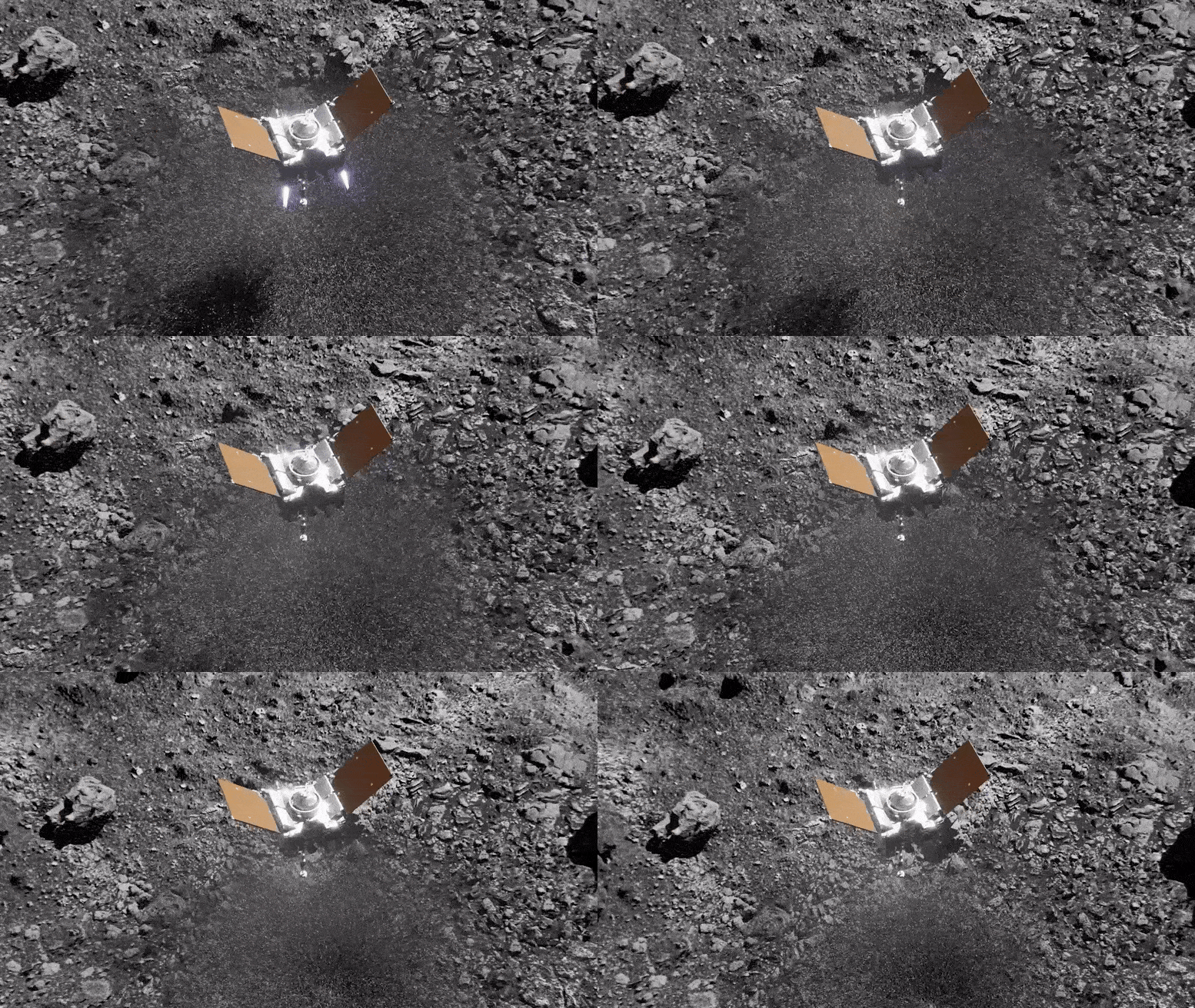
Scientists from Curtin’s School of Earth and Planetary Sciences were among the first in the world chosen to analyze samples retrieved by NASA’s OSIRIS-REx mission, a seven-year endeavor to collect material from the ancient asteroid Bennu.
Bennu is believed to be composed of rubble fragments from a 4.5-billion-year-old parent body. This original celestial object, which contained materials that likely formed beyond Saturn, was destroyed in a long-ago collision with another object.

Salts That Hold the Story of Space
The OSIRIS-REx research team identified a range of salts in the samples, including sodium carbonates, phosphates, sulfates, and chlorides.
Associate Professor Nick Timms described the discovery of these salts as a major breakthrough in space research.
“We were surprised to identify the mineral halite, which is sodium chloride — exactly the same salt that you might put on your chips,” Associate Professor Timms said.
“The minerals we found form from evaporation of brines – a bit like salt deposits forming in the salt lakes that we have in Australia and around the world.
Revealing the Role of Ancient Brines
“By comparing with mineral sequences from salt lakes on Earth, we can start to envisage what it was like on the parent body of asteroid Bennu, providing insight into ancient cosmic water activity.”
Evaporite minerals and brines are known to help organic molecules develop on Earth.
“A briny, carbon-rich environment on Bennu’s parent body was probably suitable for assembling the building blocks of life,” Associate Professor Timms said.
The key to the new discovery was the pristine condition of the samples.
Preserving Pristine Cosmic Evidence
Many of the salts present degrade quickly when exposed to the atmosphere, however, the samples collected on the OSIRIS-REx mission were sealed and purged with nitrogen once on Earth to prevent contamination.
NASA chose Curtin to perform early analysis on the samples — the largest ever retrieved from a world beyond the Moon — due to the globally renowned John de Laeter Centre’s world-leading expertise and facilities.
Centre Director Associate Professor Will Rickard said the facility houses more than $50 million in advanced analytical instruments.
“The Centre is one of the few places in the world which could verify if the salts were in fact extraterrestrial in origin or if they had been contaminated by elements from Earth,” Associate Professor Rickard said.
“Our specialized facilities at Curtin allowed us to maintain the pristine condition of the samples, which meant when we discovered the salts were extraterrestrial and unaltered, we knew it was an important finding because these samples preserve evidence of some of the earliest phenomena of the solar system.”
Implications for Icy Worlds Beyond Earth
The findings from returned samples of asteroid Bennu may provide researchers insight into what happens on distant icy bodies in our solar system, such as Saturn’s moon Enceladus and the dwarf planet Ceres in the asteroid belt.
“Both Enceladus and Ceres have subsurface brine oceans,” Associate Professor Timms said.
“Even though asteroid Bennu has no life, the question is could other icy bodies harbor life?”
Explore Further:
- Scientists Just Found DNA’s Building Blocks in Asteroid Bennu
- NASA Uncovers Life’s Building Blocks in Asteroid Bennu’s Pristine Sample
- Briny Traces in NASA’s Asteroid Sample Hold Clues to the Chemistry of Life
Reference: “An evaporite sequence from ancient brine recorded in Bennu samples” by T. J. McCoy, S. S. Russell, T. J. Zega, K. L. Thomas-Keprta, S. A. Singerling, F. E. Brenker, N. E. Timms, W. D. A. Rickard, J. J. Barnes, G. Libourel, S. Ray, C. M. Corrigan, P. Haenecour, Z. Gainsforth, G. Dominguez, A. J. King, L. P. Keller, M. S. Thompson, S. A. Sandford, R. H. Jones, H. Yurimoto, K. Righter, S. A. Eckley, P. A. Bland, M. A. Marcus, D. N. DellaGiustina, T. R. Ireland, N. V. Almeida, C. S. Harrison, H. C. Bates, P. F. Schofield, L. B. Seifert, N. Sakamoto, N. Kawasaki, F. Jourdan, S. M. Reddy, D. W. Saxey, I. J. Ong, B. S. Prince, K. Ishimaru, L. R. Smith, M. C. Benner, N. A. Kerrison, M. Portail, V. Guigoz, P.-M. Zanetta, L. R. Wardell, T. Gooding, T. R. Rose, T. Salge, L. Le, V. M. Tu, Z. Zeszut, C. Mayers, X. Sun, D. H. Hill, N. G. Lunning, V. E. Hamilton, D. P. Glavin, J. P. Dworkin, H. H. Kaplan, I. A. Franchi, K. T. Tait, S. Tachibana, H. C. Connolly Jr. and D. S. Lauretta, 29 January 2025, Nature.
DOI: 10.1038/s41586-024-08495-6
OSIRIS-REx (Origins, Spectral Interpretation, Resource Identification, and Security–Regolith Explorer) is a NASA space mission designed to study and return samples from the near-Earth asteroid Bennu. Launched in 2016, the spacecraft reached Bennu in 2018, mapping its surface and selecting a site for sample collection. In 2020, OSIRIS-REx successfully gathered a sample of regolith (surface material) using a touch-and-go maneuver.
The mission returned the sample to Earth in September 2023, providing scientists with pristine material from an asteroid that dates back to the early solar system. The analysis of these samples aims to shed light on planetary formation, the origins of water and organic molecules, and the potential for asteroids to carry the building blocks of life. After delivering the sample, OSIRIS-REx continued its journey, now on an extended mission to explore another asteroid, Apophis, under the new name OSIRIS-APEX.
Never miss a breakthrough: Join the SciTechDaily newsletter.
Follow us on Google and Google News.