
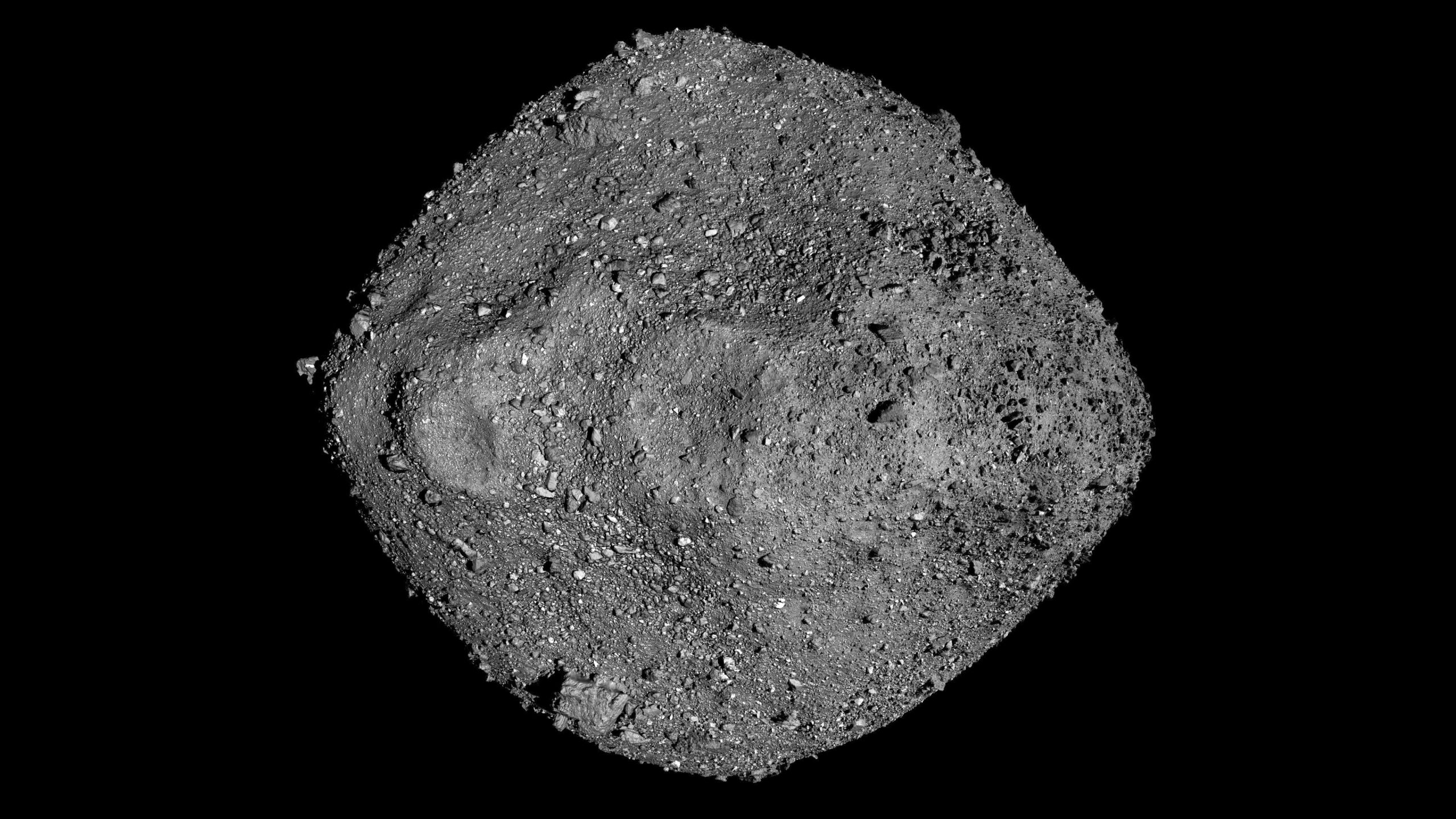
The asteroid Bennu has provided groundbreaking insights into the chemistry that may have set the stage for life in the early solar system.
Researchers analyzing samples from NASA’s OSIRIS-REx mission discovered mineral-rich brines that suggest complex organic interactions occurred on Bennu’s parent body. These samples contained never-before-seen extraterrestrial compounds, including sodium carbonate, a mineral commonly found in Earth’s evaporated lakes. Scientists were particularly intrigued by the presence of phosphorus and the near absence of boron, suggesting Bennu’s brine was distinct from Earth’s. Further studies revealed amino acids and nucleobases—the fundamental components of RNA and DNA — raising questions about how far along the pathway to life these environments may have progressed.

Each needle is less than a micrometer wide by 5–10 micrometers in length; a human hair is about 100 micrometers wide. The needles form a vein that cuts through the clay-rich rock around it, with small pieces of rock also resting on top of the sodium carbonate needles.
These minerals formed on Bennu’s parent body through the evaporation of salty, sodium-rich waters more than 4.5 billion years ago during the birth of the solar system. As this water evaporated, it formed minerals rich in sodium, carbon, sulfur, phosphorus, chlorine, and fluorine.
These minerals formed much like they do today in soda lakes on Earth and subsurface oceans on icy moons and dwarf planets of the outer solar system, including Saturn’s moon Enceladus, and the dwarf planet Ceres.
Credit: Rob Wardell, Tim Gooding and Tim McCoy, Smithsonian.
Extraterrestrial Brines and the Origins of Life
NASA’s first asteroid sample from space, collected from Bennu and delivered to Earth, has revealed a fascinating discovery. Scientists found evidence that water once existed on Bennu’s parent asteroid but later evaporated, leaving behind a salty residue. This briny environment allowed minerals and essential chemical ingredients to interact, forming more complex structures. The findings suggest that extraterrestrial brines may have played a key role in the development of organic compounds.
In a study published on January 29 in the journal Nature, researchers from the Smithsonian’s National Museum of Natural History analyzed minerals from Bennu that date back to the early solar system. Some of these minerals have never been seen in other extraterrestrial samples, adding to the significance of the discovery.
“We now know from Bennu that the raw ingredients of life were combining in really interesting and complex ways on Bennu’s parent body,” said Tim McCoy, the museum’s curator of meteorites and the co-lead author on the new paper. “We have discovered that next step on a pathway to life.”
Bennu’s parent asteroid, which formed around 4.5 billion years ago, appears to have once contained pockets of liquid water. As the water evaporated, it left behind salt deposits similar to those found in dried-up lakebeds on Earth. These remnants provide new clues about the chemistry that may have helped shape life’s origins.
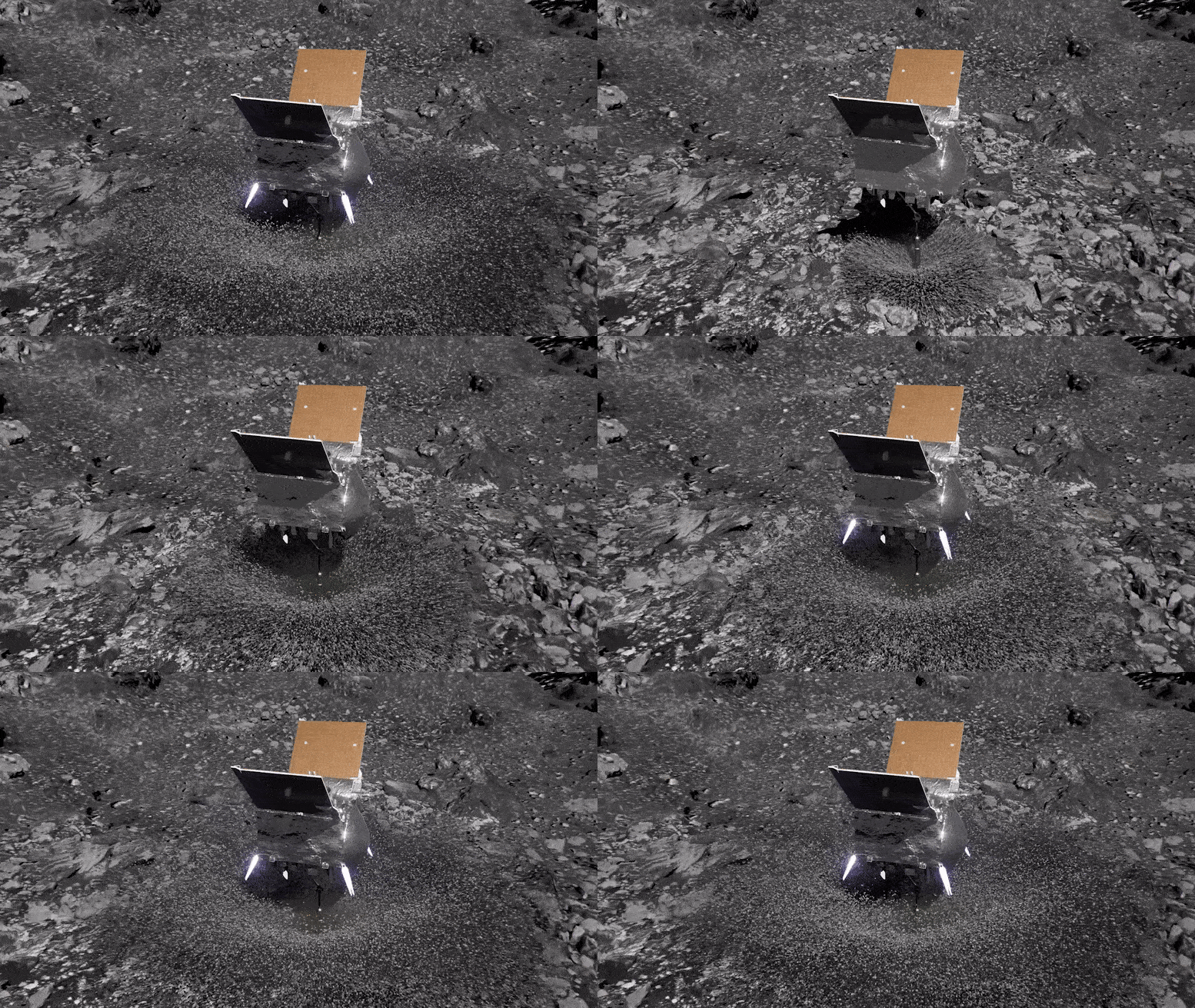
A Historic Mission to Capture Asteroid Dust
Bennu has long intrigued researchers due to its near-Earth orbit and carbon-rich composition. Scientists posited that the asteroid contained traces of water and organic molecules and theorized that similar asteroids could have brought these materials to a primordial Earth.
In 2020, NASA’s OSIRIS-REx (Origins, Spectral Interpretation, Resource Identification and Security-Regolith Explorer) spacecraft collected samples from Bennu, becoming the first U.S. space mission to collect a sample from the surface of an asteroid and the only sample collected from a planetary body in nearly 50 years—since the Apollo missions. In September 2023, as OSIRIS-REx soared past Earth, it dropped a capsule containing the Bennu samples. When the capsule touched down in the Utah desert, scientists were on site to retrieve it and protect the samples inside from terrestrial contamination.
In total, OSIRIS-REx collected around 120 grams of material, which is about the weight of a bar of soap and double the mission-required amount. The invaluable samples were divvied up and loaned to researchers around the world to analyze. This included Sara Russell, a cosmic mineralogist at the Natural History Museum in London and the co-lead author on the new paper with McCoy.
“It’s been an absolute joy to be involved in this amazing mission, and to collaborate with scientists from around the world to attempt to answer one of the biggest questions asked by humanity: how did life begin,” Russell said. “Together we have made huge progress in understanding how asteroids like Bennu evolved, and how they may have helped make the Earth habitable.”
Unveiling the Unexpected: A Surprising Discovery
NASA loaned the Smithsonian multiple Bennu samples (one of which is on display). McCoy and his colleagues analyzed these specimens using the museum’s state-of-the-art scanning electron microscope, funded in part through the Smithsonian Gem and Mineral Collectors donor group. This allowed the researchers to inspect microscopic features on asteroid fragments less than a micrometer—or 1/100th the width of a human hair—in size.
The team was surprised to find traces of water-bearing sodium carbonate compounds in the Bennu samples studied at the museum. Commonly known as soda ash or by the mineral name trona, these compounds have never been directly observed in any other asteroid or meteorite. On Earth, sodium carbonates often resemble baking soda and naturally occur in evaporated lakes that were rich in sodium, such as Searles Lake in the Mojave Desert.
The surprising discovery of sodium carbonate prompted McCoy to examine mineral specimens in the museum’s National Mineral Collection that contained the compound. He also reached out to his teammates around the world to see if they had observed anything noteworthy in other Bennu samples. The scientists discovered 11 minerals in total that likely existed in a brine-like environment on Bennu’s parent body.
Briny Clues to Otherworldly Chemistry
Bennu’s brine differs from terrestrial brines due to its mineral makeup. For example, the Bennu samples are rich in phosphorus, which is abundant in meteorites and relatively scarce on Earth. The samples also largely lack boron, which is a common element in hypersaline soda lakes on Earth but extremely rare in meteorites.
The researchers posit that similar brines likely still exist on other extraterrestrial bodies, including the dwarf planet Ceres and Saturn’s icy moon Enceladus where spacecraft have detected sodium carbonate. These brines likely also exist on other asteroids, and McCoy and his colleagues plan to reexamine meteorite specimens in the museum’s collection. While some of the salts observed in the Bennu brine would break down in Earth’s atmosphere, these minerals may leave telltale traces on meteorites that past scientists may have missed.
A Pathway Toward Life
While the Bennu brines contain an intriguing suite of minerals and elements, it remains unclear if the local environment was suitable to craft these ingredients into highly complex organic structures.
“We now know we have the basic building blocks to move along this pathway towards life, but we don’t know how far along that pathway this environment could allow things to progress,” McCoy said.
A second study, publishing concurrently in the journal Nature Astronomy Jan. 29, offers additional insights into Bennu’s composition. This paper describes multiple protein-building amino acids in the Bennu samples. It also reports the discovery of the five nucleobases that make up RNA and DNA. Some of these compounds have not been observed in meteorites that fall to Earth. Senior scientists Danny Glavin and Jason Dworkin at NASA Goddard Space Flight Center in Greenbelt, Maryland, are lead authors on the Nature Astronomy paper.
The two new studies are among the first published analyses of the Bennu samples. The Nature paper co-led by McCoy and Russell is also a major milestone in the National Museum of Natural History’s initiative, Our Unique Planet. As a public-private research partnership, Our Unique Planet investigates what sets Earth apart from its cosmic neighbors by exploring the origins of the planet’s oceans and continents as well as how minerals may have served as templates for life.
A Scientific Legacy for Decades to Come
McCoy thinks the new discoveries illustrate the scientific legacy of the OSIRIS-REx mission as the samples it collected will fuel research for decades. The samples also highlight how much is left to learn about Bennu.
“This is the kind of finding you hope you’re going to make on a mission,” McCoy said. “We found something we didn’t expect, and that’s the best reward for any kind of exploration.”
Explore Further:
- Scientists Just Found DNA’s Building Blocks in Asteroid Bennu
- NASA Uncovers Life’s Building Blocks in Asteroid Bennu’s Pristine Sample
References:
- “An evaporite sequence from ancient brine recorded in Bennu samples” by T. J. McCoy, S. S. Russell, T. J. Zega, K. L. Thomas-Keprta, S. A. Singerling, F. E. Brenker, N. E. Timms, W. D. A. Rickard, J. J. Barnes, G. Libourel, S. Ray, C. M. Corrigan, P. Haenecour, Z. Gainsforth, G. Dominguez, A. J. King, L. P. Keller, M. S. Thompson, S. A. Sandford, R. H. Jones, H. Yurimoto, K. Righter, S. A. Eckley, P. A. Bland, M. A. Marcus, D. N. DellaGiustina, T. R. Ireland, N. V. Almeida, C. S. Harrison, H. C. Bates, P. F. Schofield, L. B. Seifert, N. Sakamoto, N. Kawasaki, F. Jourdan, S. M. Reddy, D. W. Saxey, I. J. Ong, B. S. Prince, K. Ishimaru, L. R. Smith, M. C. Benner, N. A. Kerrison, M. Portail, V. Guigoz, P.-M. Zanetta, L. R. Wardell, T. Gooding, T. R. Rose, T. Salge, L. Le, V. M. Tu, Z. Zeszut, C. Mayers, X. Sun, D. H. Hill, N. G. Lunning, V. E. Hamilton, D. P. Glavin, J. P. Dworkin, H. H. Kaplan, I. A. Franchi, K. T. Tait, S. Tachibana, H. C. Connolly Jr. and D. S. Lauretta, 29 January 2025, Nature.
DOI: 10.1038/s41586-024-08495-6 - “Abundant ammonia and nitrogen-rich soluble organic matter in samples from asteroid (101955) Bennu” by Daniel P. Glavin, Jason P. Dworkin, Conel M. O’D. Alexander, José C. Aponte, Allison A. Baczynski, Jessica J. Barnes, Hans A. Bechtel, Eve L. Berger, Aaron S. Burton, Paola Caselli, Angela H. Chung, Simon J. Clemett, George D. Cody, Gerardo Dominguez, Jamie E. Elsila, Kendra K. Farnsworth, Dionysis I. Foustoukos, Katherine H. Freeman, Yoshihiro Furukawa, Zack Gainsforth, Heather V. Graham, Tommaso Grassi, Barbara Michela Giuliano, Victoria E. Hamilton, Pierre Haenecour, Philipp R. Heck, Amy E. Hofmann, Christopher H. House, Yongsong Huang, Hannah H. Kaplan, Lindsay P. Keller, Bumsoo Kim, Toshiki Koga, Michael Liss, Hannah L. McLain, Matthew A. Marcus, Mila Matney, Timothy J. McCoy, Ophélie M. McIntosh, Angel Mojarro, Hiroshi Naraoka, Ann N. Nguyen, Michel Nuevo, Joseph A. Nuth III, Yasuhiro Oba, Eric T. Parker, Tanya S. Peretyazhko, Scott A. Sandford, Ewerton Santos, Philippe Schmitt-Kopplin, Frederic Seguin, Danielle N. Simkus, Anique Shahid, Yoshinori Takano, Kathie L. Thomas-Keprta, Havishk Tripathi, Gabriella Weiss, Yuke Zheng, Nicole G. Lunning, Kevin Righter, Harold C. Connolly Jr. and Dante S. Lauretta, 29 January 2025, Nature Astronomy.
DOI: 10.1038/s41550-024-02472-9
Many researchers contributed to these studies, including Smithsonian-affiliated scientists Tim McCoy, Cari Corrigan, Rob Wardell, Tim Gooding, and Tim Rose. The study also involved experts from institutions worldwide, including the University of Arizona, NASA, Goethe University, Curtin University, Côte d’Azur University, the University of California, Berkeley, California State University, Purdue University, the University of Manchester, Hokkaido University, the University of Rochester, Lawrence Berkeley National Laboratory, the University of Queensland, Jean Monnet University, the Southwest Research Institute, Open University, the Royal Ontario Museum, the University of Tokyo, Rowan University, and the American Museum of Natural History.
The research was supported by NASA, along with funding from UK Research and Innovation, the UK Science and Technology Facilities Council, and the Canadian Space Agency.
NASA’s Goddard Space Flight Center in Greenbelt, Maryland, oversaw mission management, systems engineering, and safety for OSIRIS-REx. Dante Lauretta from the University of Arizona, Tucson, serves as the mission’s principal investigator, leading the science team and overseeing observation planning and data processing. Lockheed Martin Space in Littleton, Colorado, built the spacecraft and managed flight operations.
Never miss a breakthrough: Join the SciTechDaily newsletter.
Follow us on Google and Google News.