

A naked-eye star’s 50-year mystery is solved—its bizarre X-rays come from a hidden, feeding white dwarf.
Easily visible in the night sky within the constellation Cassiopeia, the star γ Cas has puzzled astronomers for more than 50 years. It produces X-rays with energies and temperatures far beyond what is expected from a typical massive star. New observations using the Resolve instrument aboard Japan’s XRISM space telescope have now traced this unusual emission to a white dwarf orbiting the star. This finding also confirms a long-theorized class of binary systems that had never been clearly identified. The study, led by researchers at the University of Liège, was published today (March 24) in Astronomy & Astrophysics.
What Makes Be Stars Like Gamma Cassiopeiae Unique
γ Cassiopeiae was the first Be-type star identified, a classification introduced in 1866 by Italian astronomer Angelo Secchi. These stars are massive and rotate extremely fast, periodically ejecting material into space. That material forms a surrounding disc, which can be detected through distinct features in the star’s optical spectrum.
In 1976, scientists discovered that γ Cas emits X-rays about forty times more powerful than those of similar massive stars. The plasma producing these emissions reaches temperatures above 100 million degrees and fluctuates rapidly. Over the next two decades, space-based observatories identified about twenty stars with similar behavior, forming a group known as ‘γ Cas analogues’. Researchers at the University of Liège played a key role in this work, identifying more than half of these objects.
Competing Theories About the X-Ray Source
“Several scenarios had been proposed to explain this emission,” explains Yaël Nazé, an astronomer at ULiège. “One of them involved local magnetic reconnection between the surface of the Be star and its disc. Others suggested X-rays to be linked to a companion, whether a star stripped of its outer layers, a neutron star, or an accreting white dwarf.”
Earlier studies had already ruled out stripped stars and neutron stars because observations did not match theoretical expectations. That left two possibilities: magnetic interactions involving the star itself or an accreting white dwarf companion. Until now, there was no clear evidence to decide between them.
XRISM Observations Reveal the True Source
To resolve the mystery, the team carried out a dedicated observing campaign using Resolve, a high-precision microcalorimeter on board XRISM that is transforming the study of high-energy astrophysics. Observations were taken in December 2024, February 2025, and June 2025, covering the full 203-day orbit of the system.
“The spectra revealed that the signatures of the high-temperature plasma change velocity between the three observations, following the orbital motion of the white dwarf rather than that of the Be star,” the researcher continues. “This shift was measured with high statistical reliability. It is, in fact, the first direct evidence the the ultra-hot plasma responsible for the X-rays is associated with the compact companion, and not with the Be star itself.”

Evidence Points to a Magnetic White Dwarf
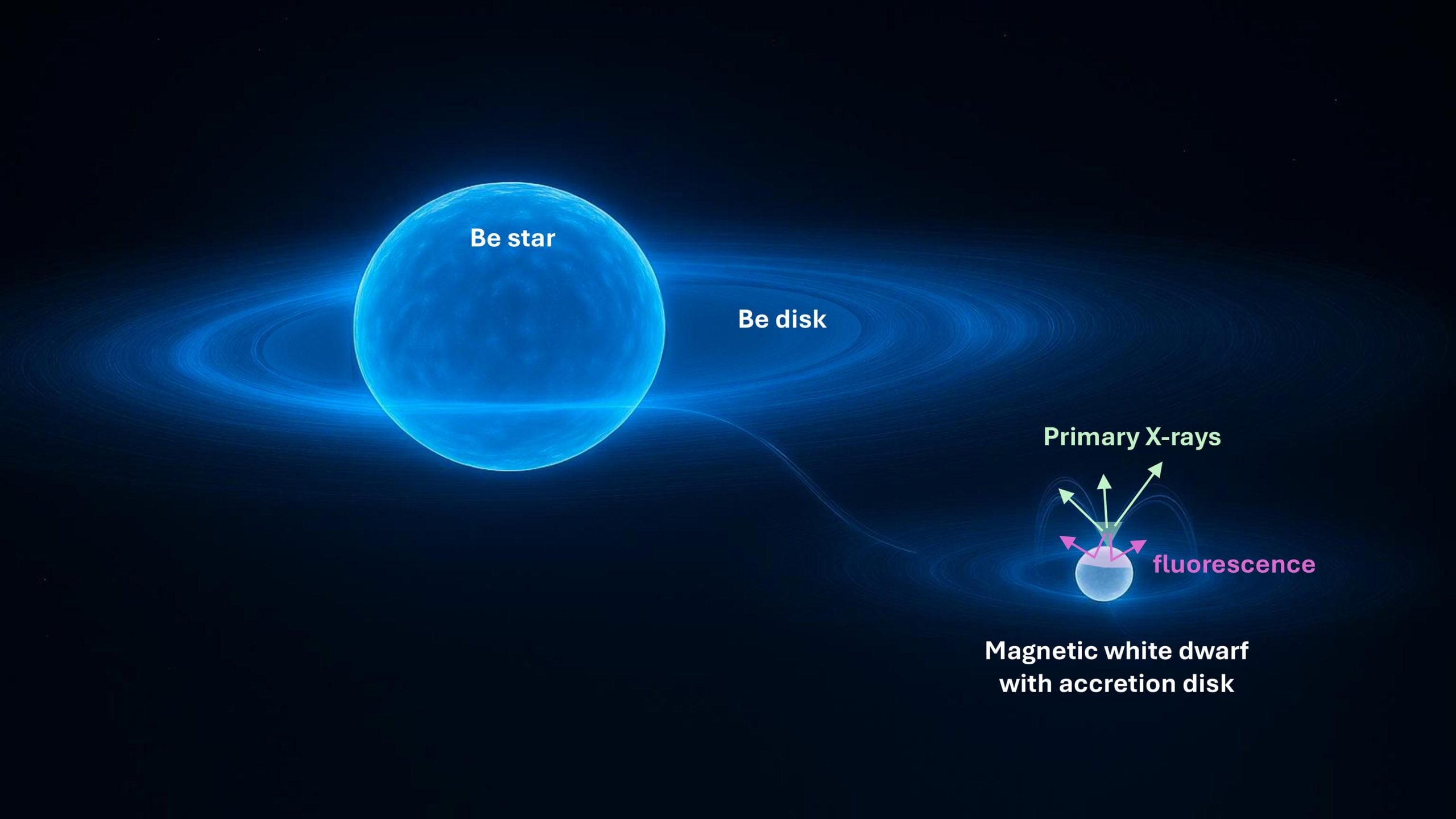
The data also provide clues about the nature of the white dwarf. The observed spectral features have a moderate width (of the order of 200 km/s), which rules out a non-magnetic white dwarf. In such systems, material would spiral in through the inner disc at very high speeds, producing much broader signals. Instead, the findings indicate a magnetic white dwarf, where the disc is truncated, and the magnetic field directs incoming material toward the object’s poles (see figure).

A New Class of Binary Star Systems Confirmed
These results establish that γ Cas and similar stars belong to a class of Be + white dwarf binary systems that had long been predicted but never clearly observed. The research team also identified two notable traits of this group. It mainly involves massive Be stars and represents about 10% of them. However, theoretical models had predicted a larger population and suggested a stronger link with lower-mass Be stars.
“This discrepancy suggests a revision of binary evolution models, particularly regarding the efficiency of mass transfer between components—a conclusion that aligns with that of several recent independent studies. Solving this mystery therefore opens up new avenues of research for the years to come! Understanding the evolution of binary systems is crucial for comprehending, for example, gravitational waves, as it is indeed massive binaries that emit them at the end of their lives,” concluded Yaël Nazé.
Reference: “Orbital motion detected in γ Cas Fe K emission lines” by Yaël Nazé, Masahiro Tsujimoto, Gregor Rauw and Sean J. Gunderson, 24 March 2026, Astronomy & Astrophysics.
DOI: 10.1051/0004-6361/202558284
Never miss a breakthrough: Join the SciTechDaily newsletter.
Follow us on Google and Google News.
1 Comment
Thank you