
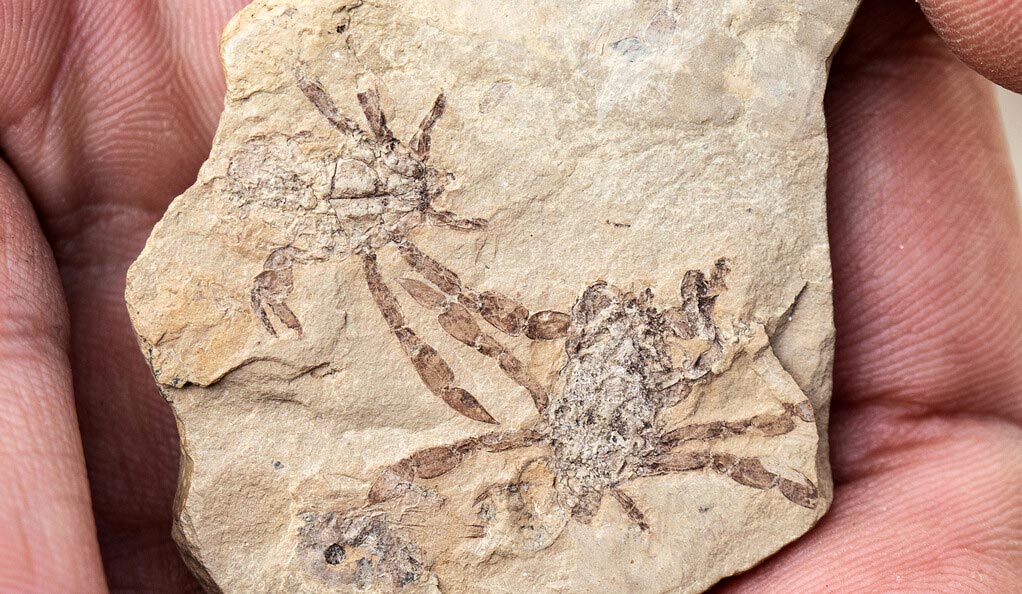
Yale and Harvard researchers have identified significant optical features in the ancient crab species Callichimaera perplexa, suggesting it was a visually-oriented predator.
Their legs may get more attention, but a new study says a crab’s eyes have much to offer, too — at least scientifically.
Writing in the journal iScience, paleontologists from Yale and Harvard have discovered new, unusually large optical features from a 95-million-year-old crab fossil, Callichimaera perplexa — a species first described in 2019 in a study led by former Yale paleontologist Javier Luque — which suggest that Callichimaera was a predator.
Callichimaera, which was found in Boyacá, Colombia, and Wyoming, in the United States, was about the size of a quarter, featuring large compound eyes with no sockets, bent claws, leg-like mouth parts, an exposed tail, and a long body. Previous research indicated that it was the earliest example of a swimming arthropod with paddle-like legs since the extinction of sea scorpions more than 250 million years ago.
“The specimens we have of the unusual Cretaceous crab Callichimaera perplexa preserve some very delicate eye tissues that don’t normally preserve,” said Kelsey Jenkins, a graduate student in Earth & planetary sciences at Yale and the new study’s first author. “This includes things like facets and internal optical tissues. This kind of excellent preservation is rare.”
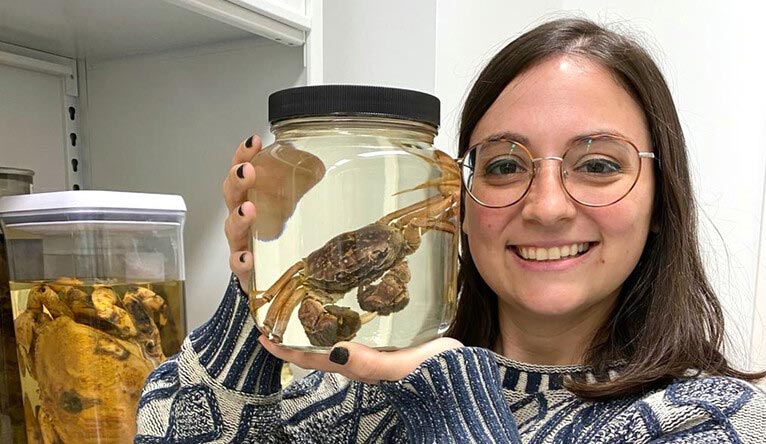
The co-corresponding author of the study is Luque, who is now a research associate at Harvard. The study’s co-author is Derek Briggs, the G. Evelyn Hutchinson Professor of Earth & Planetary Sciences in Yale’s Faculty of Arts and Sciences. Briggs is also curator of invertebrate paleontology at the Yale Peabody Museum of Natural History.
Comparing Crab Eyes Across Species
For the study, the researchers analyzed nearly 1,000 living crabs and fossils, including crabs at different stages of development, representing 15 crab species. The researchers compared the size of the crabs’ eyes and how fast they grew.
Callichimaera topped the list in both categories. Its eyes were about 16% of its body size.
“I’m 5’2”. If my eyes were this big, they’d be a little over 9 inches in diameter,” Jenkins said. “If something has eyes this big, they’re definitely very highly visual. This is in stark contrast to crabs with tiny, vestigial eyes where they may only be 1 to 3% of the animal’s body size.”
Likewise, Callichimaera’s optical growth rate was faster than any other crab the researchers studied. “Crabs whose eyes are growing very quickly are more visually inclined — likely they’re very good predators who use their eyes when hunting — whereas slow-growing eyes tend to be found in scavenger crabs that are less visually reliant,” Briggs said.
A Fresh Perspective Leads to New Discoveries
Tellingly, it was a fresh set of eyes that made the latest Callichimaera finding possible. Jenkins, whose main research experience has been with reptiles, wanted to learn more about another type of animal — hence, crabs.
“Javier and Derek mentored me, and I was able to provide an outsider’s perspective on a group of animals I was originally unfamiliar with,” Jenkins said.
Reference: “The remarkable visual system of a Cretaceous crab” by Kelsey M. Jenkins, Derek E. G. Briggs and Javier Luque, 7 December 2021, iScience.
DOI: 10.1016/j.isci.2021.103579
The research was funded, in part, by the Paleontological Society, the Yale Institute for Biospheric Studies, the National Science and Engineering Research Council of Canada, and the National Science Foundation.
Never miss a breakthrough: Join the SciTechDaily newsletter.
Follow us on Google and Google News.