
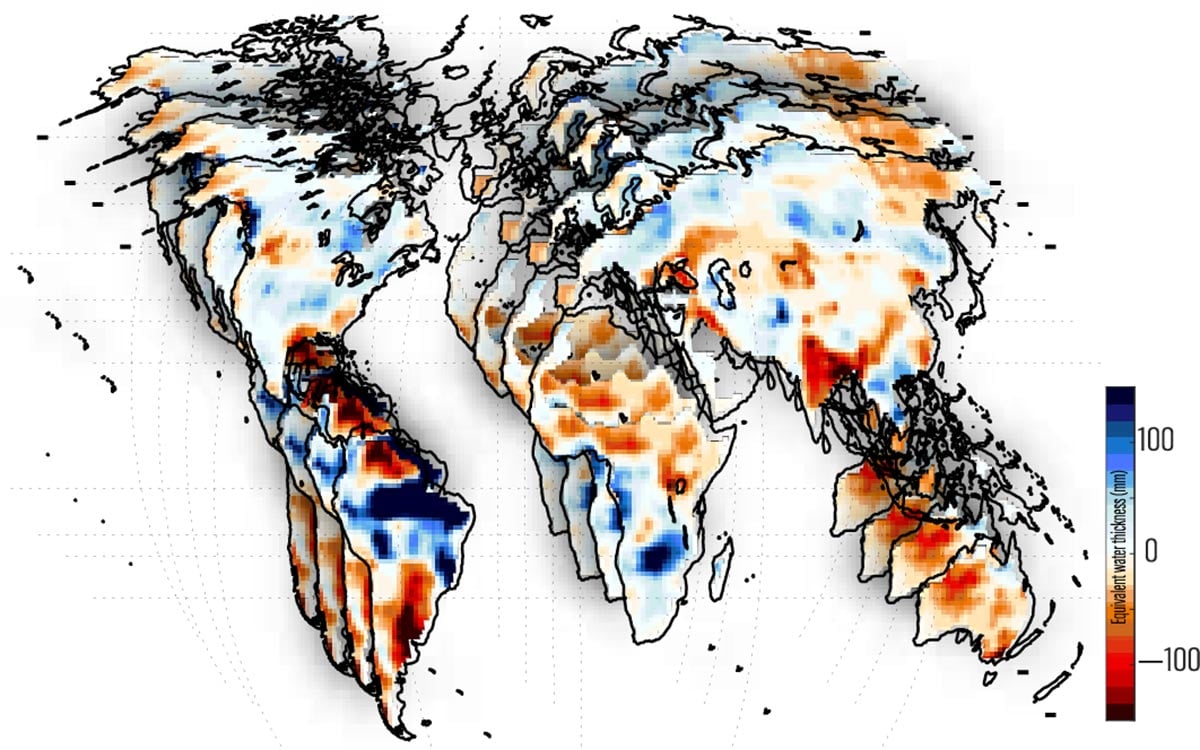
Floods and droughts across the globe are moving in sync, and a powerful Pacific climate cycle is pulling the strings.
Droughts and floods can upend lives, disrupt natural systems, and strain economies around the world. Scientists at The University of Texas at Austin are working to better understand these extreme water events by tracking how they appear and evolve across the globe. Their findings point to a powerful climate pattern that plays a central role in shaping these extremes.
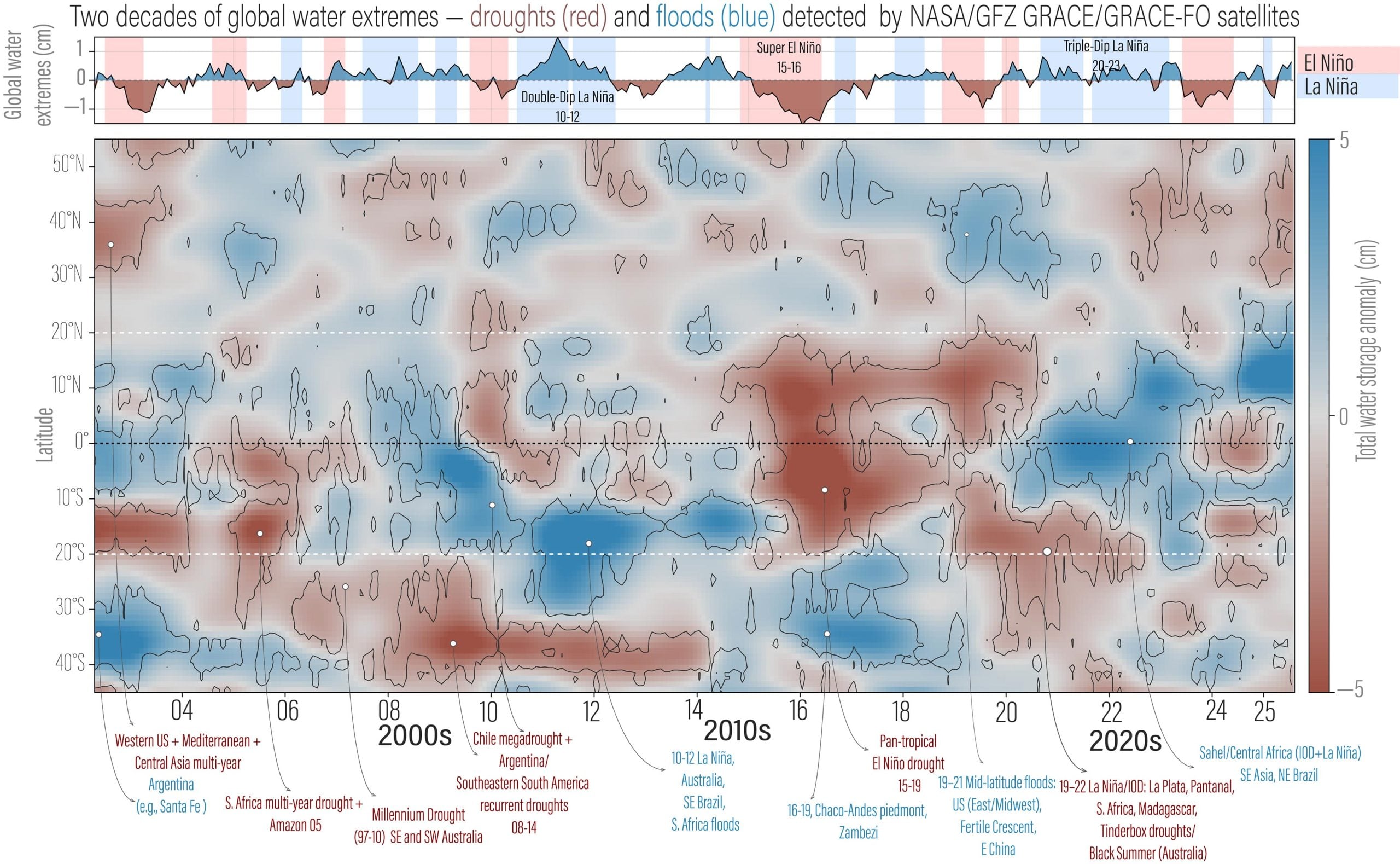
A study recently published in AGU Advances reports that over the past 20 years, ENSO, a recurring climate pattern in the equatorial Pacific Ocean that includes El Niño and La Niña, has been the leading force behind extreme changes in total water storage worldwide. The researchers also found that ENSO tends to align these extremes, causing far-apart regions to experience unusually wet or dry conditions at the same time.
Why Global Water Extremes Matter
Study co-author Bridget Scanlon, a research professor at the Bureau of Economic Geology at the UT Jackson School of Geosciences, said that seeing water extremes from a global perspective has important implications for humanitarian planning and public policy.
“Looking at the global scale, we can identify what areas are simultaneously wet or simultaneously dry,” Scanlon said. “And that of course affects water availability, food production, food trade — all of these global things.”
When multiple regions face extreme water conditions together, the consequences can ripple through food systems, supply chains, and international cooperation.
Tracking All Forms of Water
Total water storage is a comprehensive climate measure that accounts for every form of water in a given area. It includes surface water in rivers and lakes, snowpack, moisture held in soils, and groundwater stored underground. By examining this full picture, scientists can better capture how water systems respond to climate forces.
This research is among the first to examine total water storage extremes alongside ENSO (The El Niño-Southern Oscillation) on a global scale. According to lead author Ashraf Rateb, a research assistant professor at the bureau, this approach allows scientists to see how extreme conditions are connected across regions.
“Most studies count extreme events or measure how severe they are, but by definition extremes are rare. That gives you very few data points to study changes over time,” Rateb said. “Instead, we examined how extremes are spatially connected, which provides much more information about the patterns driving droughts and floods globally.”

Satellite Data Reveal Water Shifts
To estimate total water storage, the research team relied on gravity measurements collected by NASA’s GRACE and GRACE Follow-On (GRACE-FO) satellites. These observations make it possible to detect changes in water mass over areas roughly 300 to 400 kilometers across, similar in size to the state of Indiana.
The scientists defined wet extremes as water storage levels above the 90th percentile for a given region. Dry extremes were identified as levels below the 10th percentile.
Their results show that unusual ENSO behavior can push widely separated regions into extreme wet or dry conditions at the same time. In some places, El Niño is linked to dry extremes, while in other regions dryness is tied to La Niña. Wet extremes tend to show the opposite pattern.
Real Examples From Around the World
The study highlights several notable cases. In the mid-2000s, El Niño coincided with severe drought in South Africa. Another El Niño event was linked to dry conditions in the Amazon during 2015-2016. In contrast, La Niña during 2010-2011 brought exceptionally wet conditions to Australia, southeast Brazil, and South Africa.
Beyond individual events, the researchers also identified a broader change in global water behavior around 2011-2012. Before 2011, wet extremes were more common worldwide. After 2012, dry extremes became more frequent. The team attributes this shift to a long-lasting climate pattern in the Pacific Ocean that influences how ENSO affects global water systems.
Filling Gaps in the Record
Because GRACE and GRACE-FO data are not continuous, including an 11-month gap between missions in 2017-2018, the researchers used probabilistic models based on spatial patterns to estimate total water storage extremes during periods without satellite coverage.
Although the satellite record spans only 22 years (2002-2024), it still reveals strong links between climate cycles and global water behavior, said JT Reager, deputy project scientist for the GRACE-FO mission at NASA’s Jet Propulsion Laboratory and JPL Discipline Program manager for the Water and Energy Cycle.
“They’re really capturing the rhythm of these big climate cycles like El Niño and La Niña and how they affect floods and droughts, which are something we all experience,” said Reager, who was not part of the study. “It’s not just the Pacific Ocean out there doing its own thing. Everything that happens out there seems to end up affecting us all here on land.”
Planning for Extremes, Not Just Scarcity
Scanlon said the findings also reinforce the need to view floods and droughts as natural parts of the climate system that require preparation and management.
“Oftentimes we hear the mantra that we’re running out of water, but really it’s managing extremes,” Scanlon said. “And that’s quite a different message.”
Reference: “Dynamics and Couplings of Terrestrial Water Storage Extremes From GRACE and GRACE-FO Missions During 2002–2024” by Ashraf Rateb, Bridget R. Scanlon, Yadu Pokhrel and Alexander Sun, 20 November 2025, AGU Advances.
DOI: 10.1029/2025AV001684
The research was funded by the UT Jackson School of Geosciences.
Never miss a breakthrough: Join the SciTechDaily newsletter.
Follow us on Google and Google News.
6 Comments
Does this study include the consequences of Geoengeneering? If not then it needs to be. People need to know the truth.
Socrates struggled with the concept of “justice.” Please tell us what “the truth” is. Inquiring minds would like to know.
“…, which provides much more information about the patterns DRIVING droughts and floods globally.”
Do “patterns” actually DRIVE droughts and flood, or are they just a reflection of what the situation is? Why do we have ENSO events? Surely the authors aren’t suggesting that the tail is wagging the dog and extreme wet/dry events are causing the temperature oscillations that characterize El Niño and La Niña episodes! The patterns are interesting observational data, but I sincerely doubt that they are responsible for “driving” the extreme events. They ARE the events.
Despite the concept of Uniformitarianism prevailing over the ideas of Catastrophism, extreme events such as floods and droughts have always occurred as evidenced by the rock record. The question that this article doesn’t address is why do these extremes occur and what determines the range in intensity? The authors are documenting the recent patterns, but without some over-riding hypothesis about what controls the location, extent, and intensity, it tells us little about what the future may hold. That is the whole point of science. Science is about predicting, not just observing, which is only the initial step in the Scientific Method.
Oh its the slowing of the north atlantic drift that I nceases el Nino.winters anx melts more north.pole ice. I got a fix using Lake Agazzis in canada to go backinto Red Rivef again to cross Mn and go into lake Superior anx finally into.Sea of Greenland to cool African water
About truth:
John 14:6
Jesus said to him, “I am the way and the truth and the life. No one comes to the Father except through Me.”
About climate changes”
Matthew 24:6–8
“You will hear of wars and rumors of wars, but see to it that you are not alarmed. Such things must happen, but the end is still to come.
Nation will rise against nation, and kingdom against kingdom. There will be famines and earthquakes in various places.
All these are the beginning of birth pains.”
And more About the end times:
New American Standard Bible (NASB 2020)
“But as for you, Daniel, keep these words secret and seal the book until the time of the end; many will roam about, and knowledge will increase.”
Os there somethong mord than ChatGPT, a vast metwork of computers that can give you all ths answers.