

Planetary Scientists Examined Jupiter’s Atmospheric Circulation Using SOFIA
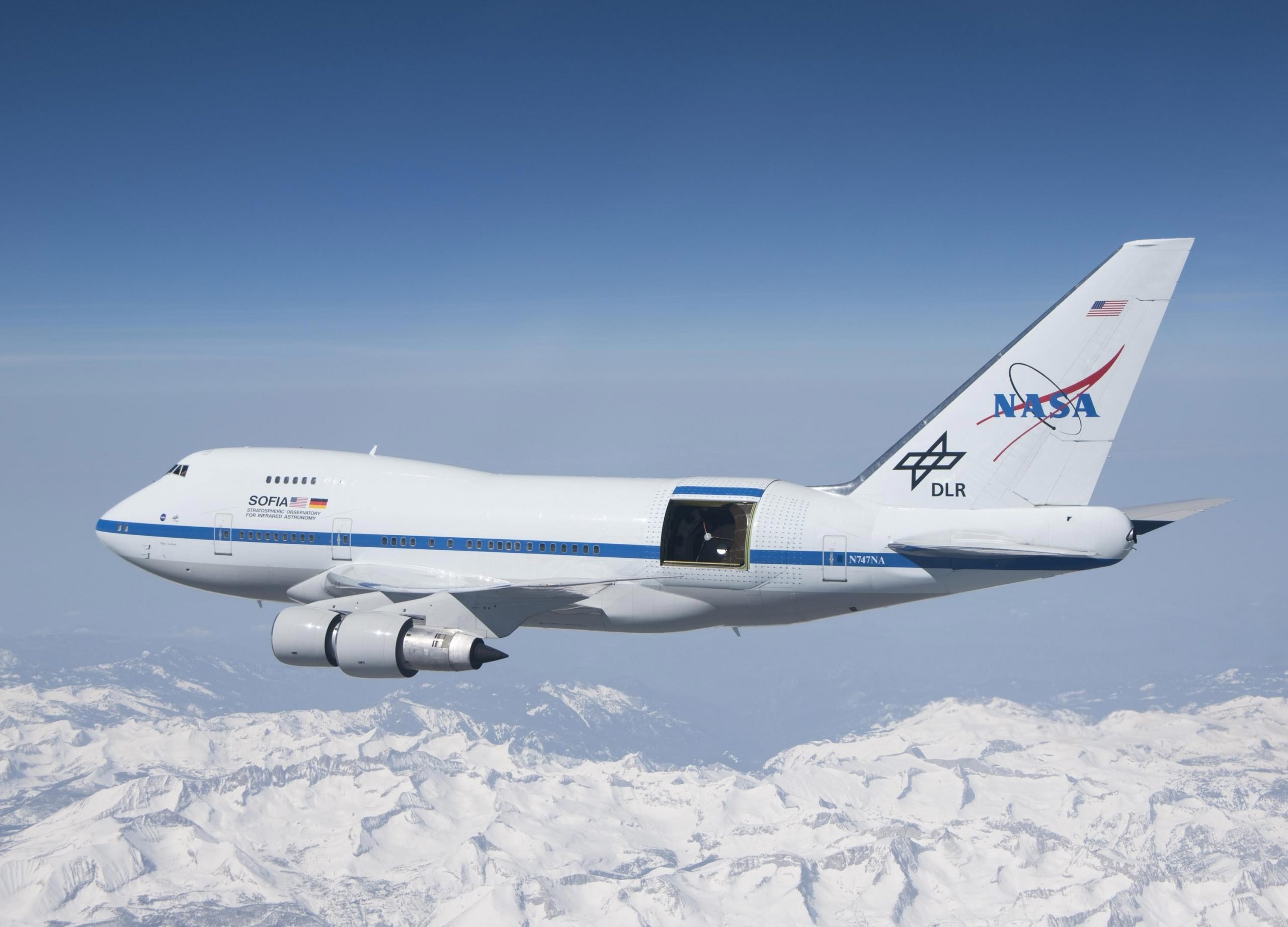
Planetary scientists utilized the Stratospheric Observatory for Infrared Astronomy (SOFIA), a joint project of NASA and the German Space Agency at DLR, to examine Jupiter’s atmospheric circulation — for the first time during the planet’s northern winter – during flights in August 2018 and July 2019.
To do so, they looked at hydrogen.
Hydrogen molecules – H2 – can be arranged in two different ways, known as parahydrogen and orthohydrogen. The two orientations have distinct energies, so determining the ratio of parahydrogen to orthohydrogen can tell astronomers about the overall temperature.
Observing Atmospheric Circulation on Jupiter
The researchers looked at the concentration of parahydrogen and orthohydrogen at altitudes just above Jupiter’s main cloud deck. They discovered that, around the equator, warm gas is rising into the Jovian atmosphere. At the north and south poles, however, the opposite is occurring: cold gas from the higher, cooler levels of the atmosphere is traveling downward.
“This gives a sense of the general circulation: rising at the equator, sinking near the poles,” said Imke de Pater, lead author on a recent paper in the Planetary Science Journal describing the observations.
Jupiter’s atmosphere had been looked at through the lens of hydrogen before – by SOFIA in 2014, and by NASA’s Voyager 1 and 2 in 1979 – but only during the northern Jovian summer. The current observations were the first-ever taken during Jupiter’s northern winter, about half a Jovian year after the 2014 SOFIA studies. This comparison illustrated how Jupiter’s poles change with the seasons, showing that its far north remains cooler than its far south, regardless of the time of year.
Jupiter’s northern and southern hemispheres are known to have an asymmetric aerosol distribution, so this temperature imbalance between its two poles is likely an effect of its asymmetry.
Unexpected Observations of Jupiter’s Galilean Moons
In studying Jupiter, de Pater and her colleagues also saw four other objects that had entered SOFIA’s field of view and the data collected: Jupiter’s four largest moons, known collectively as its Galilean satellites – Io, Europa, Ganymede, and Callisto.
“We were surprised that we actually captured all four satellites, and could determine their brightness temperature,” de Pater said.
Thanks to this pleasant surprise, the group could clearly see how the moons’ temperatures decrease with depth in their subsurface layers. These temperature changes can eventually be used to determine the composition, density, and other properties inside the satellites.
The satellites all have unique characteristics – ranging from water ice on Europa, to heavy craters on the ancient Callisto, to extreme volcanic activity on Io – making their material makeup particularly interesting to investigate.
Jupiter and its moons are too bright to be observed by the long-wavelength channels on the James Webb Space Telescope as they can saturate the instrument, and they cannot be measured from the ground due to Earth’s atmosphere blocking a large amount of mid-infrared radiation. SOFIA’s unique access to the mid-infrared, therefore, enables these measurements and provides critical information about Jupiter and its moons.
Reference: “SOFIA Observations of Variability in Jupiter’s Para-H2 Distribution and Subsurface Emission Characteristics of the Galilean Satellites” by Imke de Pater, Leigh N. Fletcher, William T. Reach, Charles Goullaud, Glenn S. Orton, Michael H. Wong and Robert D. Gehrz, 10 November 2021, Planetary Science Journal.
DOI: 10.3847/PSJ/ac2d24
SOFIA is a joint project of NASA and the German Space Agency at DLR. DLR provides the telescope, scheduled aircraft maintenance, and other support for the mission. NASA’s Ames Research Center in California’s Silicon Valley manages the SOFIA program, science, and mission operations in cooperation with the Universities Space Research Association, headquartered in Columbia, Maryland, and the German SOFIA Institute at the University of Stuttgart. The aircraft is maintained and operated by NASA’s Armstrong Flight Research Center Building 703, in Palmdale, California.
Never miss a breakthrough: Join the SciTechDaily newsletter.
Follow us on Google and Google News.