

Researchers have identified a protein that links brain immune activity, metabolism, and amyloid clearance, suggesting a new way to enhance current Alzheimer’s treatments.
Alzheimer’s disease can look like a set of grim headlines: soaring case counts, ballooning health care costs, and an aging population that makes the problem harder every year. But inside a home, the reality is quieter and more painful. “It’s a slow bereavement,” says Cold Spring Harbor Laboratory Professor Nicholas Tonks, whose mother lived with Alzheimer’s. “You lose the person piece by piece.”
For decades, one of the biggest questions has been what starts the damage in the first place. A major suspect is brain “plaque,” made of amyloid-β (Aβ). Aβ is produced naturally, but under certain conditions it can build up and form clumps. Those clusters are strongly linked to Alzheimer’s progression, even as scientists continue to debate how many different biological processes must go wrong before symptoms appear.
Tonks’ team is now highlighting a different lever in that process: the enzyme PTP1B. In a mouse model of Alzheimer’s disease, Tonks, graduate student Yuxin Cen, and postdoctoral fellow Steven Ribeiro Alves found that inhibiting PTP1B improved learning and memory, suggesting that dialing down this enzyme changes how the brain copes with the disease.
Microglia, Immune Exhaustion, and Brain Cleanup
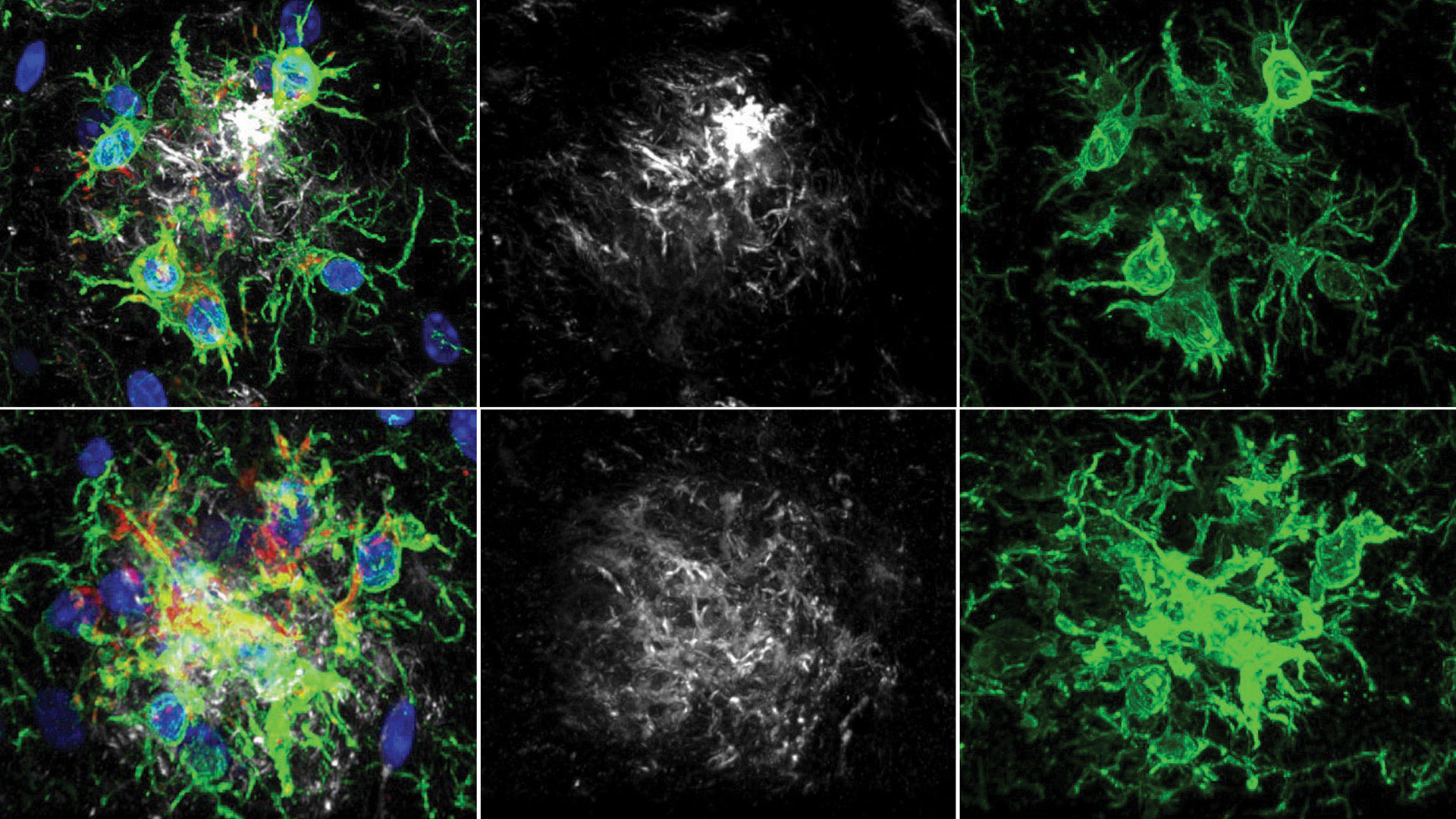
Tonks first discovered PTP1B in 1988 and has investigated its health effects ever since. In the new study, his group shows that PTP1B directly interacts with spleen tyrosine kinase (SYK), a key regulator of microglia (the brain’s immune cells). Microglia act as the brain’s frontline maintenance crew, sensing trouble and helping clear unwanted material, including excess Aβ.
“Over the course of the disease, these cells become exhausted and less effective,” says Cen. “Our results suggest that PTP1B inhibition can improve microglial function, clearing up Aβ plaques.”
Alzheimer’s risk is also influenced by factors beyond amyloid buildup. Conditions such as obesity and type 2 diabetes are strongly linked to a higher likelihood of developing the disease and may help explain its growing prevalence worldwide. Because PTP1B is already an established drug target for both metabolic disorders, these connections further support investigating its potential role in Alzheimer’s treatment.
Beyond Current Alzheimer’s Therapies
Newly approved therapies for Alzheimer’s disease primarily focus on targeting Aβ clearance, yet offer only modest clinical benefits for many patients. “Using PTP1B inhibitors that target multiple aspects of the pathology, including Aβ clearance, might provide an additional impact,” says Ribeiro Alves.
The Tonks lab is currently working with DepYmed, Inc. to develop PTP1B inhibitors for multiple applications. For Alzheimer’s disease, Tonks envisions a combination of therapies that pair existing approved drugs along with PTP1B inhibitors. “The goal is to slow Alzheimer’s progression and improve quality of life of the patients,” he says. With this research establishing PTP1B as a potential therapeutic target for the disease, it may hold the key to doing just that.
Reference: “PTP1B inhibition promotes microglial phagocytosis in Alzheimer’s disease models by enhancing SYK signaling” by Yuxin Cen, Steven R. Alves, Dongyan Song, Christy Felice, Jonathan B. Preall, Linda Van Aelst and Nicholas K. Tonks, 2 February 2026, Proceedings of the National Academy of Sciences.
DOI: 10.1073/pnas.2521944123
Never miss a breakthrough: Join the SciTechDaily newsletter.
Follow us on Google and Google News.
3 Comments
Thanks so much for the excellent intellectual updates.
Something came up. Not certain if it’s true. Let’s check out out. No one is at fault, it’s that there were circumstances where people were invading other areas and the MCC was doing things to counter there appearance here.
One of those things possibly, which came up, was make this up so that people would try it on themselves. It’s possible that it doesn’t work on humans.
Message me for talk. I also am looking for coherent persons to help me save the world, and make some required changes. Let me know!
Something came up. Not certain if it’s true. Let’s check out out. No one is at fault, it’s that there were circumstances where people were invading other areas and the MCC was doing things to counter there appearance here.
One of those things possibly, which came up, was make this up so that people would try it on themselves. It’s possible that it doesn’t work on humans.
Message me for talk. I also am looking for coherent persons to help me save the world, and make some required changes. Let me know!