
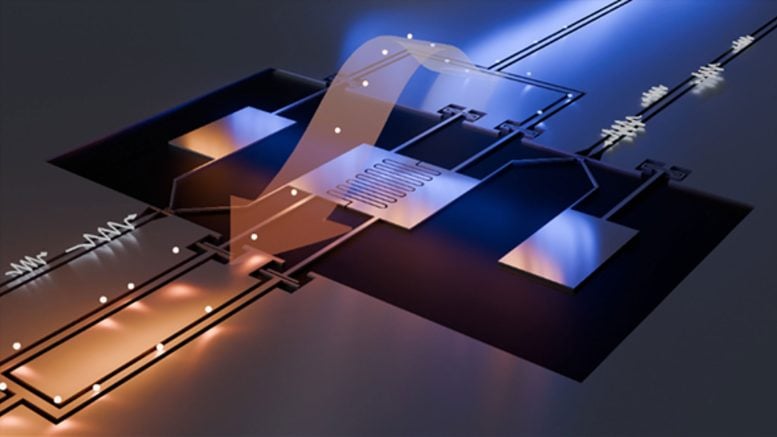
By using controlled microwave noise, researchers created a quantum refrigerator capable of operating as a cooler, heat engine, or amplifier. This approach offers a new way to manage heat directly inside quantum circuits.
Quantum technology has the potential to reshape many core areas of society, including drug discovery, artificial intelligence, logistics, and secure communications. Despite this promise, major engineering hurdles still stand in the way of practical applications. One of the most serious challenges is maintaining control over quantum states, which are extremely sensitive and form the foundation of quantum computing.
Superconducting quantum computers push this challenge to an extreme. To work at all, they must be cooled to temperatures near absolute zero (around -273°C). In that deep cold, electrical resistance vanishes, electrons flow freely, and qubits can reliably form the quantum states that carry information. The catch is that the same qubits can lose that information quickly if they feel tiny temperature changes, unwanted electromagnetic signals, or everyday background noise.
Scaling Challenges and the Problem of Heat
Quantum computers need many more qubits to solve real problems, but larger devices are harder to keep quiet and evenly cold. As circuits grow, heat and noise have more ways to spread, which increases the risk of wiping out quantum information.

“Many quantum devices are ultimately limited by how energy is transported and dissipated. Understanding these pathways and being able to measure them allows us to design quantum devices in which heat flows are predictable, controllable, and even useful,” says Simon Sundelin, doctoral student of quantum technology at Chalmers University of Technology and the study’s lead author.
Using noise for cooling
In a study published in Nature Communications, the Chalmers team reports a “minimal” quantum refrigerator that flips the usual strategy. Instead of spending all effort on suppressing noise, they use a controlled version of it to drive heat transport predictably.
“Physicists have long speculated about a phenomenon called Brownian refrigeration, the idea that random thermal fluctuations could be harnessed to produce a cooling effect. Our work represents the closest realization of this concept to date,” says Simone Gasparinetti, associate professor at Chalmers and senior author of the study.
The core of the device is a superconducting artificial molecule created in Chalmers’ nanofabrication laboratory. While it mimics the behavior of natural molecules, it is built from tiny superconducting circuits rather than atoms. By linking this artificial molecule to multiple microwave channels and adding controlled microwave noise as random fluctuations within a narrow frequency range, the researchers can guide how heat and energy move through the system with high precision.
Precision Heat Control at the Smallest Scales
“The two microwave channels serve as hot and cold reservoirs, but the key point is that they are only effectively connected when we inject controlled noise through a third port. This injected noise enables and drives heat transport between the reservoirs via the artificial molecule. We were able to measure extremely small heat currents, down to powers in the order of attowatts, or 10⁻¹⁸ watt. If such a small heat flow were used to warm a drop of water, it would take the age of the universe to see its temperature rise one degree Celsius,” explains Sundelin.
Because they can tune reservoir temperatures and track these tiny heat flows, the same setup can switch between operating modes, acting as a refrigerator, a heat engine, or a thermal transport amplifier. That flexibility is important for large quantum processors, where the hottest spots are often created right where qubits are controlled and measured, not at the edges of the cryostat.
“We see this as an important step towards controlling heat directly inside quantum circuits, at a scale that conventional cooling systems can’t reach. Being able to remove or redirect heat at this tiny scale opens the door to more reliable and robust quantum technologies,” says Aamir Ali, a researcher in quantum technology at Chalmers and co-author of the study.
Reference: “Quantum refrigeration powered by noise in a superconducting circuit” by Simon Sundelin, Mohammed Ali Aamir, Vyom Manish Kulkarni, Claudia Castillo-Moreno and Simone Gasparinetti, 26 January 2026, Nature Communications.
DOI: 10.1038/s41467-025-67751-z
Funding: The research project has received funding from: the Swedish Research Council; the Knut and Alice Wallenberg Foundation through the Wallenberg Centre for Quantum Technology (WACQT); the European Research Council; and the European Union.
Never miss a breakthrough: Join the SciTechDaily newsletter.
Follow us on Google and Google News.
6 Comments
You able to remove or redirect heat at this tiny scale opens the door to more reliable and robust quantum technologies.
VERY GOOD.
Please ask researchers to think deeply:
1. How do you understand superconductivity and so-called quantum?
2. Is quantum a cat that is both dead and alive?
Are these science?
Example 1
Two sets of cobalt-60 are manually rotated in opposite directions, and even without detection, people around the world know that they will not be symmetrical because these two objects are not mirror images of each other at all. However, a group of so-called physicists and so-called academic publications do not believe it. They conducted experiments and the results were indeed asymmetric, but they still firmly believed that these two objects were mirror images of each other, and the asymmetry was due to a violation of the previous natural laws (CP violation). In the history of science, there can never be a dirtier and uglier operation and explanation than this.
—— Excerpted from https://scitechdaily.com/what-happens-when-light-gains-extra-dimensions/#comment-947619.
Example 2
Please see how the so-called “mystery of θ – τ” is explained: θ and τ are completely identical in all measurable physical properties such as mass, lifetime, charge, spin, etc. However, experimental observations have shown that the θ meson decays into two π mesons, while the τ meson decays into three π mesons, making it difficult for physicists to explain why they are so similar. Physicist Martin Block proposed a highly challenging idea: θ and τ are the same particle, but in weak interactions, parity is not conserved. An easy to understand explanation is the following analogy:: There are two boxes of apples with identical weight, color, and taste. However, when one box is opened, there are two apples, while when the other box is opened, there are three apples. This confuses the old farmer who buys apples. He circled around the orchard and came up with a highly challenging idea: these two boxes of apples are not from the same tree, so they are the same.
—— Excerpted from https://scitechdaily.com/what-happens-when-light-gains-extra-dimensions/#comment-947686.
Everyone who has a reverence for natural laws and regulations deserves respect.
Matter, energy, and space-time are all manifestations of structure, not independently existing substances. Vortices are fundamental not because they are carriers of some more basic substance, but because they are the fundamental units of structure. The core proposition of Topological Vortex Theory (TVT) eloquently expresses this position: “Topology precedes matter, structure precedes existence.”
This philosophical turn echoes discussions in 20th-century philosophy of science regarding “structural realism”—when scientific theory undergoes revolutionary change, continuity is often carried not by entities but by mathematical structures. From classical mechanics to quantum field theory, from relativity to string theory, entities are continually overturned, but mathematical structures (such as symmetry, invariants, topological properties) persist in some manner. TVT pushes this insight to its extreme: if structure is truly fundamental, then the “vortex” as the archetype of topological structure has the potential to become the first principle for reconstructing physics.
thanks for this
‘Being able to remove or redirect heat at this tiny scale opens the door to more reliable and robust quantum technologies’ . And yet more effective surveillance technologies.
Use the core as said nitrogen as the base core and draw out he electrons. use a form of magnetism to keep them in the same order for any said quantum learning. some gasses have a few similar base properties. magnetism has been known as unstable which can be true in some instances bus it stablized most noble gasses could make quantum memory possible. encasing in a pyrex or quartz base between the said base should make this possible
If magnetism doesn’t work a current of some sort would have to be in order, moisture…a DC form of electricity or a compressed laser