

Researchers have synthesized complex menthyl esters and uncovered the mechanism by which they interact with the liver X receptor.
Researchers developed menthyl esters with significant anti-inflammatory and anti-obesity effects, potentially offering new treatments for chronic inflammatory conditions and metabolic disorders.
Recent therapeutic advances and commercial successes have often been driven by modified derivatives of natural products. Menthol, a naturally occurring cyclic monoterpene alcohol, is found in various plants, especially in mint family members like peppermint and spearmint. It is widely used in confectionery, chewing gum, and oral care products. Notably, menthol also possesses significant medicinal properties, including analgesic, anti-inflammatory, and anti-cancer effects.
In a recent study, a team of researchers led by Professor Gen-ichiro Arimura from the Department of Biological Science and Technology, Tokyo University of Science, Japan, developed and investigated menthyl esters of valine (MV) and isoleucine (MI), which are derived from menthol by replacing its hydroxyl group with valine and isoleucine, respectively.
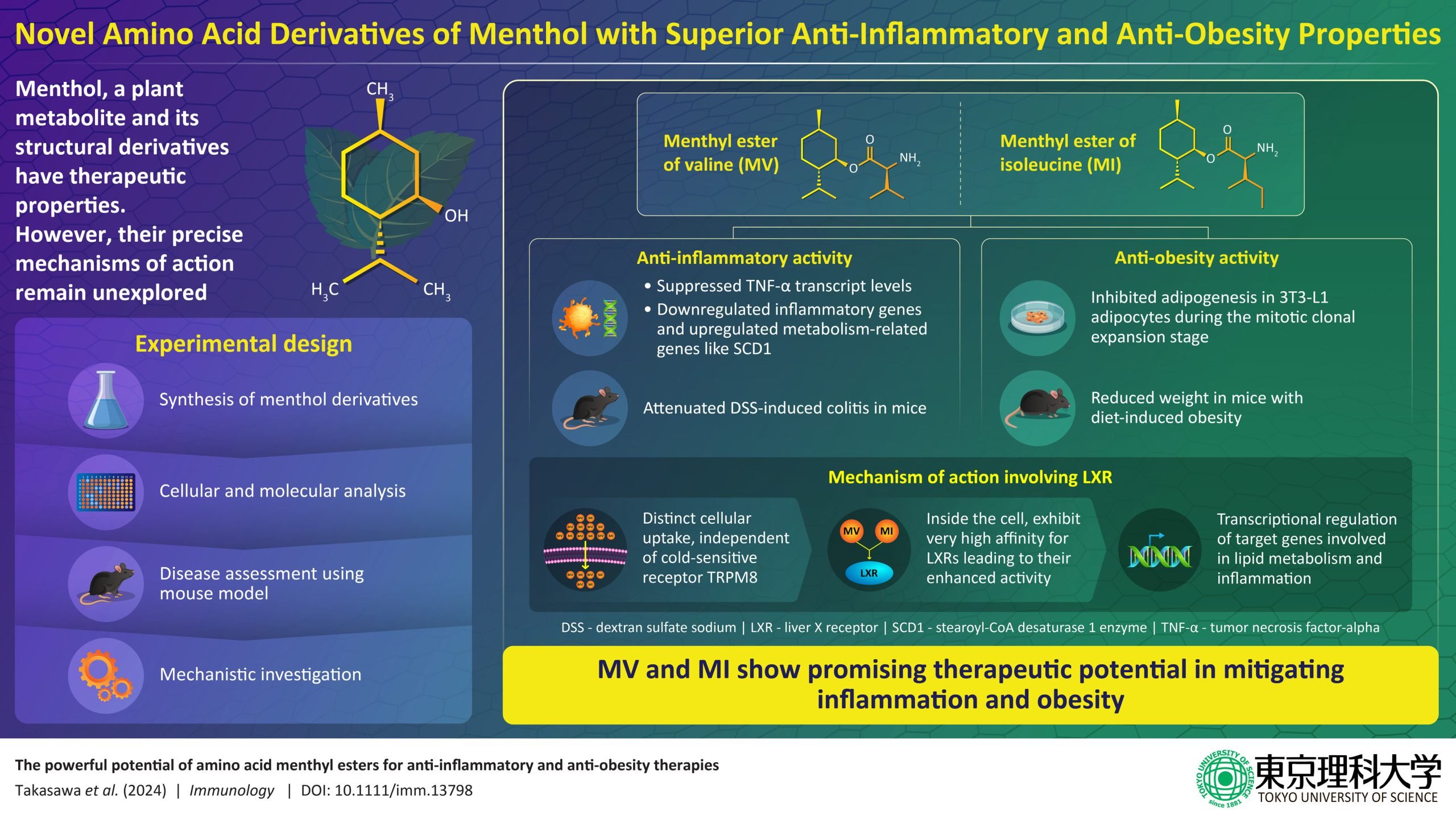
Their research findings were recently published in the journal Immunology. Sharing the motivation behind the present work, Prof. Arimura says, “The functional components of plants that contribute to human health have always intrigued me. Discovering new molecules from natural materials inspired our research team to develop these amino acid derivatives of menthol.”
Anti-Inflammatory Properties of Menthyl Esters
The researchers began by synthesizing menthyl esters of six amino acids characterized by less-reactive side chains. Subsequently, they assessed the properties of these esters using in vitro cell line studies. Finally, they conducted experiments in mice to explore the effects of these compounds under induced disease conditions. The exceptional anti-inflammatory profiles of MV and MI were determined by assessing the transcript levels of tumor necrosis factor-α (Tnf) in stimulated macrophage cells. Remarkably, both MV and MI outperformed menthol in the anti-inflammatory assay. RNA sequencing analysis revealed that 18 genes involved in inflammatory and immune responses were effectively suppressed.
Elated with their findings, the researchers went a step further and investigated the mechanism of action of the menthyl esters. They discovered that the liver X receptor (LXR) – an intracellular nuclear receptor, had an important role in the anti-inflammatory effects and this was independent of the cold-sensitive transient receptor TRPM8, which primarily detects menthol. Delving deeper into the LXR-dependant activation of MV and MI, they found that Scd1 gene – central to lipid metabolism was upregulated by LXR. Moreover, in mice with induced intestinal colitis, the anti-inflammatory effects were further validated with suppressed transcript levels of Tnf and Il6 genes by MV or MI, in an LXR-dependent manner.
Potential Anti-Obesity Effects
Driven by the discovery of LXR-SCD1 intracellular machinery, Prof. Arimura and his team hypothesized that menthyl esters possess anti-obesity properties. They found that these esters inhibited adipogenesis-fat accumulation, specifically at the mitotic clonal expansion stage in 3T3-L1 adipocyte cells. During animal studies, the diet-induced obesity in mice was ameliorated and adipogenesis was suppressed.
Menthyl esters possess unique advantages compared to other anti-inflammatory or anti-obesity compounds currently being researched or used. Their specific mechanisms of action, which contribute to their dual anti-inflammatory and anti-obesity effects sets them apart from other compounds and may make them particularly effective in addressing both inflammatory conditions and metabolic disorders. They could benefit specific populations like individuals with chronic inflammatory conditions, metabolic syndrome, or obesity-related complications.
“Although this study focused on their functions and mechanisms of action in diseases modeled after inflammation and obesity, we expect that these compounds will also be effective against a wide range of lifestyle-related diseases caused by metabolic syndrome, such as diabetes and hypertension, as well as allergic symptoms,” says Prof. Arimura optimistically.
In conclusion, this study underscores the importance and value of multi-faceted molecules derived from naturally occurring substances. Future research involving these novel and superior menthyl esters may result in therapeutic compounds to tackle the ever-growing health concerns of obesity and inflammatory conditions.
Reference: “The powerful potential of amino acid menthyl esters for anti-inflammatory and anti-obesity therapies” by Seidai Takasawa, Kosuke Kimura, Masato Miyanaga, Takuya Uemura, Masakazu Hachisu, Shinichi Miyagawa, Abdelaziz Ramadan, Satoru Sukegawa, Masaki Kobayashi, Seisuke Kimura, Kenji Matsui, Mitsunori Shiroishi, Kaori Terashita, Chiharu Nishiyama, Takuya Yashiro, Kazuki Nagata, Yoshikazu Higami and Gen-ichiro Arimura, 08 May 2024, Immunology.
DOI: 10.1111/imm.13798
This work was partially supported by a grant from the Japan Society for the Promotion of Science (JSPS) KAKENHI (20H02951 and 24K01723) and by a Tokyo University of Science Research Grants to Gen-ichiro Arimura.
Never miss a breakthrough: Join the SciTechDaily newsletter.
Follow us on Google and Google News.
4 Comments
“Finally, they conducted experiments in mice to explore the effects of these compounds under induced disease conditions.” “Moreover, in mice with induced intestinal colitis…” Mints for mice bred for disease.
See my article, Animal Research: The Rot at the Core of Medicine. https://www.academia.edu/123055005/Animal_Research_The_Rot_at_the_Core_of_Medicine
My morbidly obese neighbour had a gasric sleeve about 10+ years ago. She has ruined her gut and is still chowing down. I’m afraid people (children) are not taught the food pyramid and there is so much bad food for us. Years ago – 1983 I was 50kg (5ft 1″in old money) and told to lose weight. I was treated with malevolence. I am an aged person now and I am vegetarian. The problem is self control, people eat too much food and the wrong kind. I am now 57 kg and just came out of Hospital. The weight on some people astounds me. Never had a mobile, keep busy and try to help others. Sitting and lack of exercise gains weight. I will have my critics, even Beethoven and Einstein did, but for God’s sake let common sense prevail. Thank you for this fascinating research – Jo
Not everyone is the same.
Some have damaged or altered gut biota from environmental or antibiotics.
Everything is gut biome.
Wonderful stuff not much more complicated than isoleucine, fantastic!