
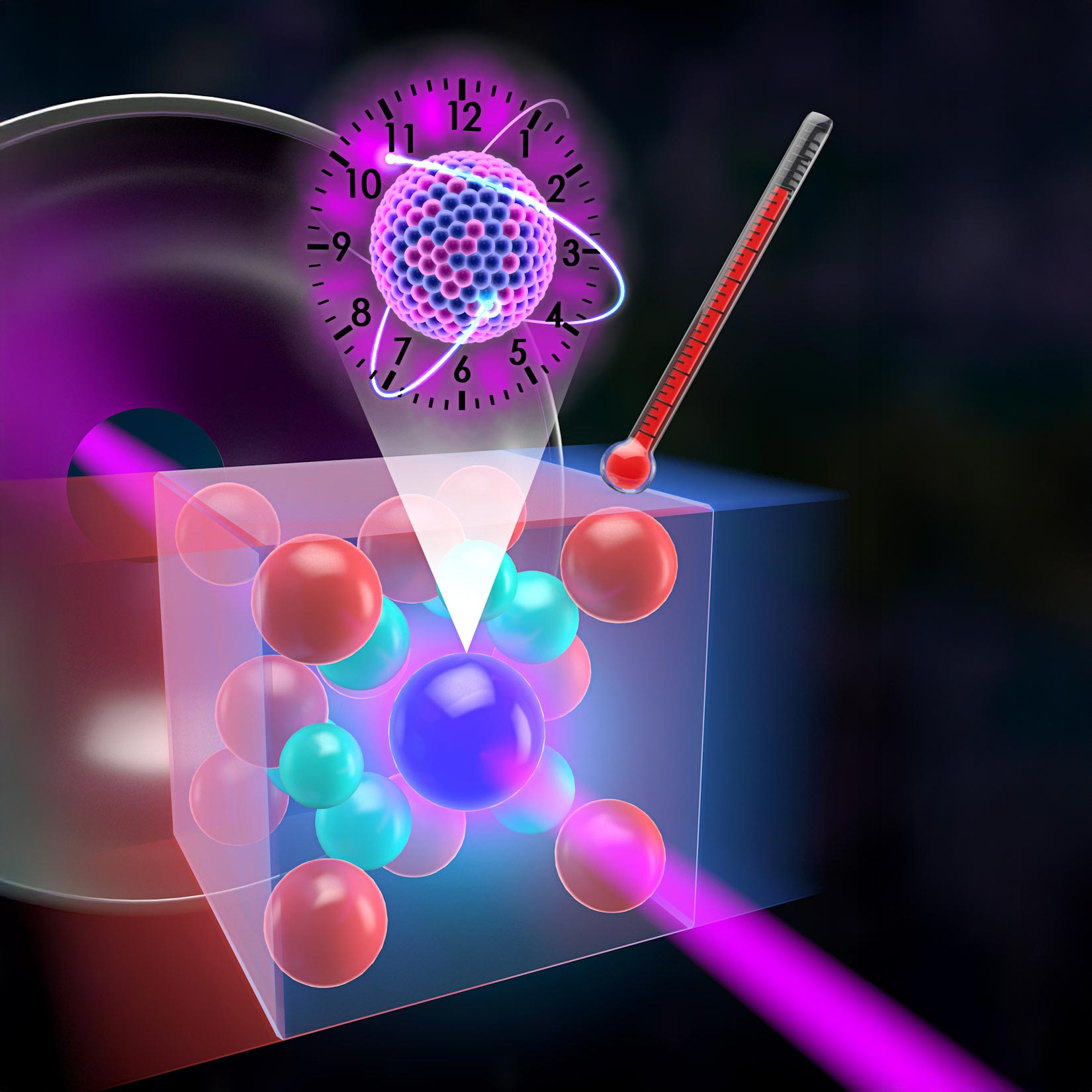
JILA researchers are pioneering a nuclear clock using thorium-229, which offers unprecedented stability compared to atomic clocks.
By embedding thorium into a solid-state crystal, they have found a nuclear transition largely resistant to temperature changes, crucial for precision timekeeping. Their work could not only redefine timekeeping but also open doors to detecting new physics.
Pushing Beyond Atomic Clocks
For decades, atomic clocks have set the standard for precision timekeeping, playing a crucial role in GPS navigation, physics research, and fundamental scientific tests. Now, researchers at JILA, led by physics professor Jun Ye in collaboration with the Technical University of Vienna, are exploring an even more stable alternative: a nuclear clock. Unlike atomic clocks, which rely on electron transitions, this new clock is based on a low-energy transition within the nucleus of a thorium-229 atom. Because nuclear transitions are less affected by environmental disturbances, a thorium-based clock could offer unprecedented stability and be used to test physics beyond the Standard Model.
Ye’s lab has been investigating nuclear clocks for years. Their landmark experiment, published as a cover article in Nature last year, provided the first frequency-based, quantum-state-resolved measurement of the thorium-229 nuclear transition in a specially designed crystal. This confirmed that the transition could be measured with enough precision to serve as a reliable timekeeping reference.
Understanding Temperature Effects on Nuclear Transitions
To develop a practical nuclear clock, scientists need to understand how external factors—especially temperature—affect the nuclear transition. In a new study, highlighted as an “Editor’s Choice” in Physical Review Letters, the team analyzed how the thorium nuclei’s energy levels shifted as the crystal was heated to different temperatures. This research is a crucial step toward building an ultra-stable nuclear timepiece.
“This is the first step toward characterizing the systematics of the nuclear clock,” says JILA postdoctoral researcher Dr. Jacob Higgins, the study’s first author. “We have found a transition that’s relatively insensitive to temperature, which is exactly what we want for a precision timekeeping device.”
“A solid-state nuclear clock has a great potential to become a robust and portable timing device that is highly precise,” notes Jun Ye. “We are searching for the parameter space for a compact nuclear clock to maintain 10-18 fractional frequency stability for continuous operation.”
The Precision of Nuclear Clocks
Because the nucleus of an atom is less affected by environmental disturbances than its electrons, a nuclear clock could retain accuracy under conditions where atomic clocks would falter, as the clock is more resistant to noise. Among all other nuclei, thorium-229 is particularly well-suited for this because it has a nuclear transition with unusually low energy, making it possible to probe with ultraviolet laser light rather than high-energy gamma rays.
As opposed to measuring thorium in a trapped ion system, the Ye lab has taken a different approach: embedding thorium-229 into a solid-state host—a calcium fluoride (CaF₂) crystal. This method, developed by their collaborators at the Technical University of Vienna, allows for a much higher density of thorium nuclei than traditional ion-trap techniques. More nuclei means stronger signals and better stability for measuring the nuclear transition.
Heating a Nuclear Clock
To look at how temperature affects this nuclear transition, the researchers both cooled and heated the thorium-doped crystal to three different temperatures: 150K (-123°C) with liquid nitrogen, 229K (-44°C) with a dry ice-methanol mixture, and 293K (around room temperature). Using a frequency comb laser, they measured how the nuclear transition frequency shifted at each temperature, revealing two competing physical effects within the crystal.
For one effect, as the crystal warmed, it expanded, subtly altering the atomic lattice and shifting the electric field gradients experienced by the thorium nuclei. This electric field gradient caused the thorium transition to split into multiple spectral lines, which shifted in different directions as the temperature changed. The second effect is that the lattice expansion also changed the charge density of electrons in the crystal, modifying the electrons’ interaction strength with the nucleus and causing the spectral lines to move in the same direction.
Finding a Temperature ‘Sweet Spot’
As these two effects fought for control of the thorium atoms, one particular transition was observed to be far less temperature-sensitive than the others, as the two effects mostly canceled each other out. Across the full temperature range examined, this transition shifted by only 62 kilohertz, a shift at least 30 times smaller than in the other transitions.
“This transition is behaving in a way that’s really promising for clock applications,” adds Chuankun Zhang, a JILA graduate student. “If we can stabilize it further, it could be a real game-changer in precision timekeeping.”
As a next step, the team plans to look for a temperature ‘sweet spot’ where the nuclear transition remains almost completely independent of temperature. Their initial data suggests that somewhere between 150K and 229K, the transition frequency would be even easier to temperature stabilize, providing an ideal operating condition for a future nuclear clock.
Customizing a Nuclear Clock System
Building an entirely new type of clock requires one-of-a-kind-designed equipment, much of which doesn’t exist to the level of customization required. Thanks to JILA’s instrument shop—with its machinists and engineers—the team was able to create critical components for their experiment.
“Kim Hagan and the whole instrument shop have been super helpful throughout this process,” Higgins notes. “They machined the crystal mount, which holds the thorium-doped crystal, and built parts of the cold trap system that allowed us to control the temperature precisely.”
Having in-house machining expertise allowed the researchers to quickly iterate on designs and ensure that even small changes—such as swapping out the crystal—could be done with ease.
“If we only had used off-the-shelf parts, we wouldn’t have had the same level of confidence in our setup,” adds JILA graduate student Tian Ooi, another team member. “The custom-built pieces from the instrument shop save us so much time.”
Sensing Beyond Time
While the primary goal of this research is to develop a more stable nuclear clock, its implications go beyond timekeeping. The thorium nuclear transition is very insensitive to disturbances in its environment, but highly sensitive to variations in fundamental forces—any unexpected shift in its frequency could indicate new physics, such as the presence of dark matter.
“The nuclear transition’s sensitivity could allow us to probe new physics,” Higgins explains. “Beyond just making a better clock, this could open doors to entirely new ways of studying the universe.”
Reference: “Temperature Sensitivity of a Thorium-229 Solid-State Nuclear Clock” by Jacob S. Higgins, Tian Ooi, Jack F. Doyle, Chuankun Zhang, Jun Ye, Kjeld Beeks, Tomas Sikorsky and Thorsten Schumm, 17 March 2025,Physical Review Letters.
DOI: 10.1103/PhysRevLett.134.113801
This research was supported by the Army Research Office, the Air Force Office of Scientific Research, the National Science Foundation, the Quantum System Accelerator, and the National Institute of Standards and Technology (NIST).
Never miss a breakthrough: Join the SciTechDaily newsletter.
Follow us on Google and Google News.
2 Comments
As long as there are no clicks ( starts and stop between points ) time is the most fluid of any observable movement in space .
The answer woke me up . what is time the most subtle accurate consistent movement known to man that never verys . time keeping maybe something we have been looking at but saw differently . The Cosmic Microwave Background Radiation has all the qualities to keep time . The hum of time no ticks of stop and start and is spread evenly throughout the universe .