
Close Menu
    Facebook X (Twitter) Instagram
    SciTechDaily
    • Biology
    • Chemistry
    • Earth
    • Health
    • Physics
    • Science
    • Space
    • Technology
    Facebook X (Twitter) Pinterest YouTube RSS
    SciTechDaily
    Home»Health»A Simple Eye Test May Identify Risk of Alzheimer’s in Middle Age
    Health

    A Simple Eye Test May Identify Risk of Alzheimer’s in Middle Age

    By University of OtagoFebruary 14, 2022No Comments3 Mins Read
    Facebook Twitter Pinterest Telegram LinkedIn WhatsApp Email Reddit
    Share
    Facebook Twitter LinkedIn Pinterest Telegram Email Reddit
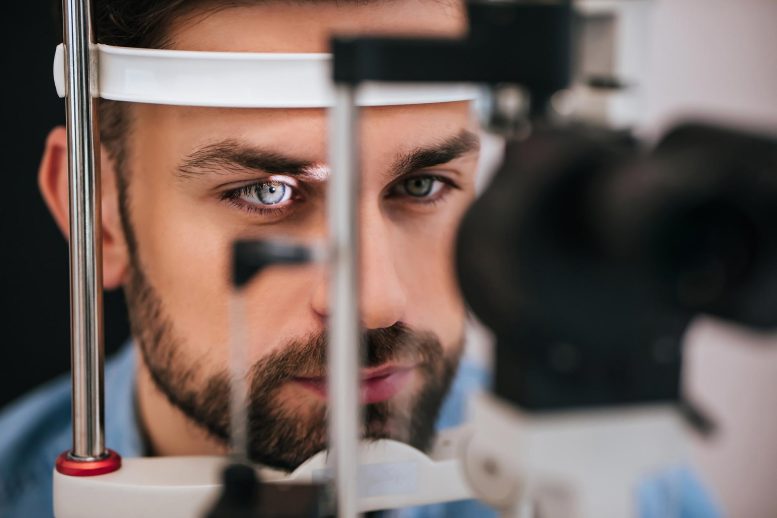
    Ophthalmology Eye Test
    Research suggests that the retinal nerve fiber layer (RNFL) may reflect brain health, indicating that optical scans could assist in diagnosing cognitive decline.

    Retinal thickness could serve as an early marker for Alzheimer’s, allowing optical scans to predict cognitive decline and assist in early detection of the disease.

    A simple eye test may make diagnosing the earliest stages of ‘diseases of old age’ possible when people are much younger, University of Otago researchers hope.

    Parts of our retina have previously been proposed as biomarkers for Alzheimer’s, but researchers from Otago’s Dunedin Multidisciplinary Health and Development Research Unit have been investigating the retina’s potential to indicate cognitive change earlier in life.

    Study lead Dr. Ashleigh Barrett-Young says diseases of old age, such as Alzheimer’s, are usually diagnosed when people start forgetting things or acting out of character.

    “This is often when the disease is quite far along. Early detection is possible through MRI or other brain imaging, but this is expensive and impractical for most.

    “In the near future, it’s hoped that artificial intelligence will be able to take an image of a person’s retina and determine whether that person is at risk for Alzheimer’s long before they begin showing symptoms, and when there is a possibility of treatment to mitigate the symptoms,” she says.

    Retinal Thickness and Cognitive Performance

    The study, published in JAMA Ophthalmology, analyzed data from 865 Dunedin Study participants looking specifically at the retinal nerve fiber layer (RNFL) and ganglion cell layer (GCL) at age 45.

    Dr. Barrett-Young says they found thicker RNFL and GCL in middle age was associated with better cognitive performance in childhood and adulthood. Thinner RNFL was also linked to a greater decline in processing speed (the speed in which a person can understand and react to the information they receive) from childhood to adulthood.

    “These findings suggest that RNFL could be an indicator of overall brain health. This highlights the potential for optical scans to aid in the diagnosis of cognitive decline.”

    “Given we haven’t been able to treat advanced Alzheimer’s, and that the global prevalence of the disease is increasing, being able to identify people in the preclinical stage, when we may still have the chance to intervene, is really important,” she says.

    Further studies are required to determine if retinal thinning predicts Alzheimer’s, or just the normal cognitive decline of old age, but the researchers have hope.

    “In the future, these findings could result in AI being used to take a typical optical coherence tomography scan, done at an optometrist, and combine it with other health data to determine your likely risk for developing Alzheimer’s.”

    Reference: “Associations Between Retinal Nerve Fiber Layer and Ganglion Cell Layer in Middle Age and Cognition From Childhood to Adulthood” by Ashleigh Barrett-Young, PhD; Antony Ambler, MSc; Kirsten Cheyne, PhD; Hayley Guiney, PhD; Jesse Kokaua, PhD; Barbara Steptoe, DOT; Yih Chung Tham, PhD; Graham A. Wilson, MBChB; Tien Yin Wong, MD and Richie Poulton, PhD, 10 February 2022, JAMA Ophthalmology.
    DOI: 10.1001/jamaophthalmol.2021.6082

    Never miss a breakthrough: Join the SciTechDaily newsletter.
    Follow us on Google and Google News.

    Alzheimer's Disease Ophthalmology Retina University of Otago
    Share. Facebook Twitter Pinterest LinkedIn Email Reddit

    Related Articles

    Stunning Results: Revolutionary Retinal Chip Lets Patients With Severe Vision Loss Read Again

    NIH Scientists Discover Gene Responsible for Rare Eye Disease

    Predicting Parkinson’s: Can Retinal Thickness Unlock Future Cognitive Decline?

    New Hope for Preventing Blindness: Unlocking the Microbial Mystery Behind Inherited Eye Diseases

    Incredible Potential: A New Way To Prevent Common Causes of Vision Loss

    Your Eyes May Reveal Your True Biological Age – And Your Risk of Illness and Death

    Cataract Surgery Linked With 30% Lower Risk of Dementia

    Souvenaid Appears to Stimulate Growth of New Synapses in Patients With Early Alzheimer’s

    Scientists Restore Basic Elements of Vision in Live Mice

    Leave A Reply Cancel Reply

    • Facebook
    • Twitter
    • Pinterest
    • YouTube

    Don't Miss a Discovery

    Subscribe for the Latest in Science & Tech!

    Trending News

    Largest-Ever Study Finds Medicinal Cannabis Ineffective for Anxiety, Depression, PTSD

    250-Million-Year-Old Egg Solves One of Evolution’s Biggest Mysteries

    Living With Roommates Might Be Changing Your Gut Microbiome Without You Knowing

    Century-Old Cleaning Chemical Linked to 500% Increased Risk of Parkinson’s Disease

    What if Your Memories Never Happened? Physicists Take a New Look at the Boltzmann Brain Paradox

    One of the Universe’s Largest Stars May Be Getting Ready To Explode

    Scientists Discover Enzyme That Could Supercharge Ozempic-Like Weight Loss Drugs

    Popular Sweetener Linked to DNA Damage – “It’s Something You Should Not Be Eating”

    Follow SciTechDaily
    • Facebook
    • Twitter
    • YouTube
    • Pinterest
    • Newsletter
    • RSS
    SciTech News
    • Biology News
    • Chemistry News
    • Earth News
    • Health News
    • Physics News
    • Science News
    • Space News
    • Technology News
    Recent Posts
    • Scientists Prove There Are Just Six Degrees of Separation in a Social Network
    • Bee Bacteria Could Fix a Major Flaw in Plant-Based Milk
    • Scientists Discover a Surprising Way To Make Bread Healthier and More Nutritious
    • Natural Compounds Boost Bone Implant Success While Killing Bacteria and Cancer Cells
    • After 60 Years, Scientists Uncover Unexpected Brain Effects of Popular Diabetes Drug Metformin
    Copyright © 1998 - 2026 SciTechDaily. All Rights Reserved.
    • Science News
    • About
    • Contact
    • Editorial Board
    • Privacy Policy
    • Terms of Use

    Type above and press Enter to search. Press Esc to cancel.